
On July 2025, a day in New York, former President of the Greater New York Hakka Association, Yang Yushu, received a phone text from an unfamiliar number. However, she quickly realized that it seemed to be from a technician at the Apple Store.
As she carefully read the text, it indeed was about her iCloud issue. Not long ago, she had some problems with iCloud and had sought help from the Apple Store. The store was busy, so they called a remote technician who fixed it with screen sharing.
The text also stated that he was a technician from the Apple Store. He had found that Ms. Yang’s iCloud had been hacked, her social security number, ID, and other information had been leaked, putting her in a dangerous situation. The “thief” had even gone to her bank to buy bitcoins. It was mentioned that in a few hours, the money would be irretrievable, and federal authorities were investigating the matter. The “scammer” turned out to be an employee at her regular bank branch who provided Ms. Yang with a phone number for assistance.
No wonder Ms. Yang believed it. The follow-up messages stated that the “scammer” had used Zelle to send money to two people, sending $900 and $1800. At the same time, a text from the bank asked if she wanted to transfer $1800, to which she replied “no,” preventing the money from being transferred.
The scammer then claimed that someone was tracking her, and her life was in danger, so she must not turn off her phone and needed to go to the bank immediately to withdraw money.
“I was terrified at that moment,” Ms. Yang shared this experience with others at a seminar at the Overseas Chinese Education Center five months later. “The so-called technician used a method, similar to hypnosis, to manipulate me into following his instructions without questioning.”
Subsequently, following the real scammer’s instructions, Ms. Yang withdrew $50,000 in cash from the bank, placed it in a box as requested, and waited for a “federal” official to retrieve the money.
Ms. Yang’s case is just one of the millions of fraud cases reported in the United States every year. According to the statistics from the Federal Trade Commission, they received 2.6 million reports of fraud in 2024, a 25% increase from the previous year, resulting in an average daily loss of $34 million.
On December 6, the Taipei Economic and Cultural Office in New York held an anti-fraud seminar at the Flushing Overseas Chinese Education Center. Speaking at the event, Legal Secretary Lai Yichen shared his over a decade of experience in investigating fraud cases. He stated that fraud is not a new issue, but since 2023, with the development of artificial intelligence technology, scammers’ tricks have become increasingly sophisticated and hard to detect.
Lai emphasized that in 2024, “investment fraud” was the most severe form of fraud, with victims losing $5.7 billion. Following that, “impersonation scams” caused losses of $2.95 billion, followed by “online shopping fraud” with $750 million and “job offer scams” with $500 million.
More than ten overseas Chinese attendees shared various scams experienced by themselves, neighbors, and friends in the past year. Some fell victim to romance scams, losing $120,000; some had their identity stolen during a car purchase, resulting in tens of thousands of dollars being fraudulently withdrawn from banks; some were informed of a package scam that was thwarted; others had their driver’s licenses stolen and received fraudulent emails.
Ms. Yang’s case falls under “identity fraud,” with the scammer impersonating an Apple Store maintenance technician.
While sharing her story, Ms. Yang frequently mentioned feeling “hypnotized.” There were several opportunities for her to stop the scam while at the bank. However, the scammer’s words, such as claiming that the person who “stole” her identity was a bank employee, and not to turn off her phone, continued to manipulate her rational thinking, controlling her to comply with the scammer’s instructions.
Psychologists in their papers such as “Persuasion Principles in Social Engineering,” “Creative Persuasion Techniques in Phishing Emails,” and “Psychological States: Key Factors in Fraud and Compliance Warnings in Real Life” pointed out that intense emotions like fear, desire, shame, and loneliness can shift the brain from “analytical mode” to “survival mode,” suppressing critical thinking and leading to highly reactive behavior.
Therefore, scammers often use tactics like telling victims their bank accounts are frozen, or their lives are in danger (triggering fear), mentioning lottery winnings or high-return investments (triggering greed and excitement), or simply asking for help (triggering empathy or shame) to evoke strong emotions for the victim, leading them to lose rational judgement.
Why do victims feel “hypnotized?” Experts indicate that this feeling comes from scammers creating a sense of immersion and intimacy through extended conversations, narrowing the victim’s focus solely on the scammer’s words, ultimately leading the victim to act as instructed. Thus, the victim appearing “hypnotized” is actually a result of psychological manipulation and cognitive overload.
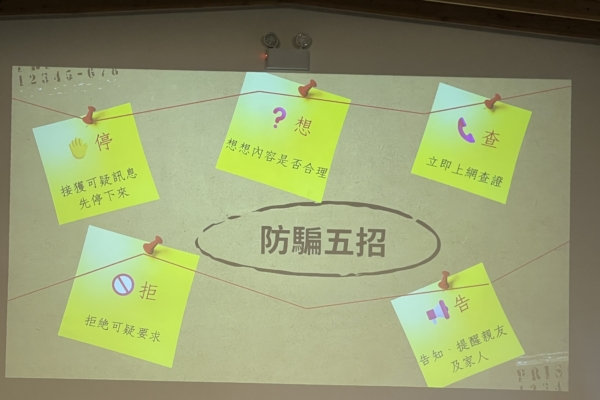
Secretary Lai summarized five steps for preventing fraud. The first is “stop.” Scammers typically urge immediate decisions, but nothing in the world requires a decision within three seconds. They often push you to hurry or else, not allowing time for careful consideration. Therefore, “pause” is crucial.
The second step is “think.” Evaluate if the content makes sense. Promises of guaranteed profits or exclusivity are likely scams.
Next is “check.” Before clicking on suspicious links, go to the official website and verify details. If someone claims a specific identity, confirm its existence online.
“Reject” is the fourth step. Hang up on unknown or hidden caller IDs.
Lastly, “report.” Scammers often stress confidentiality, but it’s vital to share such incidents with family and friends.
“The simplest approach is: if you encounter unfamiliar information or suspect fraud, inform family and friends immediately. More people can lead to better judgments,” said Lai. “You can also consult AI. With big data analysis, AI can inform you if this is a scam based on similar cases encountered before, offering a tool for informed decisions.”
Scammers never stop at just one. After manipulating Ms. Yang into giving away $50,000 out of fear, the scammer demanded she transfer an additional $200,000 to a Citibank account for an online investment.
Fortunately, Ms. Yang’s account was linked to her son’s, who received bank notifications every time she made a transaction. Feeling pressured, Ms. Yang confided in her son, who quickly intervened and prevented her from further being swindled.
“I felt heartbroken, handing over so much cash for nothing and feeling foolish,” Ms. Yang bravely shared her ordeal with a reporter. “My son scolded me at the time, but later, both my son and daughter comforted me, making me feel lucky.”
Ms. Yang agreed with the experts that “everyone can fall victim to fraud.” When she reported the incident to the police, they informed her that even an editor at a prominent New York media outlet specializing in fraud news had been scammed out of $30,000, manipulated by the scammer claiming his son was in danger.
“No one is infallible; we all have vulnerabilities,” Secretary Lai emphasized. “Therefore, we should refrain from labeling victims as fools or overly trusting individuals who fell for schemes. In today’s world, things have changed drastically; thus, it’s essential to understand this concept.”