
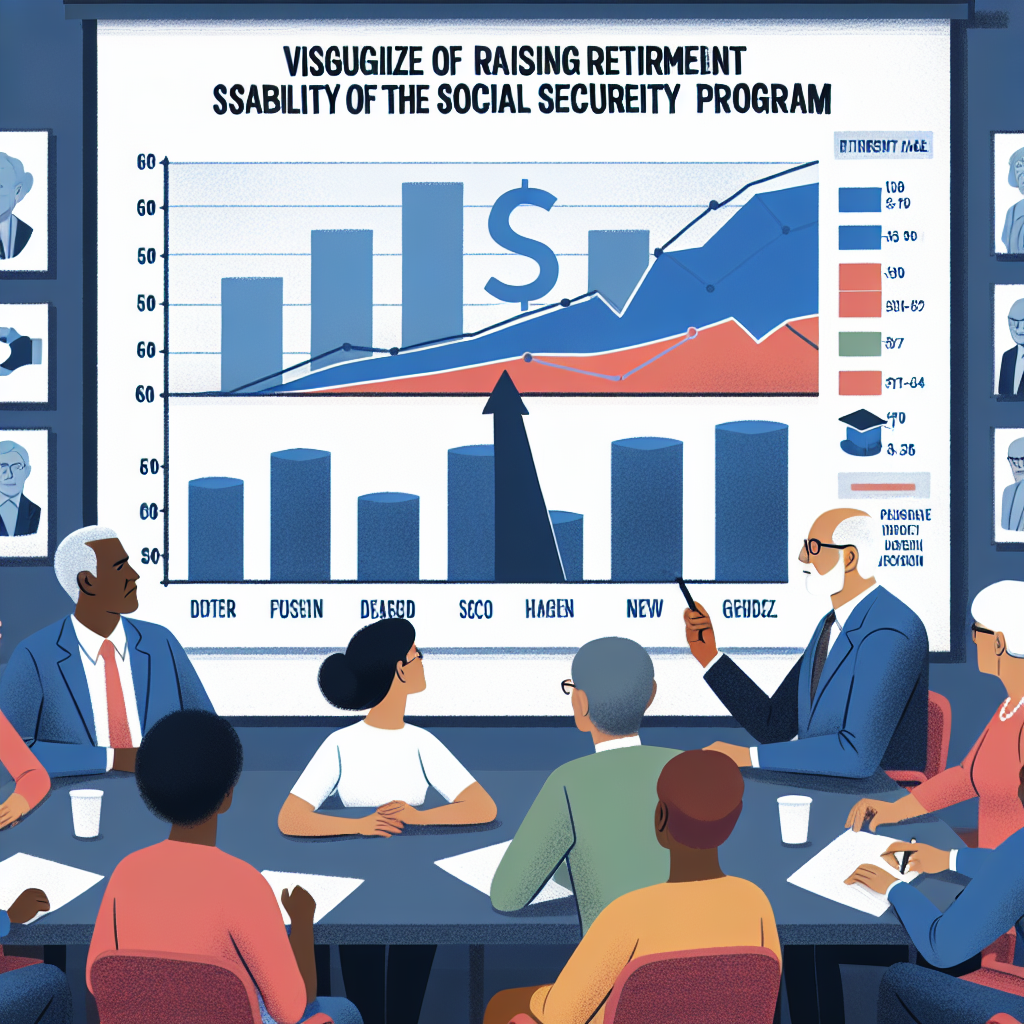
In the United States, as the Social Security program approaches a point where its funds may not be sufficient to cover its obligations, various measures are being considered to support the program’s finances. One of the possibilities being included in the discussion is raising the retirement age.
This comes at a time when concerns about the long-term financial status of the Social Security program continue to grow. The Chief Actuary of the Social Security program revealed in a letter on August 5th that the two main trust funds – the Old-Age and Survivors Insurance (OASI) and Disability Insurance (DI) funds – are projected to run out of funds by early 2034. This forecast is about six months earlier than previously predicted.
If the trust funds are depleted by 2034, the payroll tax revenue will only cover around 80% of scheduled benefits, decreasing to 72% by the year 2099. This means that without action from Congress, tens of millions of Americans could face automatic cuts in benefits.
The early depletion of funds is partly attributed to provisions in the “One Big Beautiful Bill Act” that extended tax cuts from the first term of President Trump and expanded tax breaks for seniors. These changes are expected to reduce revenue from Social Security taxes and increase expenditures by about $168.6 billion before 2034.
Looking at the funds separately, the OASI fund, which pays retirement and survivor benefits, is projected to be exhausted by the end of 2032, while the Disability Insurance (DI) fund is expected to remain solvent over the next 75-year projection period.
Frank Bisignano, the head of the SSA, stated that policymakers have about eight years to devise solutions and emphasized that the ultimate responsibility lies with Congress and the trustees of the Social Security program. In addition to raising the retirement age, discussions are also underway regarding increasing the taxable income cap.
Bisignano noted that the cap figure will continue to rise, providing another factor for consideration in crafting solutions. Referring to the current cap of $176,100 in taxable income for 2025, he mentioned that wages above this level are currently exempt from the 6.2% payroll tax.
For a long time, the Democratic Party has advocated for eliminating or raising this cap. Senators Bernie Sanders of Vermont and Elizabeth Warren of Massachusetts introduced legislation in 2023 proposing taxing income over $250,000 while enhancing benefits for certain groups, aiming to extend the sustainability of the Social Security fund until 2096.
On the other hand, Republicans lean towards adjusting benefits and eligibility. A proposal from the Republican Study Committee last year suggested gradually raising the retirement age, tightening spending, and restricting benefits for high earners’ spouses.
Analysts from institutions like the Brookings Institution suggest that any enduring solution may require a combination of increased revenues and benefit reforms, similar to the 1983 reform, to ensure the program’s fiscal sustainability for years to come.
Discussions on the sustainability of the Social Security funds are also drawing attention to concerns about waste within the program. The SSA Inspector General’s office reported on September 16 that between 2008 and 2023, around $33 million in benefits were erroneously paid to deceased individuals in New York. A similar review conducted last year in New York City found that as much as $91 million was disbursed after the beneficiaries had passed away.
Officials have stated that measures are being taken to enhance record management, close “absurd” accounts for elderly beneficiaries, and recover overpaid funds. The Treasury Department has also reclaimed over $31 million in improper federal payments in recent months.
Furthermore, the government has been advancing efficiency measures, including the gradual reduction of paper checks. Under an executive order from March this year, most federal benefits must be delivered electronically starting from September 30, such as through direct deposit or prepaid cards. Beneficiaries still receiving paper checks are expected to be less than 1%.
Secretary of the Treasury Janet Yellen stated in August, “Reducing the use of paper checks has been a long-standing bipartisan goal. Thanks to President Trump, this will help reduce fraud and theft.”
These developments indicate a complex landscape where policymakers are grappling with the challenges of ensuring the sustainability of Social Security for current and future generations. As discussions evolve and proposals are debated, the future of the program hangs in the balance.