
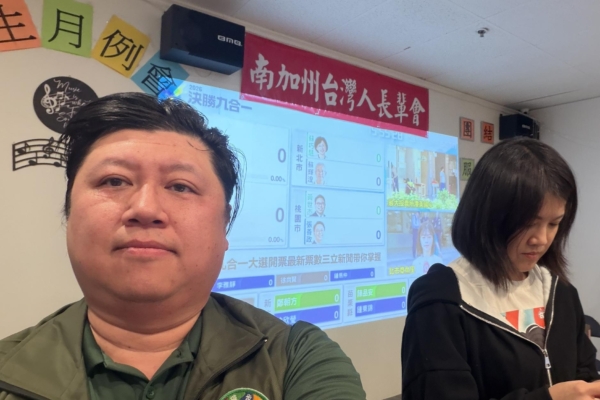
The recent local elections in Taiwan have concluded, drawing significant attention from the Taiwanese diaspora across the globe, particularly in the United States. The results and trends observed during the elections, including public referendums, have stirred heightened interest among overseas Taiwanese communities. In this context, the spokesperson for the Democratic Progressive Party (DPP) in the U.S. West Coast, Wu Zhaofeng, shared his insights during a post-election interview, highlighting that the elections not only exhibited changes in local political landscapes but also reflected voters’ attitudes towards long-term governance. He emphasized the importance voters place on practical policies and their effective implementation.
Regarding the highly scrutinized mayoral race in Taipei, Wu noted that while DPP candidate Shen Boyang did not win the election, it is crucial to analyze the Taipei contest beyond mere individual outcomes. Pre-election concerns about Shen’s low visibility and lack of local campaigning experience raised questions about his ability to galvanize support for fellow party candidates. However, the overall results from the Taipei city council elections reveal noteworthy trends warranting attention, indicating that Shen indeed contributed to a collective movement, akin to the effect of small streams coalescing into a larger current.
Wu elaborated that Shen did not fixate solely on whether he won, but focused on the electoral results of the entire party and its candidates. He believes that the next two years will be a crucial phase for Shen to cultivate local support and build a political base in anticipation of the next national election. The ability to maintain the support established during this election cycle will be a point of observation for many.
Looking at the broader results of county and city mayor elections across Taiwan, Wu pointed out a discernible “pendulum effect.” Many voters expressed fatigue with single-party rule and sought change through their ballots. He provided examples from regions like Yilan, Taichung, Chiayi City, and Yunlin, where local voters showed a clear shift in political preferences, corroborating the notion that the political landscape at the local level is fluid and subject to change.
In terms of campaign issues, Wu observed that discussions during this election deeply centered around domestic concerns, encompassing transportation, child-rearing, long-term care, and the development of the artificial intelligence (AI) industry—areas closely related to daily life and local development. In contrast, national-level issues such as cross-strait relations, national defense, and foreign affairs received comparatively less attention in local election debates.
Addressing the relatively infrequent use of the slogan “resist China, defend Taiwan” during the election campaign, Wu emphasized that the DPP is not disregarding its related principles. Instead, the party is transitioning from an emphasis on rhetoric and slogans to a more practical approach that prioritizes concrete actions. He likened this to planning a trip to Hawaii; merely discussing the destination without taking action—such as saving money, booking flights, and creating an itinerary—remains just talk. The DPP’s current strategy is to translate its principles into tangible deeds.
Further elaborating, Wu mentioned that support for corresponding policies is gradually securing backing and being implemented, particularly concerning the activities of Chinese agents in Taiwan and their infiltration of Taiwanese society through temples and organized crime. The government is actively investigating these matters, with some cases already emerging in the judicial process, reflecting genuine administrative efforts rather than mere political posturing.
Wu believes citizens are becoming increasingly weary of election slogans and are looking for solid policy outcomes. This electoral phenomenon serves as an essential reminder for the central government and legislative members. In the next two years, alongside efforts to advance national security and foreign policy, it is important for the central government to pay closer attention to the public sentiments reflected in local elections, incorporating the daily concerns of the populace into central policy discussions and proposing concrete measures.
Regarding the recent passing of the referendum to “abolish the non-nuclear homeland,” Wu highlighted the need for rational discussions around energy policy in line with international conditions and technological advancements. He argued that the idea of a “non-nuclear homeland” should not be a static political slogan. The potential inclusion of nuclear energy as one of Taiwan’s energy options must be rigorously evaluated concerning safety, environmental protection, and public health.
Wu acknowledged that there have been various societal concerns about nuclear safety in Taiwan in the past. However, as technology evolves and energy environments shift, public perceptions regarding nuclear energy may also change. He argued that if the government effectively manages nuclear power plants while ensuring safety and environmental safeguards, coupled with transparent information sharing, trust in society can be garnered, making nuclear energy a viable subject for public policy discussions.
He stressed that the referendum results reflect people’s choices regarding policy direction but do not equate to an immediate restart of nuclear power plants. Subsequent actions should involve the government conducting thorough safety evaluations and presenting concrete implementation measures to foster public understanding and trust in relevant policies.
In conclusion, Wu stated that the voting outcomes vividly showcase the Taiwanese people’s diverse expectations regarding local governance, livelihood policies, and energy topics. For the Taiwanese community in Los Angeles and abroad, this election transcends mere partisan gains and losses; it serves as a vital window to observe the currents of public opinion and the deepening of democracy in Taiwan.