
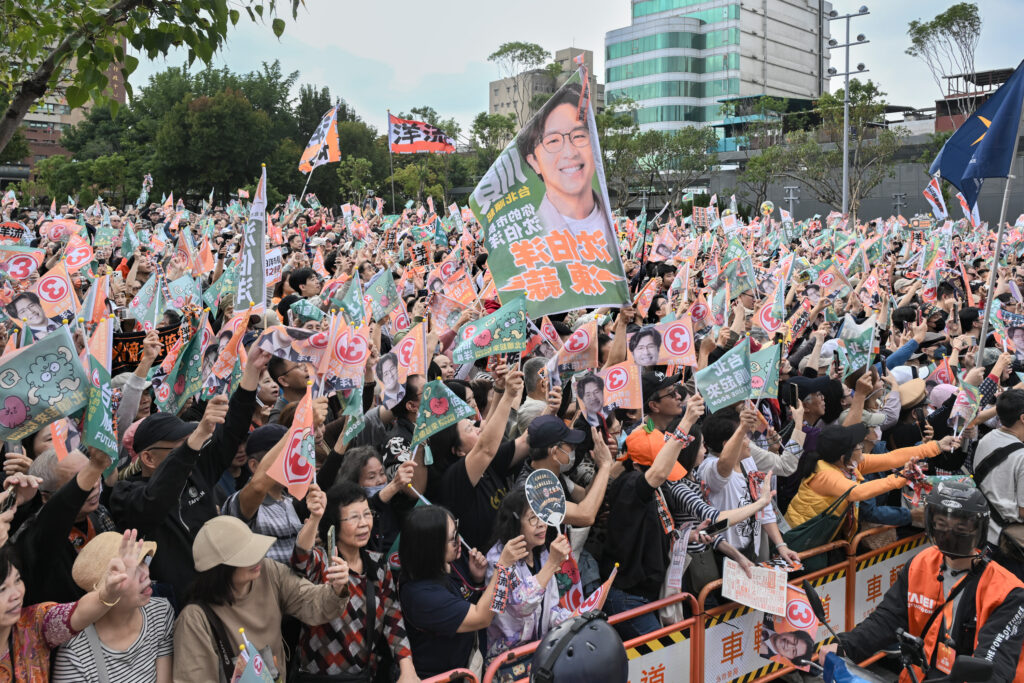
On Saturday, November 28, Taiwan held its local elections, resulting in the selection of 11,051 local officials across 22 counties and cities, including mayors and village heads.
This election, often referred to as the “nine-in-one” election, also featured a nationwide referendum on whether to reinstate the use of nuclear energy. Approximately 19.6 million Taiwanese citizens were eligible to participate in the voting process.
Beijing paid close attention to the election, viewing it as an important indicator for predicting Taiwan’s political landscape ahead of the presidential elections in 2028. Taiwanese security officials have accused Beijing of attempting to influence these elections.
Though local leaders do not have authority over Taiwan’s diplomatic or defense policies, the Chinese Communist Party (CCP) has sought to sway voters through various means, including economic incentives and sanctions against companies owned by the father of one mayoral candidate.
Despite having never ruled Taiwan since its establishment, the CCP continues to assert that it does not rule out the possibility of using force to bring Taiwan under its control.
The election raised several questions regarding the influence of the CCP in this local electoral process.
Experts Emma Y. Liu and Edgard D. Kagan from the Center for Strategic and International Studies (CSIS) noted that Beijing sees Taiwan’s local elections as an early indicator of political trends before the 2028 presidential election.
The researchers indicated that Beijing would focus on any shifts in public sentiment towards China, the strength of various political parties, and the rise of new political leaders.
Major urban centers in Taiwan have historically been a breeding ground for national leaders. Among the five directly elected presidents, four had previously served as mayors. Notably, Lee Teng-hui, Chen Shui-bian, and Ma Ying-jeou all held the position of Taipei mayor, while the current president, Lai Ching-te, served as mayor of Tainan.
However, wins in local elections do not guarantee success in presidential elections. In the 2018 local elections, the opposition Kuomintang (KMT) secured 15 mayoral positions out of 22, and in 2022, they won 14. Nonetheless, the ruling Democratic Progressive Party (DPP) triumphed in the presidential elections of 2020 and 2024.
Local election campaigns typically center around issues such as housing, transport, and economic development, while presidential elections place greater emphasis on national security, cross-strait relations, and national identity.
A report submitted to Congress by the U.S.-China Economic and Security Review Commission (USCC) in November highlighted that the Taiwanese populace generally opposes falling under Beijing’s governance, thereby constraining the policy options available to elected leaders in Taiwan.
The report stated, “Even if the results of the 2026 and 2028 elections align with Beijing’s expectations, this may not lead to the so-called political changes in ‘cross-strait unification’ that Beijing desires.”
In Taiwan’s capital, Taipei, KMT mayor Chiang Wan-an secured re-election against DPP legislator Puma Shen. Shen, a former criminology professor specializing in the study of CCP influence operations, is also a co-founder of the civilian defense organization Kuma Academy.
One of the primary points of contention between the two candidates was their stance on the Taipei-Shanghai exchange forum, an initiative aimed at fostering cooperation between the two cities in areas such as healthcare and urban governance.
Chiang advocated for continued dialogue through this forum as a means to reduce tensions, while Shen questioned its actual effectiveness, warning it might create opportunities for CCP infiltration into Taiwan. He proposed expanding exchanges between Taipei and other international cities but did not completely rule out engagement with Shanghai.
Shen has faced backlash from Beijing, which designated him as a target for punitive measures. In 2024, he was placed on a blacklist, and in October 2025, Chongqing police initiated an investigation against him on charges of inciting separatism.
On October 14 of this year, Beijing imposed sanctions on a company owned by Shen’s father, a move similar to other actions taken against different businesses owned by his family. Additionally, Taiwanese prosecutors indicted four private detectives in October for allegedly surveilling Shen and his family for weeks at the behest of two residents from Hong Kong.
The voting on Saturday was the first nationwide electoral challenge faced by KMT chairperson Cheng Li-wen since her meeting with Chinese leader Xi Jinping in Beijing on April 10.
Following this meeting, Beijing announced ten measures aimed at promoting travel, transport, agricultural imports, and other avenues of exchange. In response, Taiwan’s intelligence agency warned that Beijing was attempting to influence local elections through these economic incentives.
A poll conducted shortly after Cheng’s visit revealed that approximately 47% of respondents held negative views of the meeting, while 35% viewed it positively.
Among the 1,195 participants, supporters of the KMT and the smaller Taiwan People’s Party (TPP) generally had more favorable opinions of the Beijing meeting compared to supporters of the DPP.
The KMT and TPP have been trying to collaborate in local elections. Both parties support KMT candidate Lee Si-chuan in the race for the mayorship of New Taipei City, the most populous city in Taiwan. However, they failed to reach a similar cooperative agreement in Hsinchu County.
The two parties hold divergent views on Beijing. The KMT advocates for dialogue with Beijing based on the so-called “1992 Consensus,” which suggests that both sides of the Taiwan Strait belong to one China, albeit with different interpretations of what that means.
While Taiwan’s formal name is the Republic of China, Beijing claims Taiwan as part of the People’s Republic of China, a claim that the DPP government in Taiwan refuses to acknowledge.
The TPP’s platform advocates for the establishment of a new basis for cross-strait dialogue while safeguarding Taiwan’s sovereignty, as well as calling for Beijing to cease its military activities targeting Taiwan.
On November 18, Taiwan’s Criminal Investigation Bureau reported that law enforcement had uncovered over 30 cases of suspected foreign interference in the elections.
On November 20, prosecutors indicted TPP city councilor candidate Zhou Xiaoyun for allegedly accepting campaign funding from the CCP, receiving assistance from a team reportedly operating 20,000 fake Facebook accounts.
The Mainland Affairs Council (MAC) of Taiwan expressed on November 25 that the CCP has long been gathering personal information on Taiwanese citizens through various channels for influence operations, political infiltration, and transnational suppression.
A survey released by Deutsche Welle on November 25 indicated that manipulated content aimed to undermine DPP Taipei mayor candidate Shen, while misleading videos claimed that the U.S. was abandoning Taiwan and would not assist in the event of a CCP invasion.
Taiwan’s heavy reliance on imported fuels means that if the CCP were to impose a blockade and disrupt maritime transport, Taiwan and its pivotal semiconductor industry would face significant challenges.
The national referendum held on Saturday sought the opinion of voters regarding whether the government should utilize nuclear power to revitalize the economy and abandon its non-nuclear energy policy.
Taiwan had closed its last operating nuclear reactor in May 2025. If the referendum passes, according to Taiwan’s Civil Referendum Act, the government will have to take measures to end the non-nuclear energy policy and reinstate the use of nuclear power.
However, safety inspections and regulatory approvals will still be required before any nuclear power plants can be reactivated.
Katie Sizemore, a national security fellow at the U.S. think tank Council on Foreign Relations (CFR), pointed out that if Beijing were to implement a blockade, local governments in Taiwan would play a critical role in the response.
Sizemore wrote on November 25 that municipal and county governments in Taiwan are responsible for deciding how to allocate civil defense budgets, which includes funding for resident training, evacuation plans, emergency shelters, and supplies and equipment reserves.
In August of this year, Taiwan held its annual Han Kuang military exercise simultaneously with a town resilience drill that evaluated relevant response capabilities.
The drills included communication tests conducted in seven counties in central Taiwan on August 10 and in seven northern counties on August 13, purposefully lowering internet speeds for 30 minutes to test emergency response capabilities, along with conducting drills on maintaining voice calls, text messaging, and emergency lines during crises.