
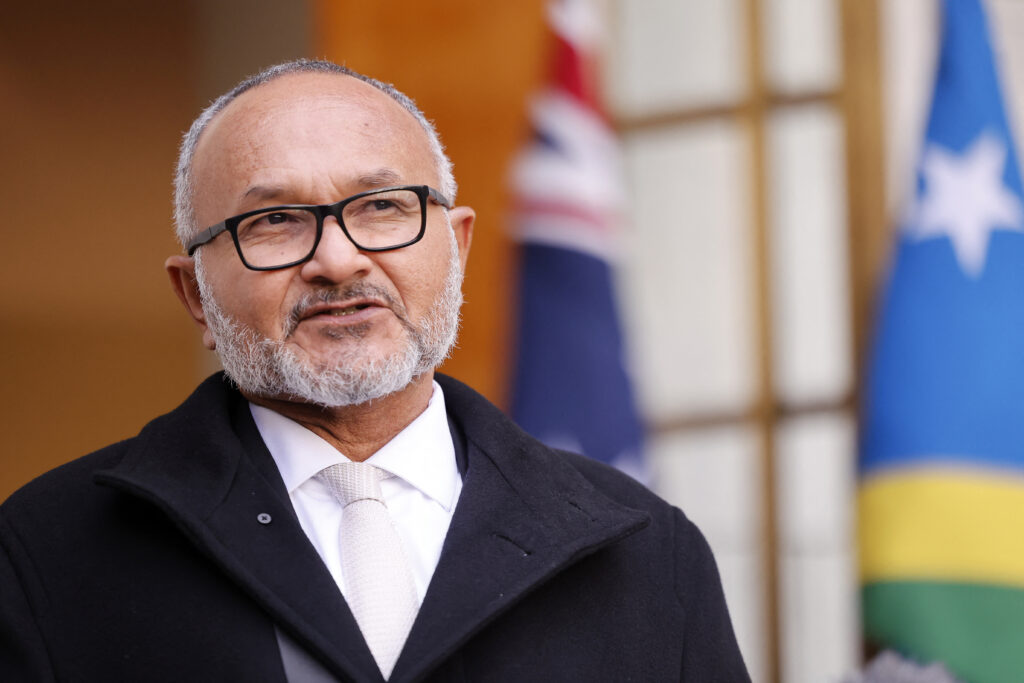
The Solomon Islands have officially signed a comprehensive security agreement with Australia, solidifying Australia’s position as the main security partner for the island nation. This agreement aims to enhance the management of foreign military presence and control sensitive infrastructure within the Solomon Islands.
Experts suggest that this shift in policy aligns with changes in leadership, the interests of citizens, and the establishment of security trust. Such an agreement is perceived to not only undermine Beijing’s influence within the Solomon Islands but also to limit the Chinese Communist Party’s (CCP) expansion of military presence into the South Pacific region.
On November 25, a comprehensive treaty was ratified in Canberra, marking Australia’s designation as the primary security partner for the Solomon Islands. This accord includes provisions to prevent any foreign nation from establishing military or security bases on Solomon Islands territory and establishes that sensitive infrastructure must remain free from militarization or foreign interference. This development is recognized as a significant advancement in Australia’s efforts to secure its influence against the backdrop of Chinese expansion in the South Pacific.
According to a joint statement from the Australian Prime Minister’s office, the new treaty encompasses various aspects including security, policing, infrastructure, education, and personnel exchanges. Australia has pledged to support the Solomon Islands in strengthening its police force and border management, while also providing assistance in education, economic development, and visa policies. Furthermore, any external arrangements concerning vital infrastructure and security cooperation will also involve consultations with Australia.
Prior to this agreement, reports indicated that the Solomon Island government had informed Beijing of its decision not to renew the security agreement with China, established in 2022, which is set to expire in April 2027.
Despite the announcement, Prime Minister Matthew Wale has yet to publicly confirm the end of the agreement, citing confidentiality clauses pertaining to ongoing negotiations. Australian officials asserted on November 25 that they would provide AUD 670 million in grants and AUD 70 million in concessional loans to support the Solomon Islands over the next decade. This financial commitment totals AUD 740 million, aimed at enhancing education, infrastructure, policing, budgeting, and local development. Support will also include backing for the Wale government’s free education initiative, construction of roads and renewable energy projects, and increased facilitation for Solomon Islanders seeking work and visa opportunities in Australia.
In 2022, the security cooperation agreement signed between China and the Solomon Islands raised alarms in Australia, the United States, and New Zealand regarding China’s expanding military presence in the South Pacific. At that time, the U.S. State Department issued warnings that the broad scope of the agreement could potentially create a space for the deployment of Chinese military forces and disrupt security in the Pacific region. The Australian government subsequently expressed concerns over the lack of transparency in the agreement, fearing it could undermine regional stability.
Experts in defense and security analysis, such as Shien Ming-shi from Taiwan’s National Defense and Security Research Institute, have emphasized the strategic implications of the new Australia-Solomon Islands treaty. He noted that the Solomon Islands’ reintegration into an Australia-led security framework reinforces the security line established by the U.S. and Australia in the South Pacific, thereby constraining China’s strategic projection into the area.
Shien further explained that the Solomon Islands’ pivot towards Australia is influenced by the changing leadership, public interests, and long-term security trust factors. The previous Prime Minister, Manasseh Sogavare, had adopted a pro-China stance, culminating in a security agreement with China in 2022. Wale, then the opposition leader, took a differing position. His ascent to power has allowed for a recalibration of diplomatic relations, serving as a catalyst for this shift towards Australia.
The goals set forth by the new treaty also outline specific sensitive infrastructure, such as airports, ports, energy, and communication facilities, which must be protected from militarization and foreign interference. It establishes a framework for negotiations regarding security and sensitive infrastructure matters, emphasizing that Solomon Islands security cooperation should primarily involve assistance from Pacific Islands Forum (PIF) members.
However, practical implementation of these security measures may still present challenges given the dual-use nature of infrastructure. As Shien remarked, without concrete evidence of military use or action, it may be difficult to impose restrictions effectively.
In light of the recent developments, Beijing is likely to adjust its operational approach within the Solomon Islands, continuing to bolster economic ties and market dependencies while reducing reliance on sensitive projects such as large ports and policing collaborations.
Analysts caution that while China might not relinquish its influence over the island nations, it may resort to leveraging low-cost goods, trade, and networks of Chinese businesses to maintain its sway, alongside deploying financial resources and political connections to affect local governance.
The geographic position of the Solomon Islands is critical for both the United States and Australia as it lies along vital maritime routes. Experts have highlighted the strategic implications should China succeed in establishing military bases in the region, which could threaten U.S. and Australian military reinforcement and regional defense strategies.
In summary, the recent treaty marks a pivotal moment in Pacific geopolitics. Australia’s renewed commitment to the Solomon Islands underscores a broader effort among Western allies to curb China’s ambitions in a strategically vital region. The partnership promises to breathe new life into local development while posing significant challenges to Chinese influence in a domain crucial to global security.