
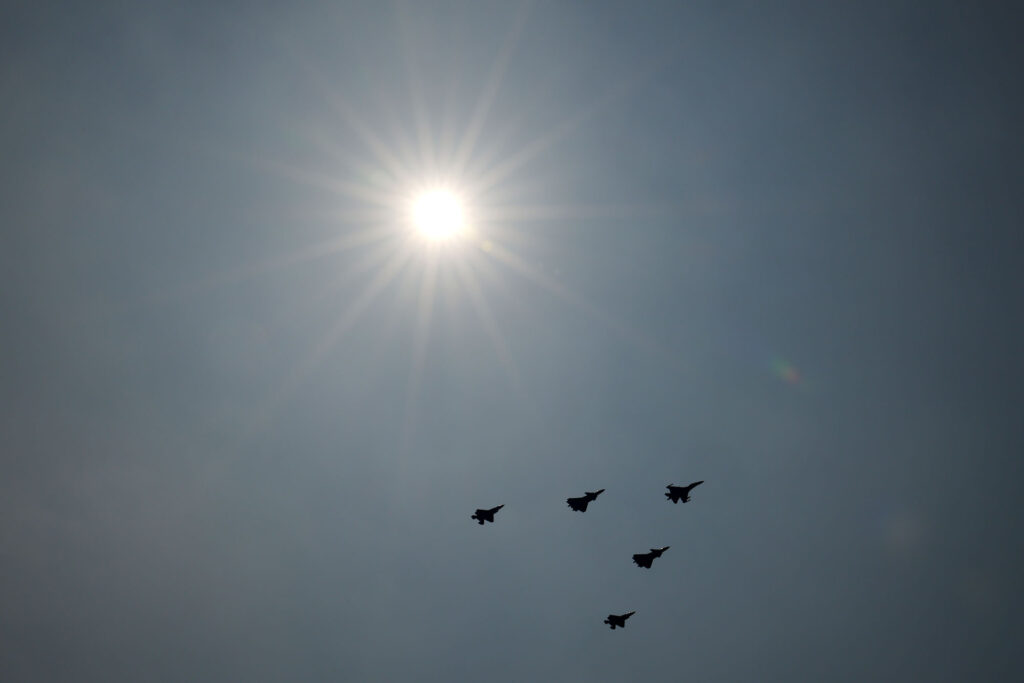
On November 16, a report titled “Peace Disease: Is the PLA Battle Ready?” was released by the Center for Strategic and International Studies (CSIS), a prominent American think tank. The report thoroughly examines various weaknesses of the Chinese military, highlighting potential unpredictable challenges it would face in the event of conflict across the Taiwan Strait. This article synthesizes some of the insights from the report and delves deeper into the vulnerabilities of the Chinese Air Force.
The CSIS report assesses that many of the Chinese Air Force’s operations consider Taiwan as a potential battlefield. However, executing missions against Taiwan is expected to be fraught with difficulties, particularly if the United States and its allies decide to intervene. The Chinese Air Force may need to penetrate and suppress Taiwan’s air defense systems, carry out high-intensity strikes on military targets, leadership arteries, and infrastructure, and possibly deploy airborne troops to restrict Taiwan’s access to foreign aid. It would also have to provide air protection for the Chinese Navy and amphibious forces. However, these operations will be severely hampered by numerous weaknesses.
According to the report, the J-16 and J-20 fighter jets of the Chinese military are effective in regions near the First Island Chain, closer to the Chinese mainland, and could pose a risk to U.S. forward bases in the Western Pacific. Nonetheless, the lack of a robust base network in the Western Pacific, few international allies, and insufficient aerial refueling capabilities make sustained large-scale operations beyond the First Island Chain difficult for the Chinese Air Force.
In recent years, the J-16 fighter jets have provided escort for H-6 bombers, crossing the Miyako Strait. Despite receiving support from aerial refueling aircraft, the J-16s have been observed to carry only four or two air-to-air missiles and quickly return after crossing the Strait, allowing the H-6 bombers to proceed into the Western Pacific alone. This indicates that the operational range of the Chinese fighter jets is far less impressive than officially claimed.
Chinese fighter jets have also practiced circumventing Taiwan from the south, conducting simulated strike training, or providing support for the Chinese Navy. However, even with aerial refueling assistance, these jets have had to make swift returns. If refueling operations occur too far from the Chinese mainland during wartime, they are quickly put in danger, which complicates the logistical challenges of aerial refueling.
The report characterizes the H-6 bombers as mere upgrades of outdated platforms, noting that the anticipated stealthy H-20 bombers, which could possess long-range strike capabilities, are not expected to be operational until the 2030s. Consequently, China’s ability to carry out airstrike missions against regions with advanced air defense systems remains limited.
The report outlines a lack of unified close air support operational theory within the Chinese Air Force. Individual units often develop their own tactics and training programs without synchronized collaborative training with adjacent units. While there has been some enhancement in electronic warfare capabilities, the survival rates in numerous operational scenarios appear to be quite limited. Therefore, the Chinese Air Force is expected to face significant challenges in close air support and battlefield air interdiction missions.
Coordination between the Chinese Air Force and the Army is still deemed insufficient. Historically, the Chinese Army has heavily relied on artillery for firepower, with the Chinese Air Force conducting missions well back from the front lines. Recently, the Army’s helicopters have begun to participate in joint training, but the Air Force does not seem to engage routinely in similar combined arms exercises. In simulations of an invasion of Taiwan, it appears that the Chinese Army is preparing to rely on long-range systems like the PHL-191 rocket artillery for strike missions.
The report also cites assessments from several operational personnel, suggesting that the Chinese Air Force struggles to sustain precise strikes against moving targets and often lacks situational awareness in beyond-visual-range combat situations.
Historically, the Chinese Air Force has faced challenges in its aerial strike capabilities. Recently, it was acknowledged that the newest J-35 radar internally can only accommodate air-to-air missiles and cannot fulfill penetrating airstrike missions, effectively rendering it a supplement to the J-20. During the Korean War, Chinese pilots operated Soviet-made bombers for a handful of unsuccessful airstrike missions and narrowly avoided being completely shot down by U.S. fighter jets. Since that period, China has rarely carried out operational air raids.
The report notes that the Chinese Air Force’s role during the 1979 conflict with Vietnam was minimal. The last successful manned aircraft shoot-down by the Chinese Air Force occurred during the Vietnam War in 1967 when they attacked American planes. The last engagement involving surface-to-air missile units taking down a plane happened during the 1987 conflict with Vietnam.
In comparison to the U.S., the Chinese Air Force is severely lacking in combat experience. Footage released by China often shows fighters with minimal ground-attack munitions, while H-6 bombers predominantly carry just two anti-ship missiles, targeting American naval vessels rather than Taiwan itself.
Various interviewees indicated that Chinese pilots must strictly adhere to command protocols, facing operational challenges when required to maintain radio silence and unable to receive instructions from higher command.
The report highlights that, compared to other military branches, the Chinese Air Force faces heightened political skepticism. There have been instances of several pilots defecting to Taiwan in aircraft. Pursuant to concerns over loyalty, the Chinese military has sometimes restricted flight operations in maritime airspaces.
In assessments, the report suggests the Chinese Air Force excels in striking stationary targets but is significantly weaker regarding moving targets. Attacking dynamic targets necessitates a high level of autonomy among pilots, which cannot be achieved when the military lacks war-speed assessment of bomb damage.
The dual leadership model—comprising political commissars and military commanders—may impede decision-making speed when military strategies diverge from the planned course of action. This situation complicates striking dynamic targets, and deep operations could prove challenging due to difficulties in coordinating with control towers. Experts have noted, “The further away from the mainland, the greater the problems become for the Chinese military.”
Historically, the training within the Chinese Air Force has been highly stylized, referred to by Chinese scholars as “nanny-style” training. During flights, if a trainee’s aircraft stalls or encounters problems, the instructor immediately takes over piloting duties. Operations training procedures are set in advance, indicating prescribed flight paths to target locations, and even after pilots lock onto assigned targets, they must request clearance to engage from the control tower.
The report concludes that China still lacks a dedicated air weapons school, and there exists an overall deficiency of qualified instructors at the level of operational units. The top-down operational approach leads to many pilots lacking innovative capabilities, and senior commanders often exhibit insufficient command proficiency. Pilots receive their instructions in briefing rooms, often with limited choices and no larger latitude for action. Much of the training does not reflect real combat scenarios, and some exercises are marred by significant levels of impropriety.
The report evaluates that the training hours for Chinese Air Force fighter pilots average between 100 to 125 hours, in contrast to the approximately 200 hours or more for their U.S. counterparts. Furthermore, much of the training undertaken by the Chinese Air Force merely meets minimum requirements and further reduces time available for diverse, non-predefined mission execution.
On November 11, an article in the Chinese military’s official publication highlighted air combat training for the J-20 fighter jets, although it primarily focused on close-range dogfighting. It also referred to the concept of “air knife fighting” from the Korean War period, illustrating a potential lack of grasp on beyond-visual-range skills or a failure to recognize the need for beyond-visual-range air combat training.
The report posits that the precision strike capabilities of the Chinese Air Force largely rely on space-based systems rather than continuous airborne early warning platforms, consequently limiting their ability to locate dynamic targets effectively. Despite improvements in China’s space-based systems and drone reconnaissance capabilities, they remain vulnerable to directed energy weapons, electronic warfare, and kinetic countermeasures.
The report further reveals that the Chinese Air Force is striving to enhance the command capabilities of various aircraft like the KJ-500, but the controllers of the KJ-500 struggle to maintain real-time communications with all aircraft involved, as direct communication can only occur with senior commanders.
If a situation arises where the KJ-500’s effective operational range becomes limited, it suggests that the real efficacy of China’s early warning aircraft is constrained. U.S. military sources have disclosed that F-35 fighters detected Chinese J-20s and their early warning aircraft over the East China Sea, expressing keen interest in disrupting this kill chain. China has never substantiated claims of J-20s encountering U.S. F-35 aircraft.
In May 2025, Pakistan reportedly used J-10 fighters to shoot down Indian aircraft with support from Swedish early warning aircraft. Pro-China media claimed that Chinese early warning planes directed J-10 operations; however, if the communication systems fail to facilitate real-time correspondence, this assertion would simply be a self-congratulatory claim.
The report indicates that China faces substantial internal coordination challenges when protecting its airspace. Surface-to-air missile units rarely share combat zones with friendly aircraft. One expert speculates that the Chinese military is reluctant to allow pilots to operate when their surface-to-air missile systems are active.
Moreover, there are concerns regarding the overall quality of China’s air defense systems. Analysts have pointed out that radar coverage blind spots and dependence on a few critical nodes could lead to delayed responses.
The report concludes that in significant emergent situations like an invasion of Taiwan, the Chinese military may still lack sufficient airlift capabilities to rapidly deploy airborne troops or transport materials.
Evaluation reveals that only a small segment of the Chinese Air Force’s transport fleet has undergone training for large-scale airlift operations, and airborne troops are seldom practiced in conjunction with the fixed-wing fighters tasked to provide cover or fire support.
The report further critiques the Chinese Air Force for lacking an adequate professional unloading team, with cumbersome procedures leading to delays in material transport. The cargo doors and floor weight capabilities of civilian aircraft are also limited, restricting heavy transport capabilities. China has never conducted extensive large-scale logistical support drills and has not deployed such airlift logistical capacities in real crisis scenarios.
The report assesses that China has consistently faced challenges in producing advanced turbojet engines, previously relying on Russian engines. In recent years, there has been a shift towards domestically produced engines, but the overall quality of aircraft remains questionable, especially in light of corruption issues. Experts have remarked that items manufactured in China are often “not durable enough.”
Frequent accidents resulting from maintenance issues and pilot errors continue to pose substantial challenges for the Chinese Air Force. Each aircraft is staffed with specialized ground personnel, and if a pilot and their plane are reassigned to a new base, the maintenance units must relocate accordingly. This rigid maintenance structure complicates the integration of different aircraft types within the same unit.
The report indicates that both the Chinese Air Force and other military branches are heavily reliant on conscripted personnel who, due to limited education, often lack requisite skills. Frequent enlistments and discharges lead to high personnel turnover, reducing the overall skill level of the Chinese Air Force, thereby necessitating regular basics training.
The report illustrates that all Chinese Air Force officers graduate from military academies, which hinders knowledge exchange. Most officers spend their entire careers within the same unit, diminishing the capacity for cross-unit learning and adaptation. Many Air Force personnel feel their skills are underutilized, choosing to leave the force for civilian careers.
In the context of any emergent incidents involving Taiwan, the Chinese Air Force may confront numerous challenges, such as limited pilot skill and initiative, weak close air support, and dynamic target localization capabilities, potential difficulties in adapting to rapidly changing battlefield scenarios, insufficient aerial intelligence, surveillance, and reconnaissance capabilities, and challenges in coordinating with other military branches and their own air defense systems. Capabilities to utilize airborne troops to seize airports could also be lacking, alongside restrictions on transport and maneuverability, complications in operating far from coastal areas, and a persistent lack of joint operation concepts.
In conclusion, the report evaluates that the mobility and creativity of adversaries could present significant challenges to the Chinese Air Force, which may follow relatively fixed operational frameworks. Additionally, as with other military branches, issues such as corruption and politicization continue to impede the effectiveness of the Chinese Air Force.