
A chilling autumn breeze sweeps through the Appalachian Mountains, where deep crimson leaves flutter to the ground, while the frosted earth crunches underfoot. With cold hands tucked into pockets, the aroma of burning firewood rises from a nearby chimney, and hot chocolate is served steaming at Friday night competitions. These sensory experiences form the backdrop of my childhood memories spent in this stunning region of the Eastern United States.
Perched atop the hills of Tennessee, the vibrant hues of the landscape spread like a patchwork quilt, gleaming beneath the bright blue sky. In my youth, I would stand under towering oak trees, watching as leaves spiraled down, dancing gracefully in the air while I reached out with my little hands to catch them.
As autumn rolled in, it heralded the arrival of Thanksgiving. For us as children, this meant no school—a joyous occasion where we gathered at home to feast on a delicious turkey dinner.
I vividly remember a Thanksgiving evening in the late 1970s when my stepfather managed to hunt a wild turkey. It became a centerpiece of our festive dinner.
“A wild turkey for Thanksgiving,” I thought with excitement. “Just like the Pilgrims and Native Americans did.”
To this day, I can still visualize the idyllic scenes from our history books, depicting the shared feast where satisfaction stemmed simply from a full belly.
Like many American families, our kitchen served as the hub of Thanksgiving festivities. The air was thick with the sweet scents of brown sugar and cinnamon, while caramelized sweet potatoes bubbled enticingly in a roasting pan. On the stove, potatoes and green beans simmered with savory bits of bacon, and this year, a wild turkey cooked in the oven.
Gathered around the dining table, we held hands for a moment of gratitude before diving into the feast. This turkey was markedly different from the ones found at the supermarket; its meat was leaner and its body slightly smaller than the Butterball birds we typically saw.
Upon taking a first bite of the wild turkey, I suddenly halted, puzzled by the unexpected taste. Why was it so tough? I frowned, taken aback by the texture that contradicted my expectations.
“This doesn’t taste like turkey,” I declared at the table, perhaps too bluntly, which only landed me in hot water.
My mother, an excellent cook, was likely appalled, thinking I had been spoiled by store-bought fare.
She shot me a look that made me shrink back in my chair, prompting me to chew slowly on my remaining morsels.
Standing just 4 feet 10 inches tall, my mother was a petite yet incredibly generous woman. Growing up in a poor family in West Virginia, she cherished food and wanted us to appreciate every bite rather than take it for granted.
One of her oft-repeated adages to my sister and me was to clean our plates because “there are children in Africa who are starving.” The truth of that statement was irrelevant—what mattered was the guilt it instilled in us, ensuring we ate everything.
Despite all that, a sense of relief washed over me knowing that my stepfather never hunted for another wild bird for our holiday feasts.
Fast forward several decades, the memory resurfaced when my husband, Bobby Sanchez, expressed a desire to cook a wild turkey of his own. That image of the tough bird lingered in my mind, cautioning me against the venture.
“No, that’s not a good idea,” I cautioned. “They’re tough and tasteless.”
“Trust me, it will be delicious,” he assured me with confidence.
Though I remained skeptical, ready to tell him, “I told you so,” the time was quickly approaching for me to taste his turkey—revisiting my previous judgments over the years.
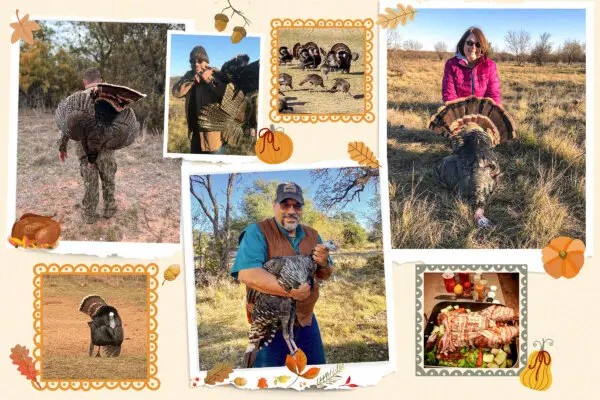
In the autumn of 2021, during our hunting trip at a rented site in West Texas, Bobby successfully shot a young male turkey. Adorned with iridescent brown feathers and a striking blue neck with red wattles, this bird was nothing like the commercially farmed, overfed varieties that never flew. Wild turkeys, honed by constant running, possessed powerful legs and had the ability to take flight for short distances when chased by coyotes or bobcats.
In Texas, turkey hunting is permitted in the fall and spring, and many hunters prefer using shotguns in spring when male turkeys gobble and flaunt their brilliant plumage to attract females, making them easier to spot. With specific calls, hunters lure them in closer, aiming for a clean shot to the head or neck.
Bobby is not only skilled in hunting but also surpasses me in culinary talents. One evening, after picking up the kids from school, I cooked dinner, only to be made acutely aware of my limitations. I heated up some vegetables and placed fish in the oven, only to overcook it.
As we sat down for the meal, the kids took a bite of the fish and looked at me.
“Mom, it doesn’t taste like Dad’s cooking,” my youngest son remarked.
“It’s a little dry,” my daughter added with a nod.
I shot them a look, reinforcing my authority at the dinner table.
“You need to eat it, and you need to like it,” I said, half-jokingly.
They poked at their plates, taking their time to finish. In that moment, nostalgia washed over me as I reflected on my childhood, realizing that the cycle continues.
As Thanksgiving approached in 2021, decades had passed since my first taste of wild turkey. Bobby began preparing his own meal. Here, I would like to share his method and recipe for the eight-pound wild turkey, which indeed transformed my perception of this distinctive bird.
**Wild Turkey Brine Recipe:**
– Three lemons
– One cup of salt
– One cup of brown sugar
– One cup of apple cider vinegar
– About ten whole black peppercorns
– One onion
– Four cloves of garlic
– Four dried guajillo chiles
– One large bag of ice
**Brining Method:**
In a cooler filled with water, squeeze the juice of the three lemons, including the pulp, into the brine mixture. Add one cup each of salt, brown sugar, and apple cider vinegar, then stir until the salt and sugar completely dissolve. Next, add whole black peppercorns, a quartered onion, the crushed garlic, and the dried chiles. Submerge the turkey in the brine, adding ample ice to maintain a low temperature.
Let the turkey brine for a minimum of 48 hours, after which, rinse it under cold water and pat it dry with paper towels.
**Cooking Ingredients:**
– Four stalks of celery
– Two green bell peppers
– Two onions
– Two green apples
– A handful or a bag of carrots
– One pack of bacon
– Salt, pepper, paprika, and garlic powder to taste
**Cooking Method:**
In a large roasting pan, layer chopped bell peppers, celery, onions, carrots, and green apples. Stuff the same mixture into the turkey cavity. Season the turkey with salt, pepper, paprika, and garlic powder. Wrap the turkey tightly with an entire pack of bacon, crisscrossing it over the surface. Roast at 365°F (approximately 185°C) for about an hour until the skin begins to brown, then cover it with foil and reduce the temperature to 325°F (approximately 160°C) and continue to roast for about two hours, or until the internal temperature reaches 165°F (approximately 74°C).
Before carving the turkey, be sure to remove the bacon. It’s important to note that turkey legs can often be tough, and while they shouldn’t be wasted, cooking at a higher temperature helps seal in the juices, ensuring the wild turkey is a standout centerpiece for any Thanksgiving table.