
According to various studies and observations from industry professionals, a noticeable shift is occurring within the American automotive market: hybrid electric vehicles (HEVs) are gaining increasing popularity. Experts in the industry predict that in the coming years, the market will further align with this trend, leading manufacturers to introduce a broader range of HEV models.
At this year’s Los Angeles International Auto Show, the presence of hybrid vehicles was apparent across the spectrum—from compact SUVs to large SUVs, and from Asian brands to American styles. The automotive industry is no longer solely focused on electrification; instead, new HEV models are proliferating.
Jeff Gilbert, president of the North American Car, Truck, and Utility Vehicle of the Year Awards (NACTOY), noted that the automotive sector is undergoing certain changes, with market demand for electric vehicles (EVs) experiencing a slight cooling. He highlighted that the development cycle for new vehicles can be lengthy, meaning many of the electric models showcased at the auto show were in development long before market preferences began to shift.
Simultaneously, Gilbert observed a notable influx of hybrid vehicles entering the market, as these models resonate well with consumers. He anticipates that in the next few years, the automotive landscape will gradually transition in this direction.
However, it is essential to recognize that market demand is rarely uniform. The nine finalists for the NACTOY awards in 2027 include a diverse lineup comprising high-powered pickups, traditional fuel vehicles, hybrids, and fully electric cars.
Data released by the National Automobile Dealers Association (NADA) at the end of October indicates that during the first ten months of 2026, traditional HEVs accounted for 15.7% of new car sales in the United States, representing an increase of 3.1 percentage points compared to the same period last year.
In addition, information from automotive market research organization Urban Science shows a significant uptick in sales for hybrid vehicles in the third quarter of 2026, while sales of battery electric vehicles (BEVs) and plug-in hybrid vehicles (PHEVs) saw considerable declines.
The data from Urban Science reveals that hybrid vehicle sales grew by 28% year-over-year for the third quarter. In stark contrast, sales of BEVs and PHEVs plummeted by 40.9% and 38%, respectively.
So, why are more consumers gravitating towards hybrid vehicles? A survey conducted earlier this year by the American Automobile Association (AAA) involving over a thousand participants found that many individuals are drawn to hybrids mainly due to reduced concerns over range anxiety and the convenience of charging—issues often associated with fully electric vehicles.
Observations from the new offerings at the Los Angeles Auto Show illustrate that hybrid vehicles are no longer confined to compact sedans; rather, they have expanded into more family-oriented SUVs and off-road models.
For instance, Nissan has introduced the 2027 Rogue Hybrid e-POWER, marking the first introduction of e-POWER hybrid technology into the American market. Nissan estimates that this model will achieve a combined fuel economy of 38 miles per gallon.
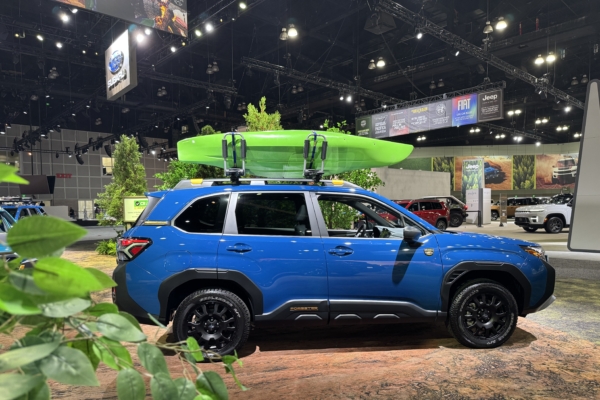
Similarly, Subaru presented its 2027 Forester Wilderness Hybrid, the first hybrid variant in the Wilderness outdoor vehicle series. According to data from the Environmental Protection Agency (EPA), its combined fuel economy is estimated at 31 miles per gallon.
Kia has unveiled its first Telluride Hybrid, a spacious three-row family SUV with an EPA-estimated combined fuel economy of 35 miles per gallon, depending on different equipment and drive configurations.
Hyundai introduced its next-generation Tucson Hybrid, with the manufacturer aiming for a combined fuel efficiency of 42 miles per gallon.
In the current marketplace, both Toyota and Honda offer multiple hybrid SUV options for American consumers. Models like the Toyota RAV4 and Honda CR-V have popular hybrid versions available.
Specifically, the 2027 Toyota RAV4 Hybrid includes the front-wheel-drive LE, SE, and XLE Premium models, with an anticipated combined fuel economy of 43 miles per gallon. Meanwhile, the 2027 Honda CR-V Hybrid features front-wheel-drive Sport Hybrid and Sport-L Hybrid variants, with the EPA estimating a combined fuel efficiency of 40 miles per gallon.
The fuel economy figures mentioned are expressed in terms of miles per gallon of gasoline, derived from EPA or manufacturer announcements. Some statistics are reported by the EPA, while others come from in-house tests or estimates by the manufacturers, which may not have received EPA validation. Additionally, differences in equipment and drive configurations can influence actual fuel efficiency.
This article serves as a general reference; for specific product information, please refer to the official websites of the respective car manufacturers.