
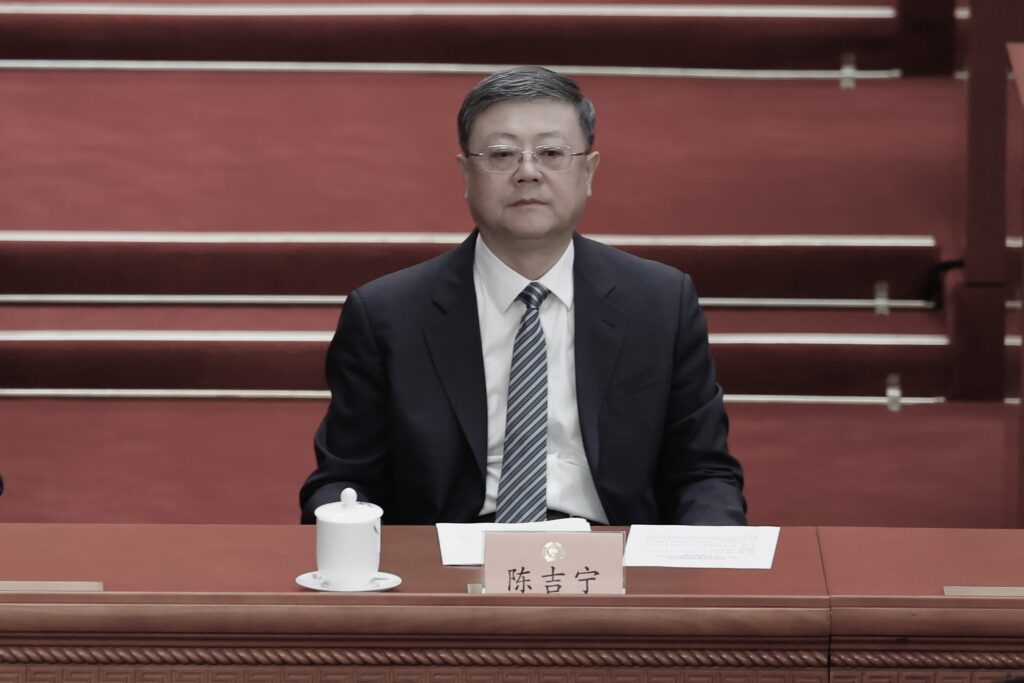
On November 24, 2026, it was reported that Chen Jining, a member of the Standing Committee of the Political Bureau of the Communist Party of China and Secretary of the Shanghai Municipal Committee, has been dismissed from his position. Chen Jining and his wife, Hu Qing, are both alumni of Tsinghua University’s Department of Environmental Engineering and Imperial College London, having attended these institutions during different academic years.
Before his recent downfall, Chen held the position of Minister of the Ministry of Ecology and Environment in China, while Hu previously served in an executive role at China Energy Conservation and Environmental Protection Group (China Energy Conservation). The couple’s connections to these influential institutions emphasize their deep ties to environmental governance in China.
Three weeks prior, on November 4, 2026, Wang Tongzhou, a former general manager of China Energy Conservation and Environmental Protection Group and a leading figure in the transportation construction sector, was stripped of his membership in the National Committee of the Chinese People’s Political Consultative Conference, confirming earlier rumors surrounding his misconduct. China Energy Conservation, with its longstanding collaboration with Tsinghua University’s Department of Environmental Engineering, has been at the core of a web of interests involving high-ranking party officials.
The energy conservation and environmental sectors in mainland China have been identified as areas under the influence of Xi Jinping’s brother, Xi Yuanping. In 2007, Xi Yuanping founded the International Energy Conservation and Environmental Protection Association, later renamed the International Ecological Economy Association (IEEPA) in 2014, which appointed Hao Jiming, an academician of the Chinese Academy of Engineering and professor at Tsinghua University, as president. Hao had been pivotal in advancing Chen Jining’s career during their time at Tsinghua.
The intricate connections between Chen Jining, Hu Qing, and various organizations such as the International Ecological Economy Association highlight interdependencies and potential conflicts of interest that permeate the environmental landscape in China. One year prior, media reports suggested that Wang Tongzhou was Xi Yuanping’s “white glove,” acting on his behalf, and accurately predicted Chen’s eventual ousting from power.
According to publicly available biographies, Chen Jining was admitted to Tsinghua University in September 1981, majoring in environmental engineering. He graduated with a bachelor’s degree in July 1986 and continued his studies at the same institution, where he earned a master’s degree in environmental engineering by October 1988. That same year, he received a scholarship to study for a doctorate at Brunel University in the United Kingdom, later transferring to Imperial College London.
After obtaining his Ph.D. in 1992, Chen served as a post-doctoral researcher at Imperial College until March 1998. His wife, Hu Qing, also completed her undergraduate studies at Tsinghua University, graduating in 1987. She pursued her master’s degree at the Chinese Academy of Sciences before obtaining her Ph.D. at Imperial College in 1998.
Following his return to China, Chen Jining took on various academic and expert roles at Tsinghua University before moving into political positions. In February 2015, he was appointed Minister of the Ministry of Ecology and Environment, while Hu Qing transitioned to a professorship at the Southern University of Science and Technology, where she currently serves.
The political landscape surrounding these figures has been turbulent, as seen by the recent removal of key officials from their posts. Three weeks ago, Wang Tongzhou’s ouster made headlines, with his connections to major energy conservation enterprises raising eyebrows about possible underlying corruption or influence peddling.
Under the watch of the Ministry of Ecology and Environment, the relationship between Chen and Wang during their overlapping tenures has become a focal point of scrutiny. The overarching governance of their respective roles relied significantly on mutual connections and collaboration with state-owned enterprises, such as China Energy Conservation.
The intricate web of political ties deepens with their ongoing collaborations with Tsinghua University’s environmental programs. Moreover, numerous experts from Tsinghua have engaged in strategic consultations and decision-making with China Energy Conservation, evidencing a symbiotic relationship between academia and industry.
As part of a broader investigation into corruption and power dynamics within the Chinese Communist Party, ongoing political purges have hinted at a deeper battle for influence among various factions. The recent drop of several prominent political figures indicates a systemic cleansing, with implications extending to other areas of governance and party loyalty.
The allegations swirling around these characters suggest a network heavily influenced by the Xi family, particularly highlighting Xi Yuanping’s involvement in the energy sector. Recent reports indicate that every mention of energy conservation and environmental initiatives might draw connections back to Yuanping’s influence.
Overall, the unfolding events around Chen Jining’s dismissals and the interrelations among high-ranking officials reflect unprecedented tension within the current political climate. Observers speculate about the future implications for party governance and the ongoing rivalries within the ranks. As the waves of political cleansing continue to ripple through the party, the question remains: who will be the next to face scrutiny, and what underlying agendas are being pursued behind the scenes?