
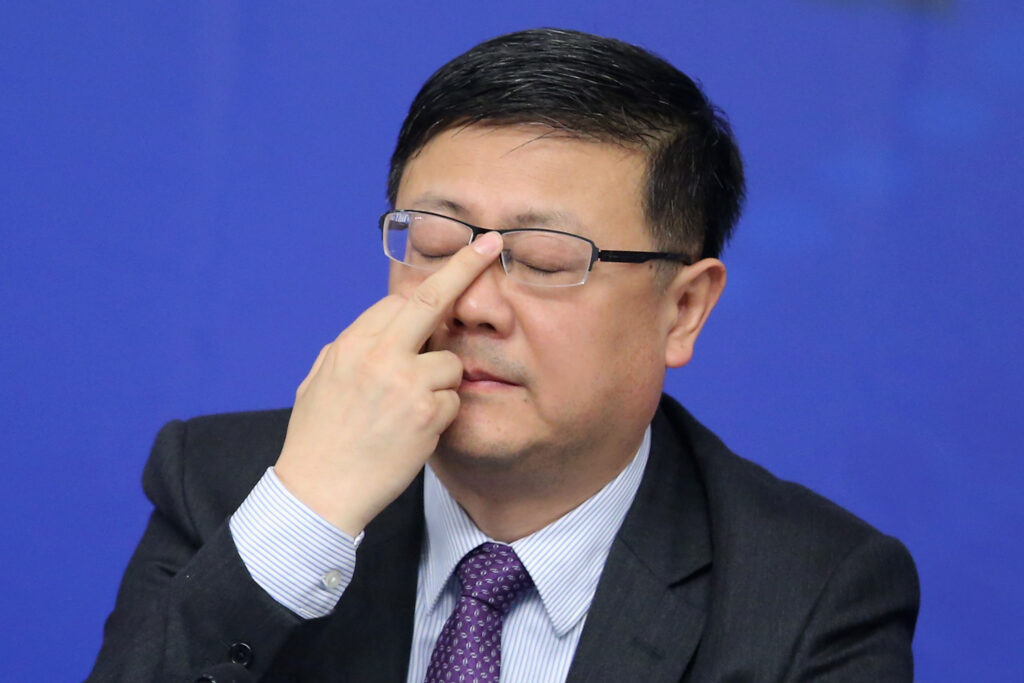
On November 24, high-ranking Chinese official Chen Jining, a member of the Politburo and Shanghai Party Secretary, was unexpectedly ousted, sparking surprise both domestically and internationally. Chen, known as a technocrat, held a different reputation than the previously fallen Politburo member Ma Xingrui, largely due to his educational background in the West, which has attracted more attention to officials like him.
This raises the question: what does Chen Jining’s downfall signify?
Academic commentator Mao Shoulong expressed on WeChat that “Chen Jining is not an ordinary fallen official… He is a top-tier technocrat who rose through the ranks from an academic background at Tsinghua University, exemplifying the ascent of individuals from the environmental protection field to the pinnacle of power.” He elaborated that this isn’t merely a personal downfall; it represents the collapse of a specific type of official and a particular promotion model, highlighting the deteriorating relationship between professionalism, power, and loyalty within the political landscape.
While the post has since disappeared from WeChat, it continues to circulate on certain independent media platforms, garnering attention.
In China, Mao Shoulong may have been reluctant to say outright: the fall of Chen Jining correlates with the failure of a promotion model.
Born in February 1964 in Jilin’s Siping City, Chen Jining exemplifies the archetypal career path of the first generation of technical elites nurtured during the so-called reform and opening-up era. After entering Tsinghua University in 1981 to study environmental engineering, he completed his master’s degree there as well. During his studies, Chen served as the student committee secretary for his department, receiving accolades from his teachers for being both politically adept and academically proficient.
After 1988, Chen spent a decade studying in the UK, where he pursued a doctoral degree at Brunel University in biochemistry. During this time, he managed to evade the political repercussions of events like the Tiananmen Square protests in 1989, leaving little trace of his political views from that period.
In July 1989, he transitioned to the Imperial College London, specializing in environmental system analysis within the civil engineering department. He obtained his engineering doctorate in 1992 and subsequently worked as a postdoctoral fellow and assistant researcher at the college. He returned to Tsinghua University in 1998, where he held various significant roles, including deputy director, director of the Environmental Science and Engineering Department, and finally becoming the president of Tsinghua in 2012.
As president, Chen Jining’s remarks at a graduation ceremony became widely circulated online. He emphasized the importance of respecting not just one’s own rights but also the rights of minorities and public contracts, stating, “Inclusion requires acceptance of others, listening to diverse opinions, especially dissenting voices…” These proclamations reflected an understanding of universal values, although he later found himself unable to express similar sentiments.
Notably, Chen Jining did not come from a prominent family nor did he have a complex web of connections. However, his years of Western training afforded him an international academic lexicon, which later became a distinct advantage in environmental diplomacy, climate negotiations, and cross-border technical collaborations.
In January 2015, Chen left Tsinghua University to become the Communist Party Secretary of the Ministry of Environmental Protection, later serving as minister, marking his transition from academia to a high-level governmental position. At the age of 51, he became the youngest minister among various national ministries. His ascent was perceived as a signal that professionalism had pathways within the Chinese Communist Party (CCP), particularly in technical fields such as environmental governance.
During his tenure as the Minister of Environmental Protection, Chen faced the pressing issue of severe environmental pollution in China, which had reached crisis levels with smog becoming a public health concern. Environmental protests became frequent, and skepticism mounted internationally regarding China’s climate commitments.
However, the practical, professional ethos of a technocrat clashed with the CCP’s political mandates and stability requirements.
Upon becoming Minister, Chen publicly endorsed a documentary on air pollution created by former journalist Chai Jing, even sending her a thank-you message. Yet, within days of the film’s release, it faced an official ban, a directive likely issued from the highest levels of the CCP under Xi Jinping. Following this, Chen’s demeanor at subsequent press conferences starkly contrasted his prior support, reflecting a resignation of professional integrity to political necessity—an unfortunate reality characteristic of the CCP’s repressive environment.
In May 2017, Chen transitioned to the role of Deputy Secretary of the Beijing Municipal Committee, later serving as the mayor, while also leading the organizing committee for the Beijing Winter Olympics.
During the extensive cleanup effort in Beijing at the end of 2017—often labeled by critics as a purge of so-called “low-end populations”—Chen was involved alongside Party Secretary Cai Qi, whose statements during the campaign drew substantial criticism. After successfully navigating this politically fraught environment, he passed an examination of loyalty to Xi Jinping and entered the Central Politburo in October 2022, subsequently assuming the role of Shanghai Party Secretary, likely influenced by powerful Tsinghua alumni and recommendations from Xi’s close associates.
With this ascent, Chen Jining achieved a level that a technocrat might aspire to: from a humble background as an environmental engineering student to a member of the Politburo and Secretary of a directly governed city. Those familiar with the inner workings of the CCP recognize this often signifies a process of losing one’s conscience, as reinforced party loyalty typically diminishes personal integrity.
Over three years in Shanghai, a city that is the economic powerhouse of China, Chen utilized his international background to facilitate governance. He welcomed a slew of significant foreign dignitaries, but beneath this facade of success lay potential risks—a concern highlighted by numerous commentators.
In 2023, Chen met with notable international figures, including former President of the Republic of China Ma Ying-jeou, Brazilian President Lula da Silva, Venezuelan President Nicolás Maduro, and Senate Majority Leader Chuck Schumer of the United States. In 2024, he met with U.S. Secretary of State Antony Blinken, Singaporean Senior Minister Lee Hsien Loong, and Italian Prime Minister Giorgia Meloni, among others. By 2025, he engaged with Australian Prime Minister Anthony Albanese and Vietnamese Prime Minister Pham Minh Chinh, and in 2026, he met South Korean President Lee Jae-myung and UK Prime Minister Keir Starmer. Lee expressed a desire to establish new connections with China’s next generation of leaders, further bolstering Chen’s image as a diplomatic leader.
However, this growing reputation as an international envoy—ease in interactions with foreign dignitaries—exacerbated rising suspicions from Xi Jinping, who earlier viewed him as a potential successor.
As for the allegations of corruption surrounding Chen Jining, there are currently no verified official communications regarding when these issues might have arisen. Following convention, authorities could trace back over a decade, possibly to his tenure in the Ministry of Environmental Protection. Yet, corruption remains a systemic malady within the CCP, where virtually any individual in a position of authority is likely to encounter issues related to graft.
The underlying reason for Chen Jining’s dramatic fall from grace may be attributed to the public recognition he garnered through his professional demeanor—perceived to exceed typical bureaucratic boundaries—raising concerns among the party’s top echelon. Furthermore, the professional spirit and human-oriented philosophy he potentially retained after navigating the political landscape stood in stark opposition to the CCP’s authoritarian principles.
After Xi Jinping’s ascent, there was a significant reliance on technocrats like Chen and Li Ganjie, along with figures from the military-industrial complex like Ma Xingrui. Much of this reliance was partially motivated by Xi’s hesitance to completely dismiss the pragmatism embodied by former Premier Li Keqiang, who was also a technocrat that the elders of the party had backed. Xi was even willing to showcase figures such as Liu He, a finance official with favorable standing in international circles.
However, with Li Keqiang’s unexpected demise, the tide of reform initiated post-Cultural Revolution began to recede. Xi has since tightened control over the party in the name of party-building and strict governance, favoring individuals like Wang Huning and Cai Qi—whose philosophies echo Cultural Revolution ideologies. The current Premier, Li Qiang, does not represent a continuation of technocratic leadership but rather serves as part of Xi’s supportive entourage. The entire model of governance within the CCP has undergone significant transformation.
During Li Keqiang’s leadership, Chen Jining, along with others such as Liu Jiwei and Ma Kai, represented a lineage of technocrats. With Chen’s investigation, this era seemingly draws to a close. This aligns with Xi Jinping’s initiatives to abolish presidential term limits in the 2018 constitutional amendments and securing re-election in 2022, as well as the ongoing ambitions for lifetime leadership leading up to the 21st party congress.
In the four years following the 20th Party Congress, authorities have increasingly prioritized political security over economic development, branded as “coordinating development and security”, serving as a pretext for political stability. This shift in governance philosophy has contributed to the stagnation of the Chinese economy and the suffering of the populace, while heavy-handed crackdowns have compounded policy inertia.
Whether due to political loyalty or corruption, the sudden fall of Chen Jining—once perceived as a potential successor in the eyes of international leaders—has undoubtedly caused foreign investors to approach China with greater caution. It has been suggested that Xi Jinping acts as a “party exterminator”, and the incident involving Chen Jining offers an insightful glimpse into this narrative.
In 1994, Hao Jiming, then head of Tsinghua’s Environmental Engineering Department, expressed a desire to “bring Chen Jining back”. Little did he foresee that, upon his return to China, Chen would ultimately find himself entangled in the confines of Qin Cheng Prison.
By not designating a successor, Xi Jinping effectively signals his position as the last leader of the CCP, fostering an environment of intra-party conflict. Recent satellite images indicate that Qin Cheng Prison is undergoing significant expansions, suggesting that this internal struggle within the party may just be commencing!