
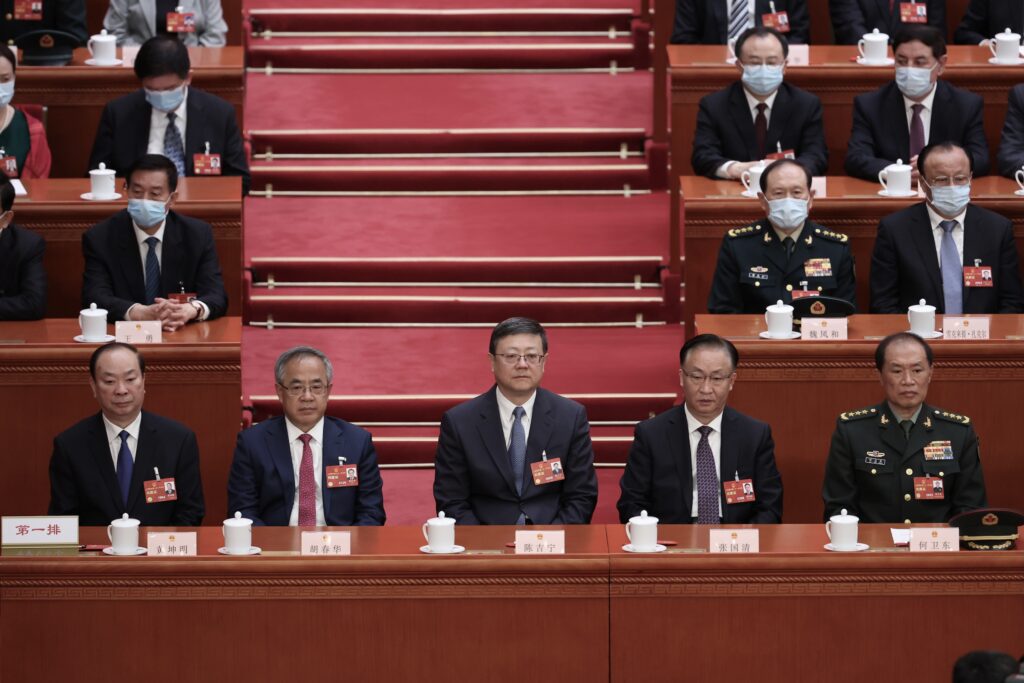
In the lead-up to the 21st National Congress of the Chinese Communist Party, fierce internal strife has erupted within the party’s upper echelons. The unexpected announcement of Chen Jining’s sudden fall from grace has sent shockwaves through political circles. Chen, a member of the Central Political Bureau and the Communist Party Secretary for Shanghai, is widely believed to be part of Xi Jinping’s “Tsinghua Clique.” The news has ignited a frenzy on social media, with various accounts sharing purported insider information, suggesting that Xi is in a vengeful mood, making it clear that no one is beyond suspicion and anyone could be next.
On the evening of November 24, Xinhua News Agency reported that Chen Jining is “suspected of serious violations of discipline and law” and is currently under investigation by the Central Commission for Discipline Inspection and the National Supervisory Commission. However, the official announcement did not disclose the specific nature of the charges against him.
Upon hearing this news, many mainland Chinese netizens reacted with shock and disbelief, posting comments that ranged from “A big tiger has fallen” to “This is a major affair.” Expressions of astonishment included sayings such as “This is not just about a tiger anymore,” and “Things are getting serious in Beijing. You can’t catch everyone; it’s simply impossible.”
On overseas X platforms, a rush of speculative information began to circulate.
One post by a former official from Inner Mongolia, Du Wen, claimed that he had received what he described as “somewhat credible information” regarding the reasons behind Chen’s downfall. He shared four key points:
1. It is connected to the case of Xia Linmao, the executive vice mayor of Beijing and a fellow Tsinghua alumnus.
2. It relates to a discussion among party elders regarding the succession of the highest leadership.
3. It involves a covert investigation by national security initiated during Chen’s study abroad, which allegedly uncovered collusion with old cadres concerning high-ranking positions.
4. It concerns the economic benefits sought for the family of Li Qiang while in Shanghai.
Another user known as Wang Gangdan commented on the internal power dynamics at play, stating that the circumstances surrounding Chen’s removal are not merely about corruption but are instead the by-product of intra-party battles. He mentioned several prominent figures, including Liu Guozhong, Li Xi, He Lifeng, Cai Qi, and Huang Kunming, as being involved. The post alleged that numerous complaints had already been filed against Chen in Beijing, accusing him of overstepping his authority and misusing his influence to secure projects for state-owned enterprises. The financial implications were severe, including accusations of misappropriating funds from Shanghai’s artificial intelligence initiatives for personal gain abroad, alleging money laundering linked to luxurious real estate purchases in places like Singapore and New Zealand.
Further rumors claimed that Chen’s family had quickly fled to New Zealand on the evening of the news breaking, with indications of a broader panic within his network.
In conclusion, a voice among insiders reportedly noted, “The boss is really going wild now; no one can be trusted. Anyone currently in power could be next.” This sentiment has fostered fears that significant upcoming developments could shake the political landscape even further, potentially implicating Taiwan-related issues and prompting preparations for drastic changes ahead.
Another user, under the moniker Moyan, noted a concerning remark that purportedly came directly from Xi Jinping: “Take care of yourself,” following a personal visit to inspect Shanghai’s AI developments that resulted in dissatisfaction over unproductive projects, ultimately leading to Chen’s dismissal.
Ray Chu Love Hong Kong shared insights from conversations with executives of state-owned enterprises, highlighting that the Central Commission for Discipline Inspection had already set its sights on Chen Jining earlier in the year. The fallout from a phone call that Chen had with a foreign investor—where he discussed expanding openness and market strategies—was seen as transgressing boundaries set by Xi, marking him as another person who had overstepped.
Analysts on Chinese politics indicate that while many of these rumors may be difficult to verify, they could reflect the intense power struggles within the CCP. The specifics mentioned warrant closer scrutiny as the situation evolves.
Recent history shows that the momentum behind Chen’s downfall has significant implications for other leaders within the party. Just days prior to his dismissal, he had participated in a key anti-corruption meeting, emphasizing the urgency of thorough investigations into corruption cases.
As the events unfold, it remains clear that the political landscape is shifting dramatically, with the repercussions of Chen Jining’s fall likely reverberating throughout the CCP in the days and weeks to come.