
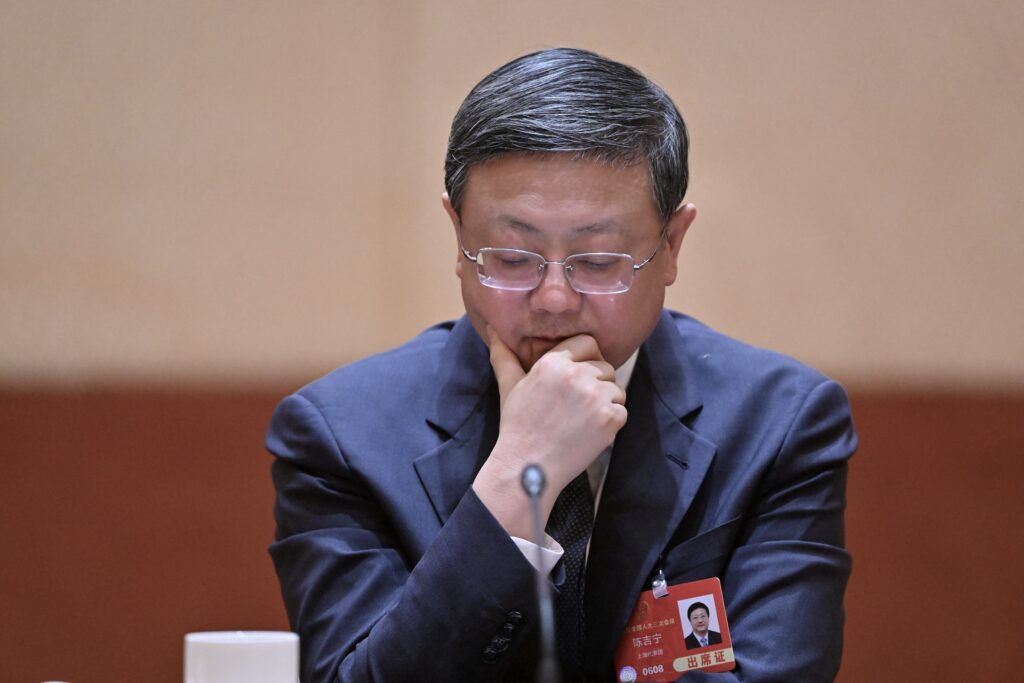
On the evening of November 24, 2026, Beijing time, reports emerged from state-run media Xinhua that Chen Jining, a member of the Chinese Communist Party (CCP) Politburo and the Secretary of the Shanghai Municipal Committee, is under investigation for serious violations of discipline and the law.
Chen Jining has become the fourth member of the Politburo of the 20th Central Committee to be investigated. The previous three were He Weidong, Vice Chairman of the Central Military Commission, Zhang Youxia, and Ma Xingrui, the former Secretary of the Xinjiang Provincial Party Committee.
At 62 years old, Chen Jining was considered a prominent candidate for the Standing Committee of the upcoming 21st National Congress of the Communist Party, and even touted as a potential successor to Xi Jinping. His downfall has generated considerable intrigue, particularly given the high-stakes internal power struggles within the upper echelons of the CCP.
According to official reports, Chen’s last public activity was on November 19, 2026, when he visited the China COSCO Shipping Group in Shanghai for a research trip and presided over a symposium.
Between November 16 and 18, 2026, Chen also engaged in public activities. On November 18, he met with Christoph Franz, the Chairman of the Board of Roche Group from Switzerland. The day prior, on November 17, he chaired a specialized consultation meeting at the Shanghai Municipal Committee of the CCP. On November 16, he attended a meeting to advance anti-corruption work in Shanghai, delivering a speech on the subject.
In contrast to other high-ranking officials who have come under scrutiny, there have been no reports from either domestic or foreign sources detailing Chen Jining’s removal or arrest up to this point.
Informants disclosed on November 1 that shortly after the conclusion of the 20th Central Committee’s Fifth Plenary Session on October 29, Chen was summoned by the General Office of the Central Committee, possibly at the request of Xi Jinping himself. The informants suggested that the timing of this conversation pointed to particular concerns, potentially related to Chen Xi, the former head of the Organization Department, or certain issues arising from Shanghai.
The sources claimed, “It seems to be connected with Chen Xi. He was recommended for his position by Chen Xi and Cai Qi, mainly by Chen Xi.”
Chen Jining has strong ties to Xi Jinping’s inner circle and has risen through the ranks thanks to the support of Chen Xi, another key figure in Xi’s administration.
Originating from Shijiazhuang County in Jilin Province and born in Yingkou City, Liaoning Province, Chen earned his Bachelor’s and Master’s degrees in Environmental Engineering from Tsinghua University from 1981 to 1988. He later pursued a doctorate in the UK and worked as an assistant researcher at Imperial College after graduating.
Chen Xi served as Deputy Secretary and then Executive Deputy Secretary of the Tsinghua University Party Committee from 1993 to 2002. During this time, in March 1998, Chen Jining returned to Tsinghua to teach, where he rose to the position of Deputy Director and then Director of the Environmental Engineering Department.
From 2002 to 2008, Chen Xi was Secretary of the Tsinghua University Party Committee. In February 2006, Chen Jining was promoted to a member of the Tsinghua University Party Committee and then to Vice President in December 2007. He subsequently became the youngest President of Tsinghua University in February 2012 since its founding in 1949.
Chen Xi transitioned to serve as the Permanent Deputy Minister of the United Front Work Department between April 2013 and October 2017, while Chen Jining was appointed Minister of Environmental Protection in February 2015. This made him one of the youngest ministers in the State Council at the time. Afterward, on May 27, 2017, he became the Deputy Secretary of the Beijing Municipal Committee and served as Vice Mayor, acting as Mayor.
Between October 2017 and April 2023, Chen Jining held the position of Politburo member and Minister of the Organization Department. He was appointed Beijing Mayor in January 2018 and advanced to Politburo membership in October 2022 during the 20th National Congress before taking over as Secretary of the Shanghai Municipal Committee.
Following the Third Plenary Session in July 2024, there have been persistent rumors regarding Xi Jinping’s health and power struggles, resulting in ongoing purges within the Tsinghua faction of Xi’s allies.
In early June 2026, a series of dismissals took place, including Chen Xi’s removal from the roles of President of the Central Party School and Director of the National Academy of Governance. During this time, reports began to surface suggesting that Chen Xi might be involved in a corruption scandal linked to his Fujian connections and the Beijing Political Consultative Conference Chair Wei Xiaodong.
Just before the Fifth Plenary Session on October 22, 2026, the Standing Committee member and Executive Vice Mayor of Beijing, Xia Linmao, was removed from his post. Xia, who had obtained degrees from Tsinghua University, served in various capacities in the Beijing Municipal Committee and had been a subordinate of Chen Jining for approximately five years.
Notably, on the day Chen Jining’s investigation was announced, his Tsinghua University alumnus Fang Hongwei, the former Secretary of the Shaanxi Provincial Committee, was indicted for bribery. Fang, who had been dropped from his position in November 2025, was closely associated with Xi Jinping, having graduated from Tsinghua and received support from Tsinghua alumni Chen Xi and Hu Heping.
In a broader context, the upheaval surrounding Chen Jining’s investigation may have political ripple effects, potentially implicating his former allies, including Cai Qi and former leaders like Chen Xi.
As Shanghai has historically been a political stronghold, the position of Shanghai Municipal Committee Secretary has often been seen as a stepping stone for ascension to higher roles within the CCP. Chen Jining’s downfall comes amid ongoing turmoil in Shanghai’s political landscape, with various officials caught up in corruption investigations.
Since June 2026, there have been numerous personnel disruptions in the upper echelons of Shanghai’s governance. Recent reports have indicated that over 30 officials from Shanghai, including deputy mayors, have been investigated, further underscoring the ongoing crackdown on corruption within the city’s leadership.
The fallout from Chen Jining’s investigation raises questions about the future trajectories of other key figures in Xi’s circle, including Hu Heping, who currently holds a significant position within the central propaganda unit, and Chen Xu, a deputy minister in the United Front Work Department.
Upon the backdrop of Xi Jinping’s authority being increasingly challenged amidst whispers of health concerns, these developments suggest a continuation of the deepening factional struggles within the CCP as it heads towards the next national congress. The political landscape remains precarious, indicating that further investigations or changes in high-ranking officials could soon occur.
Chen Jining’s investigation may signify not just the loss of one high-profile official but may well usher in a new wave of scrutiny that could impact a broader network of officials with ties to Xi or those opposing his faction. As the political chess game unfolds, the consequences for these leaders and the future direction of the CCP could shape the party’s trajectory in the coming years.