
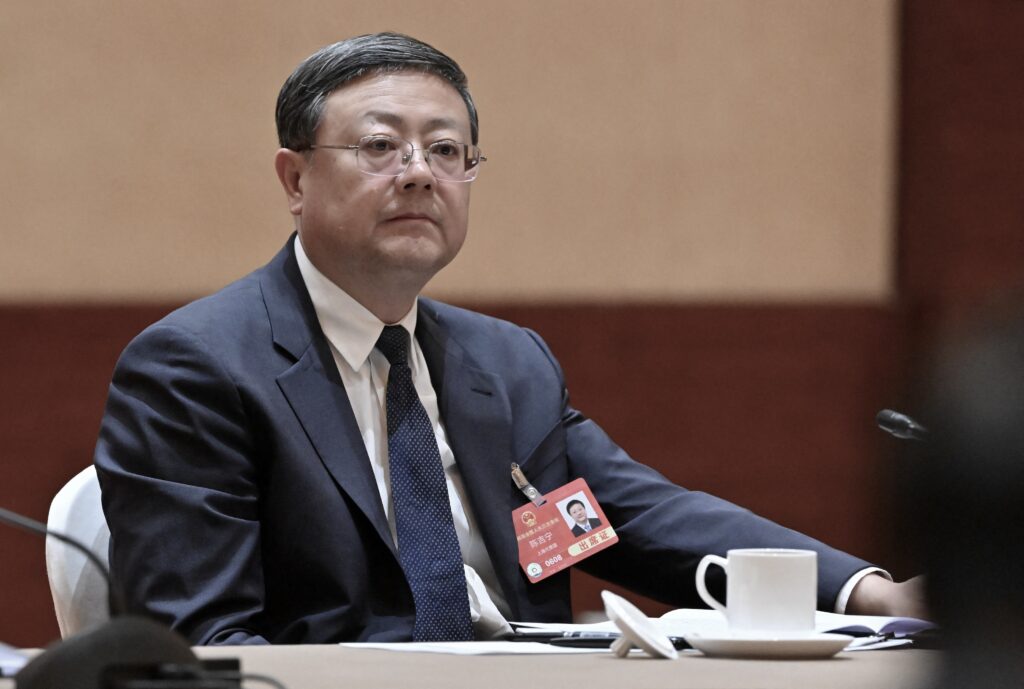
In the lead-up to the 21st National Congress of the Chinese Communist Party (CCP), significant power struggles are unfolding at the top echelons of the party. A major development has been the shocking announcement of the downfall of Chen Jining, a member of the Central Politburo and the Secretary of the Shanghai Municipal Committee. Remarkably, just five days before the official announcement of his removal, Chen was publicly engaged in research activities with the China Ocean Shipping Group and led a symposium.
The official state media has not disclosed specific details regarding the accusations against Chen. However, several key points about this situation warrant attention.
Chen Jining was born in February 1964 in Lishu, Jilin Province, making him 62 years old. He holds a doctorate in Environmental Systems Analysis from Imperial College London and is known as a “sea turtle” scholar—an individual who studied abroad and returned to China to pursue a career in governance.
His career trajectory includes prominent positions such as President of Tsinghua University from 2012 to 2015, Minister for Environmental Protection, and later, Mayor of Beijing. In 2022, he was elected as a member of the Politburo and took on the role of Shanghai’s municipal secretary.
Chen had been widely viewed as a representative of the “post-60s” technocratic class and a potential candidate for elevated ranks within the party. Historically, Shanghai has been seen as a stepping stone to higher positions, as evidenced by Li Qiang’s promotion from Shanghai to Premier.
The 5th Plenary Session of the 20th Central Committee of the CCP concluded recently, with the party sending signals for a “high-pressure anti-corruption” campaign, believed to be a preparation for the leadership changes anticipated at the upcoming 21st Congress in approximately 2027. Chen’s sudden removal occurs less than a year before this significant event.
Amidst ongoing speculation about personnel adjustments for the 21st Congress, Chen Jining had been considered a strong candidate. However, a critical barrier remains: Xi Jinping’s intention to retain power means there will be no room for potential successors to position themselves prematurely.
While rumors have circulated about Xi’s declining health, indicating uncertainty over how long he might maintain power, the increasing number of officials openly challenging central authority suggests a broader trend of disregard for Xi’s leadership. It appears that individuals like Chen may have become overconfident due to excessive praise, leading to careless remarks that ultimately triggered Xi’s suspicions.
Chen Jining shares close ties with former Organization Department Minister Chen Xi, who previously served as the Party Secretary of Tsinghua University and had a significant influence on Chen Jining’s career.
From 2002 to 2008, Chen Xi was the Party Secretary at Tsinghua University, where Chen Jining was his deputy president. Following Chen Xi’s appointment as the Organization Department Minister, Chen Jining ascended to the presidency of Tsinghua. When Chen Jining was appointed Secretary of Shanghai, it was Chen Xi who announced the move.
However, the fate of many individuals associated with the “Tsinghua faction” has taken a downturn in recent years, with investigations leading to the review of old allies. By June 2026, Chen Xi had stepped down from his various roles, including the presidency of the Central Party School.
Coincidentally, on November 24, the former Secretary of the Xi’an Municipal Committee, Fang Hongwei, also from the Tsinghua faction, was indicted.
Li Ganjie, a Politburo member who was reassigned from the Organization Department in 2025 to become Minister of United Front Work, also counts among Chen Jining’s Tsinghua alumni. Chen Jining and Li Ganjie had previously collaborated at the Ministry of Environmental Protection, and Li’s reassignment had once sparked widespread rumors regarding potential investigations.
Chen Jining is viewed as the highest-ranking individual from the Tsinghua faction to have fallen from grace, indicating that Xi Jinping is tightening his grip on his inner circle, following a broader purge that has included figures associated with the military faction, such as He Weidong and Miao Hua.
The removal of Chen is expected to disrupt the personnel structure ahead of the 21st Congress, especially with the exit of a previously favored candidate from the “post-60s” generation, potentially diminishing traditional succession expectations.
This might signal Xi’s inclination towards prolonging a strongman leadership style without rushing to designate a clear successor. The theme of the recent Plenary Session, focused on “comprehensively enforcing strict party governance,” underscores the entrenchment of anti-corruption measures as a long-term mechanism for consolidating control.
Given the current volatility, there may yet be more turmoil within the Politburo, with even some officials who have been lauded as the “youngest provincial-level leaders” potentially falling under Xi’s scrutiny.
As the 21st National Congress approaches, the list of Politburo Standing Committee members may still be actively contested, reflecting the underlying instability within the party’s power structure.
The investigation into Chen Jining marks the first time in approximately two decades that a Shanghai party secretary has been subjected to scrutiny, the last being Chen Liangyu in 2006.
As Shanghai serves as a vital economic and financial hub, the vacancy in the Party Secretary role is expected to trigger subsequent personnel adjustments and garner significant attention.
In reaction to the decision to investigate Chen, state media reported that the Shanghai Municipal Committee convened an enlarged meeting that same evening, declaring unwavering support for the central government’s decision and outlining measures for maintaining stability across the city.
This call for heightened stability suggests that authorities are wary of any factional power that Chen could have potentially established in Shanghai, which might pose a challenge to central authority.
The newly appointed Shanghai Mayor, Zhu Zhongming, is unlikely to immediately take over as Secretary. Officials may instead opt to dispatch a central authority figure temporarily to oversee Shanghai, reminiscent of the situation in Chongqing following Bo Xilai’s downfall. As one of the four direct-controlled municipalities, Shanghai holds significant political and economic importance, and authorities are clearly apprehensive about potential instability.
In addition to his ties with former Organization Department Minister Chen Xi, Chen Jining also worked alongside Cai Qi, a Politburo Standing Committee member, for approximately five years in Beijing.
With former members of the Beijing leadership team, Wei Xiaodong and Xia Linmao, facing their own problems, there remains uncertainty about whether old grievances against Chen Jining will resurface in Beijing. Similarly, the potential repercussions for his former superior, Cai Qi, are still speculative.
If Chen Jining’s primary challenges arise from his tenure in Shanghai, it is possible that the recently resigned Shanghai Mayor, Gong Zheng, may also be implicated, given that he is the brother-in-law of former Vice Premier Liu He.
Moreover, recent reports emphasizing Chen Jining’s past role as Minister for Environmental Protection raise suspicions that corruption issues may have originally begun during his management of national environmental projects.
Historically, since the establishment of the Politburo in May 1927, there has consistently been at least one Politburo member who has fallen victim to internal power struggles in each session (excluding those who have “died of illness”). This trend has become a hallmark of the CCP’s governance throughout its rule in China.
For instance, in the 7th Politburo, Gao Gang was separated for investigation in February 1954, effectively losing his position, and later committed suicide in August. Similarly, many members of the 8th Politburo were purged during political movements instigated by Mao Zedong, leading to severe consequences, including fatalities.
The pattern continued through various Politburo sessions, with notable political figures facing investigations and removals from their positions during pivotal moments in the Party’s history, highlighting the dangerous dynamics at play within the CCP.
Chen Jining’s downfall makes him the fourth Politburo member to be removed during the 20th Central Committee, following the previous removals of military leaders and others.
With this wave of scrutiny, the current number of fallen Politburo members now ties with the highest recorded in nearly fifty years post-Cultural Revolution, suggesting ongoing volatility within the ranks of the Chinese Communist Party.
This ongoing situation raises pressing questions about the future trajectory of Chinese leadership and the critical power dynamics that continue to evolve within the nation’s political landscape.