
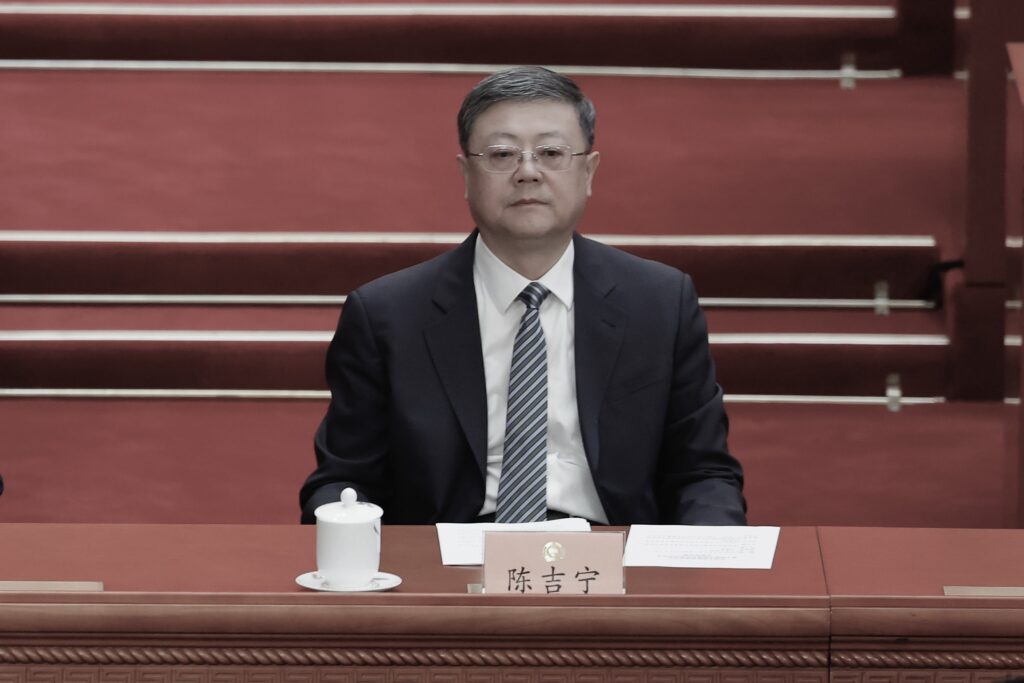
In a significant political development, the Central Committee of the Chinese Communist Party has officially announced the dismissal of Chen Jining, a member of the Politburo and Secretary of the Shanghai Municipal Committee. This decision has triggered yet another wave of turmoil within the ranks of the Chinese government.
Chen Jining previously garnered attention during his tenure as the Minister of the Ministry of Environmental Protection, where he publicly praised the documentary “Under the Dome,” created by former CCTV journalist Chai Jing. He even went so far as to send a text message to Chai, expressing his gratitude for the work that drew significant public interest to air pollution issues.
However, shortly after the release of the documentary, it faced an abrupt ban from the authorities. During a press conference at the National People’s Congress that year, Chen notably avoided addressing the documentary, which stood in stark contrast to his earlier supportive comments.
The Xinhua News Agency reported on the evening of November 24 that Chen Jining is under investigation for severe disciplinary and legal violations. The official announcement did not disclose the specific allegations or details regarding the investigation.
Born in February 1964, Chen Jining has had a notable career, having previously served as the President of Tsinghua University.
He was appointed as the Party Secretary of the Ministry of Environmental Protection on January 28, 2015, and just a month later, on February 27, he officially took on the role of Minister, becoming one of the youngest cabinet-level officials at the age of 51.
“Under the Dome,” the independent documentary released by Chai Jing on February 28, 2015, delves into the causes of air pollution in China, the challenges associated with addressing it, and its impact on public health. According to reports from that year, Chai Jing invested approximately one year and around one million yuan in producing the 103-minute film, which quickly gained widespread attention and saw a surge of online sharing.
Just 48 hours after assuming his new role as Minister, Chen Jining engaged in a discussion with media representatives, marking his first public comments on the documentary. Xinhua reported that he expressed deep appreciation for Chai’s work, acknowledging its importance in raising public awareness about environmental issues from the perspective of public health. He drew a parallel between “Under the Dome” and Rachel Carson’s 1962 book “Silent Spring,” highlighting the film’s significant role in urging the public to focus on environmental health concerns.
During this period, Chen also acknowledged the need for effective communication between the government, media, and the public in the era of new media. He emphasized the importance of actively disseminating environmental information through the media to foster public support and participation in environmental protection initiatives.
Initially, “Under the Dome” received considerable attention from various official media outlets and online platforms. For instance, People’s Daily published an exclusive interview with Chai Jing, and several video sites featured the documentary prominently on their homepages.
However, discussions surrounding the film rapidly waned. Less than 48 hours post-release, numerous video platforms had already removed it from their front pages, and the related interview on People’s Daily faced accessibility issues.
On March 3, a comprehensive official ban was imposed by the Central Propaganda Department on the documentary, with a classified notice from the Shanghai Municipal Committee instructing media outlets to cease reporting on it entirely. Staff members from the Shanghai-based “First Financial Daily,” which published the ban, reportedly faced dismissal as a consequence.
Subsequently, on March 4, Radio Free Asia further reported that they obtained a notification from the Shanghai Municipal Committee’s propaganda department, mandating all levels of media and websites to stop covering “Under the Dome” and any related commentary, requiring that previously published materials be retracted or moved to less visible positions.
Voice of America also reported on March 6 that an employee from the “First Financial Daily” was suspended due to revealing the order from the Central Propaganda Department to halt coverage of the documentary. Sources from the UK’s Financial Times corroborated these reports.
The authorities did not issue a formal statement or provide a public explanation for the reporting restrictions.
Days later, during the National People’s Congress on March 7, Chen Jining participated in a specialized press conference hosted by the event’s news center. Transcripts from Caixin indicated that reporters raised questions related to haze control, soil pollution, and the enforcement of environmental laws, yet Chen notably failed to mention “Under the Dome.”
At that press conference, both approved journalists from state media and foreign correspondents did not inquire about the documentary. Observers noted that Chen’s avoidance of the subject during the press conference starkly contrasted with his earlier expressions of support towards Chai Jing’s work.
After leaving the Ministry of Environmental Protection, Chen Jining went on to serve as Deputy Mayor and then Mayor of Beijing. In 2022, he was promoted to Secretary of the Shanghai Municipal Committee and became a member of the Central Politburo.
Now, as Chen Jining finds himself under official scrutiny, the praise he once publicly gave to a documentary exposing air pollution issues has come back into the spotlight, serving as a reminder of the complex interplay between environmental advocacy and political consequences in contemporary China.