
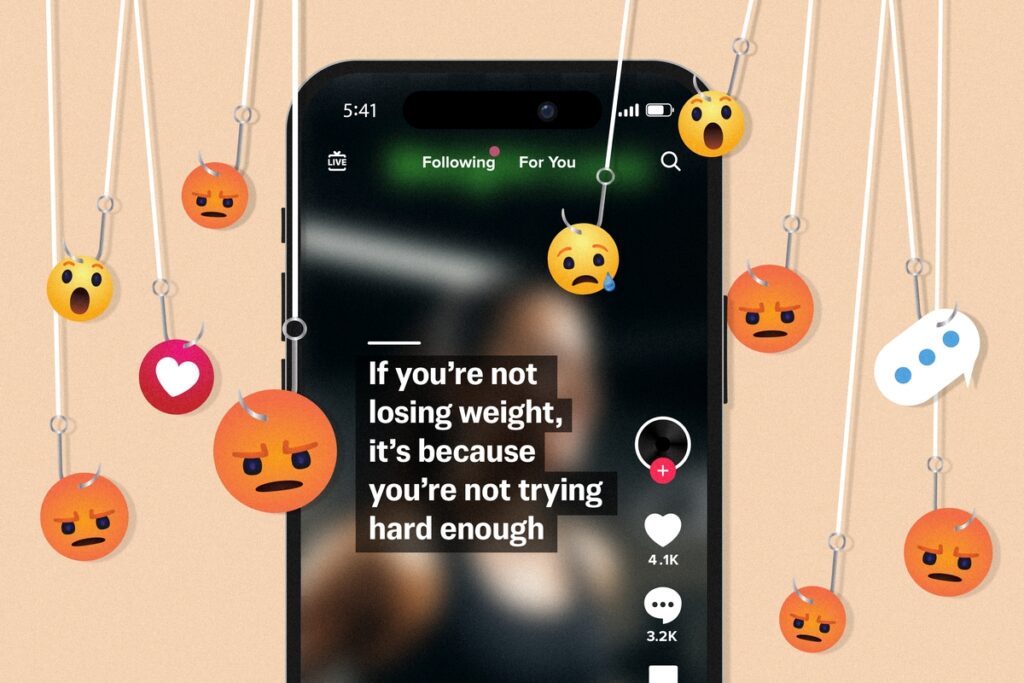
A recent video related to weight loss has sparked intense outrage among viewers on social media, stirring discussions and debates across various platforms.
The video, which contains a link to a weight loss application, attracted clicks from viewers, while others flocked to the comments section arguing and critiquing its content, further sharing the post with friends and family. However, what appeared to be a provocative social media post was, in reality, a meticulously crafted advertisement.
This outrage, which the video incited, was part of a marketing strategy designed to provoke responses.
Carmelo Zaffarana, the founder of Lucernel LLC, an independent software company that develops web platforms and mobile applications, explained, “Frankly, I have also used artificial intelligence to provoke anger.”
Zaffarana elaborated on the concept of “rage bait,” which involves leveraging AI to create content that appears to be genuine human expression while eliciting specific emotional reactions from viewers.
“For instance, imagine you have a dieting app or a calorie-tracking app. A rage-inducing video might state, ‘If you haven’t lost weight, it’s because you’re not trying hard enough,’ followed by a display of the user’s reaction. This prompts them to pick up their phone and open the app you are promoting,” he articulated. He further explained that the video often contains subtle advertising within its content.
“As a result, a plethora of angry comments surfaces below the video, which then gets shared among friends. Curious onlookers might inquire, ‘What’s the name of that app?’ This marks the beginning of the real conversion funnel,” Zaffarana added.
From his experience, he noted that typically, comments are posted either by the app’s creator or a secondary account asking for the app’s name.
“I don’t believe algorithms deliberately promote this kind of content… Its virality stems from the strong emotions it evokes; people repeatedly watch the video and share it with their peers,” he stated.
The phenomenon of artificially induced anger, often termed “rage bait,” has existed for years, but the emergence of artificial intelligence has exacerbated the issue, making it easier than ever for contentious speech to proliferate across social media and online platforms.
Interviews with experts in digital marketing, behavioral science, and rage baiting shed light on how provoking people online can yield economic benefits.
“The allure of anger lies in its ability to provoke comments and shares, which are engagement signals that push the video to a wider audience. The revenue doesn’t come from anger itself but rather from the clicks that it generates,” explained Saim Siddiqui, a faceless YouTube creator and content coach.
“Faceless” refers to content creators who never appear on camera. Siddiqui, however, witnesses the implications of AI-generated content up close on a daily basis.
Concerns are rising about the manipulation of user engagement across multiple social media platforms. Engagement can manifest in various forms, including comments, views, or clicks. Some individuals have expressed worry that this incentivized interaction is eroding the authenticity of user participation.
However, Siddiqui noted that creators exploit this very engagement type to monetize what he describes as “mostly boring content.”
According to Siddiqui, established monetization strategies include YouTube AdSense, creator revenue-sharing programs on platforms like X (formerly Twitter), Facebook, and TikTok, affiliate links in descriptions, and driving audiences to purchase paid courses or join premium communities.
He emphasized that online content creators don’t necessarily need to post an overwhelming number of posts to generate income. Yet, the greater the number of posts, the higher the likelihood that one will achieve significant interaction rates.
“You only need a few of the posts to go viral, and provocative topics are the easiest way to make content popular. Because of this, rage bait has evolved from a sporadic tactic into a scalable business model,” Siddiqui commented.
Sufyan Mughal, an AI expert from the UK-based fintech company One9Pay, has also noted that some creators have adopted this method to maximize engagement.
“The real profit comes from the immense interaction that angry content can inspire. Compared to neutral content, the comments and shares on anger-inducing content can be five to ten times greater. This means you’ll gain more exposure on the platform,” Mughal elaborated.
Leveraging emotionally charged online content to expand audience reach is not a new concept, but finding lucrative monetization routes through controversial posts remains an area under active investigation.
Dr. Kate Scott, an associate professor focusing on computer-mediated communication at Kingston University, wrote in a paper titled “From clickbait to rage bait: pragmatics and the monetisation of emotions on TikTok,” that on short video platforms like TikTok, increasing user engagement through likes, comments, shares, and saves directly translates to higher income for content creators.
Rage-inducing content is not confined to specific platforms or themes; it encompasses anything that significantly enhances post interaction. Last year, Facebook paid out nearly $3 billion to content creators, a 35% increase from the previous year, marking the highest annual payout ever recorded.
While it’s unclear how much of the controversial online content is intentionally designed to provoke anger, there is growing concern about the abundance of harmful material flooding social media.
A 2026 analysis by the Canadian Digital Media Research Network of 340 Facebook pages revealed that a coordinated team operating predominantly in Vietnam targeted users in Canada, the USA, and Europe via artificially generated false news, directing web traffic to fake news sites to earn advertising income.
Canadian digital media researchers noted, “The business model of social media platforms rewards the most attention-grabbing content, cementing a widely recognized medium of profit-driven content creation.”
Zaffarana explained that due to the proliferation of AI, measuring audience reactions to specific content is now easier than ever.
“With AI, it’s possible to mass-produce such videos, and the platforms can hardly discern whether this (angry) interaction is deliberately curated or spontaneously generated,” he said.
Social media platforms have indeed established policies to curb manipulative user engagement behaviors. Meta has issued warnings to accounts attempting to profit by manipulating interaction algorithms, indicating they might face reduced exposure and loss of monetization capabilities.
YouTube has categorized sensational or provocative content as potentially unsuitable for advertising placement, while X has explicitly classified engagement-incentivized content as non-compliant with monetization guidelines.
TikTok calls for creators to adhere to platform standards and content policies but hasn’t definitively banned posts designed to elicit emotional responses. Nonetheless, the platform prohibits the dissemination of false or misleading information that could lead to significant harm.
Zaffarana remarked that this creates a space for rage baiting: navigating the gray area. As it is hard to determine if contentious posts are purely profit-driven or merely provoking genuine emotional responses, much of this content often slips through the cracks.
Last year, the European non-profit organization AI Forensics published a report analyzing 354 TikTok accounts, raising concerns about the potential risks associated with AI-generated harmful content. The study pointed out that over 43,000 posts, primarily created by AI, garnered a staggering 4.5 billion views within just a month.
Moreover, AI Forensics observed a widespread tendency for the sexualized depiction of women, including minors. The organization also noted trends of anti-immigrant rhetoric, false news, and other explicit content.
Siddiqui, Mughal, and Zaffarana all concur that AI has facilitated the rapid creation of massive amounts of online content, and those individuals who provoke anger are undoubtedly capitalizing on this ability.
“With generative AI, the kind of content that used to take a whole team hours to complete can now be done in just minutes,” Mughal stated. “We can brainstorm dozens of different snarky content pieces and test them within minutes. The cost of content creation has plummeted while the output volume has surged, meaning the return on investment from anger-inducing content is significantly higher than ever before.”
Siddiqui echoed this sentiment.
“Now a single individual can produce dozens of videos weekly without spending much money. With such low costs of uploading, there’s no need for every video to perform well,” he remarked.
Behavioral scientist and author Gleb Tsipursky pointed out that the typical reaction people have to outrageous posts may inadvertently boost their profitability.
“Psychological factors are important. People often share content that they vehemently oppose in order to express dissatisfaction, effectively amplifying the impact of the original post,” Tsipursky explained.
He advocates that platforms should remain vigilant about “manipulative coordinated behavior and deceptive profit models while also leaving room for reasonable disagreements.”
Tsipursky believes that an outright ban on controversial viewpoints overlooks an essential distinction.
While acknowledging that AI does indeed lower the barrier to quickly create content, he maintained that the critical mechanism is “the interaction between low-cost content production methods and public response.”
“Generative AI allows people to produce and test provocative images, headlines, and posts at a speed faster than human creation, which lowers the costs associated with generating extreme emotions.”
For Mughal, he believes “recommendation algorithms still favor content that provokes anger.”
“Recommendation algorithms generate significant engagement, comments, and shares. I’ve seen accounts that have increased their follower count from mere thousands to hundreds of thousands within weeks, solely by posting controversial AI-generated video clips,” Mughal observed.
He noted that most platform algorithms tend to promote “any content that can spark debate in the comments section.”
However, Mughal cautioned those seeking to profit from online anger: immediate rewards may come at the expense of long-term profitability, creating a race to the bottom.
“Some are exploiting angry sentiment, inhibiting real dialogue. This erodes trust and leads people to believe that ongoing disputes will exist between creators and audiences,” Mughal warned.
Despite platforms improving in identifying what Mughal calls “blatant garbage,” he emphasized that uncovering contents that deliberately attempt to enhance user engagement remains challenging.
“It indeed seems to be a controversial issue; there are many gray areas in the current profit policies,” he observed.
Siddiqui concurred, stating, “This often leads to long-term harm for channels. When people click in and realize they’ve been deceived, they lose trust in the channel, and departing viewers are unlikely to make any purchases.”
For this reason, Siddiqui believes that the social media channels capable of sustainable growth are built upon useful, interesting, or meaningful content, rather than relying on artificially induced anger.
“When the information flow is inundated with manufactured outrage, audiences become increasingly cynical about everything they see, including authentic reporting and honest creators,” Siddiqui commented.
This evolving landscape of online engagement raises critical questions about the ethical responsibility of platforms and the creators navigating their increasingly controversial waters.