
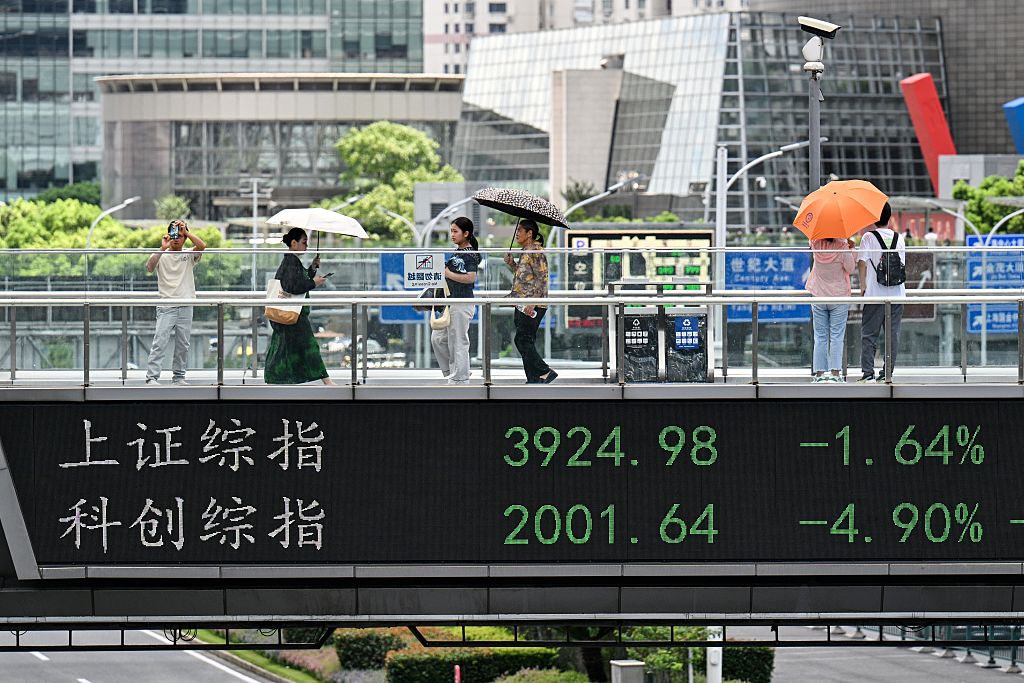
On November 20, the Chinese stock market experienced a significant downturn, with all three major indices witnessing declines. The Shenzhen Component Index and the ChiNext Index both fell by over 3%. In Shanghai, Shenzhen, and Beijing, more than 5,200 stocks closed lower, with 302 of them experiencing drops exceeding 9%.
The trading day saw the major indices open with a downward trend, with all three dipping over 2% at one point in the morning session. The Shanghai Composite Index closed at 3,533.79 points, reflecting a decline of approximately 1.2%. Meanwhile, the Shenzhen Component Index ended the day at 10,256.39 points, down by 3.09%. The ChiNext Index concluded at 2,212.13 points, sliding by 3.54%. The Beijng Stock Exchange’s BZ50 Index recorded an even steeper loss, down 4.85%.
According to statistics from Jiemian News, a total of 61 stocks across the market hit their daily price limits on the downside.
From November 16 to 20, the Shanghai Composite Index experienced a cumulative weekly decline of 2.77%, while the Shenzhen Component Index fell by 6.49%, and the ChiNext Index plummeted by 8.82%. The BZ50 Index suffered a more dramatic drop of 13.29% over the same week.
Specific sectors were particularly hard hit, including semiconductor, communication equipment, and photolithography stocks. Companies such as United Chemical and Zhangjiang Hi-Tech closed at their daily limits down, while Jiuri New Material saw a decrease of 16.88%. Chip packaging enterprise Tongfu Microelectronics and semiconductor testing equipment provider Junhaitong briefly reached their daily lower limits during trading.
The military and nonferrous metal sectors also faced declines. Hongdu Aviation closed at its daily limit down, while China Rare Earths dropped over 7%.
Game developer Caesar Culture and retail giant Guangbai Co. both faced three consecutive trading days of being locked down at their daily limits. Meanwhile, Qu Mei Home and mining equipment manufacturer Linzhou Heavy Machinery experienced consecutive downward limits over two trading days.
Investment fund manager Huang Junhao from Nufinsh expressed in an interview with International Financial News on November 20 that the day’s increased trading volume primarily reflected panic selling by some investors. He noted that there was still insufficient new capital entering the market, and no clear signs of a bottoming out were observed.
According to the Securities Times, by November 19, the financing balance for ChiNext stocks had fallen for six consecutive trading days, accumulating a reduction of approximately 24.1 billion yuan. This balance refers to the amount of money investors have borrowed from brokerages to purchase stocks, which remains unpaid.
Fund manager Xia Fengguang from Runzhi Investment also commented to International Financial News that the willingness of investors to actively buy has weakened, creating significant selling pressure on funds tracking small and medium-cap stocks. This downward trend has expanded from the ChiNext and Sci-Tech Innovation Board to impact a larger segment of smaller market capitalization stocks.