
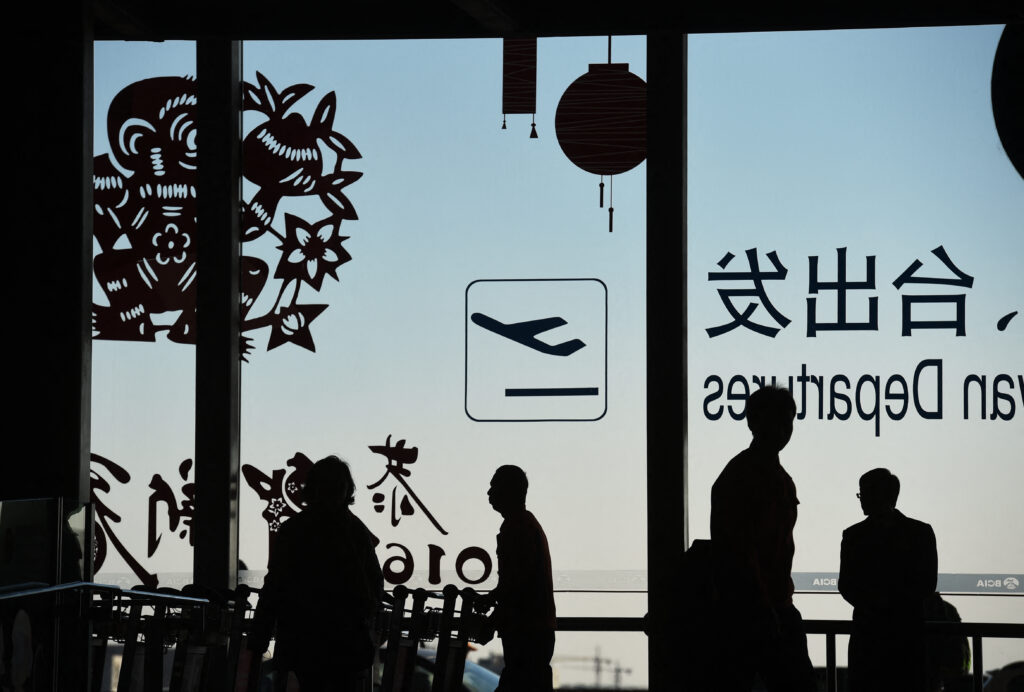
In China, over 70% of transport airports experience annual passenger traffic of less than two million. Some airports reported zero travelers in the first ten months of this year yet continue to receive government subsidies for operations. Numerous interviewees attribute the situation to superficial reasons such as the diversion of passengers to high-speed rail systems and a downturn in the economy. However, they argue that the root cause lies in the blind construction of airports by local governments seeking political achievements, coupled with a lack of accountability mechanisms in decision-making. This has led to a trend of building airports that can be constructed but are unsustainable and cannot be easily closed down, thus exacerbating the risk of corruption in engineering projects.
According to reports from “First Financial,” several smaller airports recorded no scheduled passenger flights in the first ten months of this year. Some airports serviced fewer than ten passengers per day on average, while others, which once had annual traffic exceeding one million passengers, have seen their numbers dwindle to just a few tens of thousands.
Data from DAST, a flight management platform, indicates that from January to October 2026, both Chongqing’s Fairy Mountain Airport and Yunnan’s Lijiang Luguhu Airport registered zero passenger flights and throughput. Meanwhile, Hubei’s Shennongjia Hongping Airport executed only 58 flights during the same period, transporting just 2,594 passengers, averaging fewer than nine passengers per day. Similarly, Sichuan’s Jiuzhai Huanglong Airport saw its passenger throughput drop to fewer than 20,000, a decrease of 35.8% compared to previous numbers.
A budget for subsidies for medium and small airports announced by the Civil Aviation Administration reveals substantial financial support for these struggling airports. For 2026, Fairy Mountain Airport is expected to receive 8.58 million yuan, Lijiang Luguhu Airport 9.87 million yuan, and Shennongjia Hongping Airport 5.88 million yuan. Jiuzhai Huanglong Airport’s subsidy budget surpasses 100 million yuan.
According to the Civil Aviation Administration’s published stats for the National Civil Transport Airports Production Report for 2025, as of the end of that year, China had 270 certified transport airports. Among these, 191 airports had annual passenger throughputs of under two million, representing 71% of all airports in the country.
Notably, the 191 airports combined accounted for just 6% of the national passenger throughput. However, they received a staggering 2.584 billion yuan in government subsidies in 2026, showcasing a trend of year-on-year growth.
Wang He, an expert on Chinese issues, indicated in an interview that “small and medium-sized airports in China are generally operating at a loss, influenced by diversion to high-speed railways and local economic decline, but more critically, due to the overwhelming rush for airport construction led by local governments and policy errors at the systemic level.”
Wang asserts that the current planning of new airports reveals a significant slowdown in infrastructure expansion. He noted that the “14th Five-Year Plan” emphasizes “moderate advancement, not excessive advancement,” which can be seen as an attempt to correct earlier overzealous airport construction policies. However, authorities are reluctant to openly acknowledge past decision-making errors.
Over the years since the major expansion of medium and small airports began in 2004, particularly accelerating under Xi Jinping’s leadership, the pace of construction has greatly changed. When compared to the significant expansions of the previous decade, the new five-year plan significantly reduces the scale of airport construction.
Wu Shaoping, head of an international human rights lawyers’ alliance, stated, “In recent years, China’s economy has evidently declined, with employment and consumer markets weakening. The number of people who can afford to travel is dwindling. For the average citizen, flying remains a relatively expensive means of transportation. Given the generally low income levels, the public’s capability to bear the high costs of air travel is quite limited.”
He highlighted that some airports continue to require financial input to sustain operations even amid near-zero passenger traffic. With reduced government revenue and heightened local debt pressures, the sustainability of these subsidies remains in question.
Investment projects that lack passenger support have become a long-term burden on local finances. Chongqing’s Fairy Mountain Airport serves as a prime example. Established under the banner of a “poverty alleviation airport,” this project had a total investment of 1.679 billion yuan, financed jointly by central government, civil aviation, and the Chongqing municipal treasury. The feasibility report anticipated an annual passenger capacity of 600,000, yet the passenger count has been zero during the first ten months of this year.
Senior figures within the mainland capital sector, such as Xu Zhen, analyze these types of airports as “knee-jerk projects.” Once built, these airports still require ongoing investment for operation and maintenance, making them difficult to shut down despite insufficient passenger flow, leading to the problematic situation of “able to build, unable to sustain, and impossible to close.” They have thus become a financial burden.
Xu noted, “Amid pressures on local finances and tight public service funding, the crucial question is who bears the costs of construction and ongoing operational expenditure for such projects that lack actual demand.”
The challenges of airport construction are not isolated; the high-speed rail sector faces similar obstacles. As local financial pressures escalate, the model of relying on massive infrastructure investments to drive economic growth is beginning to expose concerns regarding operational efficacy.
The Wall Street Journal previously reported that Xi Jinping inherited “an ambitious plan” on his first day in power: to build a high-speed rail network stretching 16,000 kilometers connecting major cities across China. High-speed trains were named “Fuxing.” By 2024, the length of China’s high-speed rail exceeded 48,000 kilometers, making it a unique global network.
This mammoth engineering project has incurred unimaginable costs. Over the past five years alone, more than $500 billion has been spent on building new railways, trains, and stations, with operational maintenance requiring $25 billion annually. Due to low operational efficiency, many high-speed rail lines find themselves in states of loss or severe deficit.
Regarding the phenomenon of insufficient passenger traffic and operational difficulties for certain high-speed rail routes, Wang He argues that the reasons align with those plaguing the airports: local governments pursuing political turnovers blindly, as well as a lack of effective accountability mechanisms.
He posits that a long-term dependency on infrastructure investments to stimulate economic growth, whilst overlooking actual demand, costs, and operational efficiencies, could ultimately result in numerous projects becoming long-term fiscal burdens for local administrations. The issues highlighted by airports and high-speed rail unveil systemic flaws inherent to China’s local investment model.
Wu Shaoping underscored that major engineering projects may serve as opportunities for officials to seek personal gains, with potential issues arising across bidding, approval, construction, and additional funding phases. Contracting based on connections, as well as manipulating project procurement, further intensifies financial resource wastage.
He emphasized that within the framework of the Chinese Communist Party, accountability often proves challenging to enforce. Once leaders approve a project, unless there is a significant political shift, the responsible parties are rarely held accountable for their decisions.