
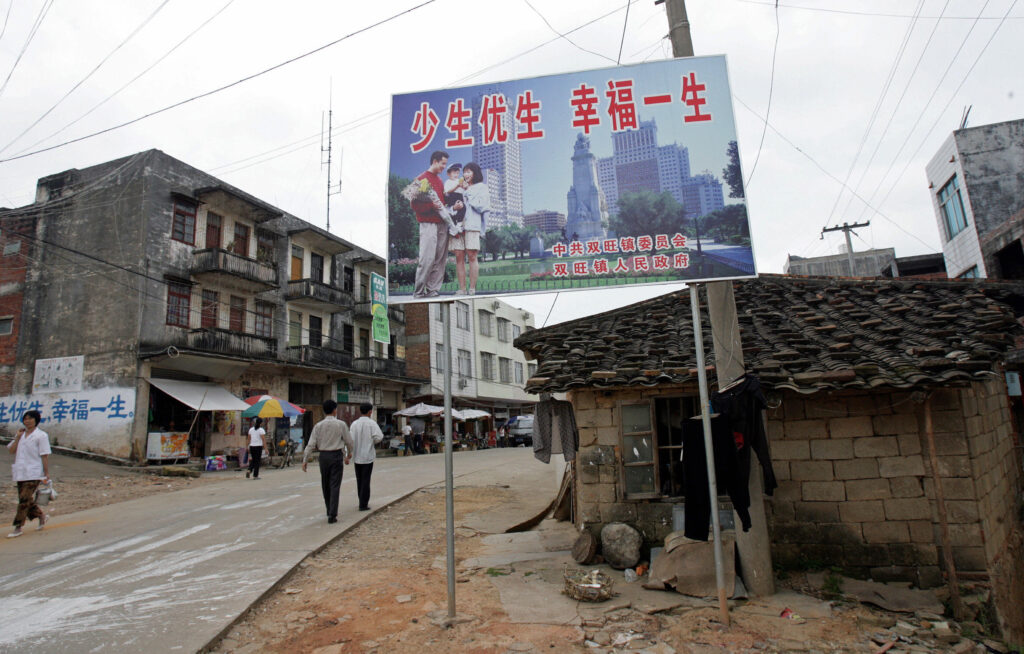
In 1998, a woman from Qingdao City, Shandong Province, began her career in grassroots family planning work after being invited by the local population control head, largely due to a lack of caretakers for her child. Now, 28 years later, she remains in her position. However, as China’s population crisis intensifies, her work in family planning has shifted towards promoting childbirth, but she has not received a salary for three consecutive years. Her experience sheds light not only on the challenges faced by grassroots family planning staff regarding pay but also highlights the broader issues surrounding China’s demographic policies, which have shifted from restricting births to encouraging them, leaving many at the grassroots level feeling lost.
Since the 1980s, the Chinese Communist Party (CCP) has aggressively implemented family planning policies, employing measures such as fines for having too many children, forced abortions, and sterilizations to control the population. Official figures from the CCP claimed that these policies prevented over 400 million births in China.
Following three years of strict COVID-19 lockdowns, the trend of population decline in China has further worsened. Economic downturns, employment difficulties, and soaring costs of raising children have led to a significant reduction in the willingness of young people to marry and have children.
In response to the population crisis, the CCP transitioned from limiting births to actively encouraging them. In 2015, the government fully relaxed the two-child policy, followed by a complete rollout of the three-child policy in 2021. They have also introduced various measures such as childbearing subsidies, extended maternity leave, and housing support, albeit with limited effectiveness.
Amid this backdrop, a grassroots family planning worker, Zhang Lan (a pseudonym), from Chengyang District in Qingdao, recently shared her experiences of not receiving her salary for three consecutive years.
Zhang Lan has worked in grassroots family planning since 1998 and shared, “As of this year, I have worked for 28 years, but I haven’t received any salary in the past three years.” Based on her calculations, she estimates that the total amount of unpaid wages over these three years is about 180,000 yuan.
She explained that in the past, her village sometimes paid part of the salary, ranging from a couple of thousand to a maximum of 30,000 yuan a year. The unpaid portion was recorded by the village accountant at the street management office and would be paid once the village had the funds.
However, starting in 2024, the situation further deteriorated, with no wages being paid at all for three consecutive years. Zhang mentioned that she had previously lodged complaints about her unpaid salary, but the village secretary responded over the phone that there would be some pay at the end of the year, citing the lack of economic income.
“We also need to eat, right? When there are family issues, and I ask the village for a salary, they say there’s no money.” She emphasized that she was not absent from work or had resigned but had been fulfilling her responsibilities without receiving the compensation she deserved.
Zhang explained that the salaries of grassroots family planning workers were historically managed by a three-tier system involving the district, street, and village. The payments were significantly affected by the collective economic income of the respective village.
In her mountainous village, which includes over thirty villages, each usually has one family planning worker. These workers are specialized personnel dedicated to family planning tasks at the grassroots level, typically at the village or community level.
“In wealthy villages, they can afford to pay more salary; in poorer mountain villages, it’s less. If there’s money, they pay, and if there’s not, they don’t.”
Zhang further revealed that the salary for family planning workers was originally calculated based on the payment standards for village committee personnel. For instance, if the village party secretary earns 60,000 yuan a year, the family planning worker would ideally receive about 48,000 yuan at an 80% rate. However, the actual payment varies greatly depending on the economic situation of the village each year.
“For example, if I should have received 50,000 yuan but only got 10,000, the remaining 40,000 is noted at the street management office. Whenever the village has money, then they can give it to us.” She clarified that this note is not done privately but is officially recorded and acknowledged by street leaders.
Zhang also mentioned that the village accountant once told her that the outstanding wages belong to the collective village economy, which should be paid out even if the worker is no longer present; their children could inherit this amount.
However, she has not received any formal written explanation about the legal status of these recorded wages, the processes for confirming unpaid wages, or the responsibilities for their eventual payment.
Zhang believes that while the wages are recorded, the timeline for actual payment is nonexistent. The assertion of “payment whenever there’s money” effectively makes grassroots workers bear the brunt of the village’s insufficient economic revenue for long periods.
In addition to being unpaid for three consecutive years, Zhang faces issues relating to labor relations and social security. She clarified that her employment was not self-directed; she was recruited by the street family planning head, and a formal employment letter from the street was issued, officially appointing her as the family planning director of her village.
In 2021, during a leadership change, she remained in her position and was issued a new employment letter covering the period from 2021 to 2026, complete with the street’s official seal. “All of us professional family planning workers have official employment letters issued by the street. We all have contracts.”
Zhang works out of the village committee office, equipped with her own workspace, a computer, as well as complete office amenities. However, she pointed out that she has not signed a labor contract with the village and lacks formal registration.
After filing complaints with relevant county departments, investigators did not inquire about the specific years of unpaid wages or the amounts owed; instead, they primarily asked if she had signed any contracts with the village. “I said I am the family planning director at the village level; we haven’t signed contracts with the village.”
From her standpoint, since the street has the authority to recruit, issue employment letters, and assign specific duties, there should be clear management and accountability regarding salary payments. It should not be acceptable for authorities to sidestep the issue of unpaid wages simply due to the lack of a contract when payment troubles arise.
Adding to her concerns is the fact that grassroots workers lack essential employee benefits, such as pension and medical insurance. “We don’t receive the five insurances and one fund; the village doesn’t provide us with pensions or medical insurance; we have to pay for them ourselves.” She noted this situation applies not only to family planning staff but also to members of the village committee, who also do not have unified insurance coverage provided by the village.
Zhang reflected on her journey, recalling that she married in 1998 and began her family planning work that September. At that time, she had no one to care for her child and could not seek employment elsewhere. The street’s family planning head approached her, inviting her to take on this role.
“I had no work at that time, my family had no money, and I couldn’t look for a job without someone to help with the baby. So, when the local family planning head came looking for someone, I agreed to this job.” Initially, she did not have many demands; she simply wanted a job close to home, which would allow her to manage her responsibilities.
After a change in local leadership in 2003, her salary changed to 300 yuan per month, paid quarterly until 2009. Subsequently, payments began to be issued annually, but the amounts were irregular, typically totaling only a few thousand yuan.
Over the past 28 years, her responsibilities extended far beyond simple birth registration.
During periods of stricter population control and family planning management, she had to gather statistics on women of childbearing age, marriage statuses, pregnancy and birth rates, and mortality data. Additionally, she was responsible for prenatal visits, postnatal visits, distributing contraceptive supplies, registering the floating population, and maintaining relevant archives.
She reminisced that during those years, grassroots family planning tasks were varied and exhaustive, with documentation and materials piling up. She was also responsible for reproductive health services, women’s health check-ups, family planning policy promotion, and related training. Every year, she attended professional training sessions covering reproductive health, child-rearing knowledge, and more.
With the implementation of the two-child policy in 2016 and the subsequent three-child policy in 2021, the focus of grassroots family planning work gradually shifted. Zhang noted that her current responsibilities include providing services to pregnant women, promoting reproductive and health knowledge, and organizing screenings for breast and cervical cancers.
She also utilizes WeChat groups to disseminate information about reproductive policies and health knowledge, instructing new mothers on postnatal care, infant feeding, and contraceptive methods. Having worked in the village for many years, she maintains good relations with villagers. “You have to engage with everyone, be polite, and ensure follow-up services are well carried out. I provide them with detailed knowledge about childbirth.”
Zhang had also served as a women’s director and handled pension insurance matters. Since she was the only female worker in the village skilled in computer use, much of the administrative and operational labor fell upon her shoulders.
Despite her efforts to resolve these ongoing issues, including multiple years of salary delays, Zhang expressed dissatisfaction with the outcomes of her appeals to relevant authorities. She recalled that after her complaints reached the county, investigators did not thoroughly examine her salary payment records from previous years nor did they verify the actual amounts owed versus what had been paid. “The county didn’t investigate my unpaid wages or inquire about how much I should have been paid in any given year.”
In her view, if investigative departments genuinely aimed to address salary issues, they should first cross-reference employment letters, salary standards, village financial records, and the documentation held at the street management office, rather than focusing solely on whether a contract exists.
Furthermore, she noted that collective rights protection among grassroots workers is challenging. “Collective rights protection involves everyone’s interests, and many individuals are hesitant to step forward. Farmers generally do not complain unless it’s a significant issue.” She believes that although many are unhappy with salary disbursements, they fear that voicing their concerns will lead to unresolved issues or conflicts with village officials or street personnel.
Zhang expressed her reluctance to engage in the village committee elections or political matters in general, stating that while she does see issues in grassroots management, “They (the village officials) are corrupt, and the discipline committee investigates them. For me, I am just a family planning director; I do not want to complain about their problems.” She conveyed disappointment with the integrity of grassroots governance and lamented the lack of honest officials focused on serving the residents.
The prolonged absence of salary has led Zhang Lan to reevaluate her choices over the past 28 years. She commented that her decision to remain in rural work was primarily motivated by the desire to care for her children and family. At that time, she valued the proximity of a job that allowed her to manage child transport, cooking, and housework without considering the long-term ramifications of lacking social security.
Now in her 50s and approaching retirement age, the opportunities to seek new employment are limited. Her son often complains about her choices, saying, “He frequently mentions that after raising him, I should have found a job with a salary and benefits rather than free labor in the village for a whole year.”
While her family does have jobs, managing household expenses remains a challenge. They must independently pay for pension and medical insurance, with rural pension contributions costing around 500 to 600 yuan monthly, compared to over 1,000 yuan for urban employees. In addition, they need to care for elderly family members, expenses related to her son’s marriage, and regular social obligations further heighten financial pressures. “With prices so high, can you imagine being unpaid? We still need to eat; we have elderly people to take care of, and there are marriage expenses for our children, and everything costs money.”
Zhang emphasized that her desire to continue working is rooted in hope for basic salary security in return for her years of effort. “Without a salary, where is the motivation to work?”
Many villagers in Zhang’s community rely on grape cultivation and the fruit industry for income, yet the village committee lacks independent economic revenue, which hinders the proper payment of staff salaries. Zhang asserted that the economic difficulties faced by the village should not become an excuse for long-term delays in staff salaries, especially given the continuous years of unpaid wages; there should be clear solutions in place.
Looking toward the future, Zhang shared that she has few other plans, merely hoping to finally receive her due wages.
From 1998 to 2026, after 28 years in grassroots work, Zhang Lan is left facing three consecutive years without a salary, no formal labor contract, and no social security. Her experiences in family planning reflect the drastic changes in China’s population policies, shifting from birth control to encouragement of childbirth.
The CCP’s three years of strict pandemic policies have dramatically impacted the economy, employment, and family income expectations. Coupled with demographic challenges stemming from long-standing family planning policies, younger generations’ willingness to marry and have children continues to decline, further exacerbating the trend of population shrinkage in China.
According to official data, in 2022, China’s birth rate fell to 9.56 million, marking the first time it dropped below 10 million, with a total population decline of 850,000—signifying the first negative growth since 1961. In 2023, the population decreased by 2.08 million, with another decline of 1.39 million expected in 2024. Zhang has not received any salary for three consecutive years starting from 2024.
Recent reports indicate that 27 provinces have published data on their resident populations for 2025, with 20 of them experiencing negative growth. Provinces such as Hunan, Sichuan, and Anhui reported decreases of 470,000, 460,000, and 410,000 residents respectively, while Shandong Province, where Zhang resides, saw a reduction of 372,000 people.
With China’s population policies transitioning from previous “birth control” strategies to current “birth encouragement” initiatives, a vast grassroots governance network, originally aimed at controlling population numbers, is undergoing significant functional restructuring.
Former family planning staff and community personnel, who once enforced policies and collected fines for exceeding birth limits, now find themselves on the frontline of promoting childbirth.
Reports from multiple sources indicate that community workers are actively reaching out via phone calls and home visits, inquiring into the pregnancy plans and even menstrual cycles of married women of childbearing age within their jurisdiction. This traditional monitoring approach has sparked debates on social media, drawing criticism from younger individuals who deem it intrusive, with some women expressing discomfort regarding their privacy.
However, unlike their previous authority to enforce rules, today’s promotion of childbirth lacks coercive power, often leaving grassroots workers in awkward positions as they face abrupt hang-ups or cold reactions from residents when carrying out task-related assessments.
Continued economic decline in China is steadily diminishing people’s willingness to marry and have children. Data from the Ministry of Civil Affairs shows that in 2022, there were only 6.833 million registered marriages across the country, the lowest since 1986. The average age for first marriages rose to 28.67 in 2020, which is 3.78 years later than in 2010. Factors like housing prices, education, healthcare, and job pressures, along with worries over future income and social security, have become crucial deterrents for young people delaying marriage and parenthood, or opting to forgo them entirely.
A recent commentary noted that the population crisis in China is not merely a reduction in birth rates but also related to the long-term control of reproductive rights by the CCP and past policy implications, compounded with the current economic predicament. The government’s shift from strict birth limitations to encouraging childbirth reflects a drastic policy transformation.