
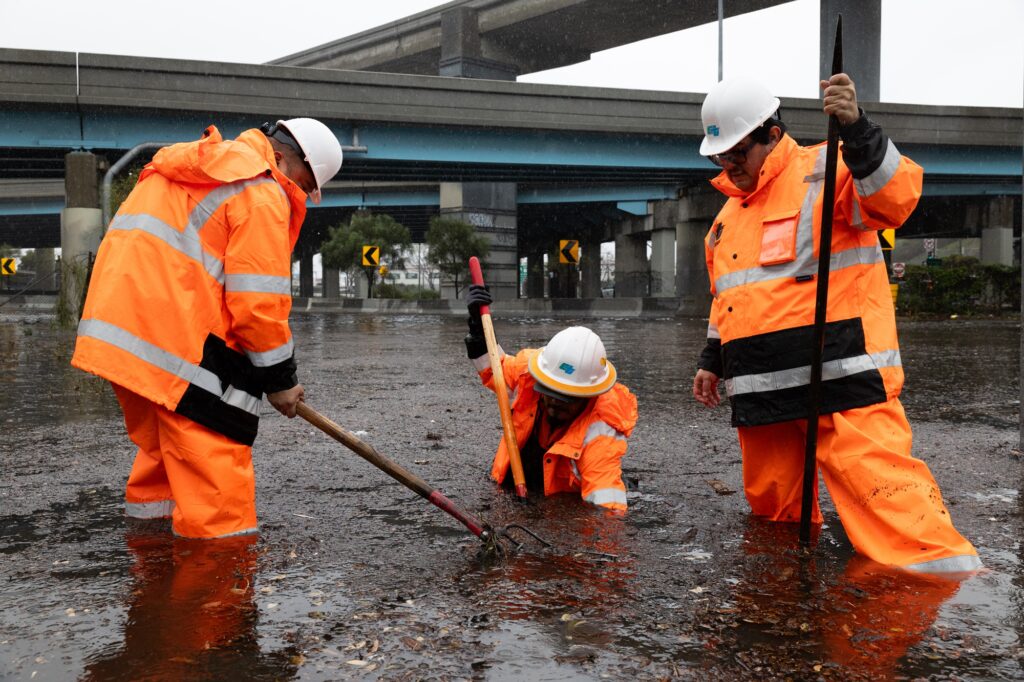
A powerful storm, classified as an “Atmospheric River,” is sweeping across California this week, bringing with it a wide range of severe weather conditions including heavy rainfall, coastal waves, flood risks, and significant snowfall in higher elevations. The National Weather Service (NWS) has issued flood warnings for multiple regions stretching from the San Francisco Bay Area to Southern California.
In the San Francisco Bay Area and Northern California, most locations are under flood alerts, with accumulated rainfall expected to reach between 3 to 5 inches throughout the week. The areas predicted to experience the most intense rainfall are located to the northeast of San Francisco, extending from Santa Rosa through Chico and Redding, and further into California’s Central Valley.
As the heavy rains coincide with high tides and colossal waves ranging from 10 to 15 feet, there is a substantial threat of tidal flooding and seawater inundation, particularly in low-lying areas of San Francisco and along the coast.
Meanwhile, Southern California, including urban centers like Los Angeles and San Diego, is facing a level two flood risk on a scale of four. Local rainfall estimates range from 1 to 3 inches, with some mountainous regions anticipating 3 to 5 inches. The most intense rainfall is expected during the night on Wednesday and into Thursday morning. Coastal areas must also be vigilant against damage from giant waves and beach erosion.
High elevation regions and areas affected by past wildfires are experiencing winter storm warnings due to anticipated heavy snowfall. Areas above elevations of 5,000 to 6,000 feet in the Sierra Nevada mountains are expected to receive 1 to 2 feet of snow or more, creating hazardous driving conditions on mountain roads and passes. Regions that have recently faced wildfires, such as Big Sur, Napa Valley, and Santa Barbara, are particularly susceptible to flash floods and mudslides due to compromised soil absorption capabilities.
An “Atmospheric River” refers to a narrow corridor of concentrated moisture in the atmosphere, typically moving from the tropical Pacific—often influenced by El Niño conditions—towards the northeast. When this moisture encounters the topography of California’s coastal mountain ranges and the Sierra Nevada, it is lifted and transformed into torrential downpours and heavy snowfall.
As this storm unfolds, residents are encouraged to stay updated on weather forecasts and to take necessary precautions against the potential hazards associated with this extreme weather event.