
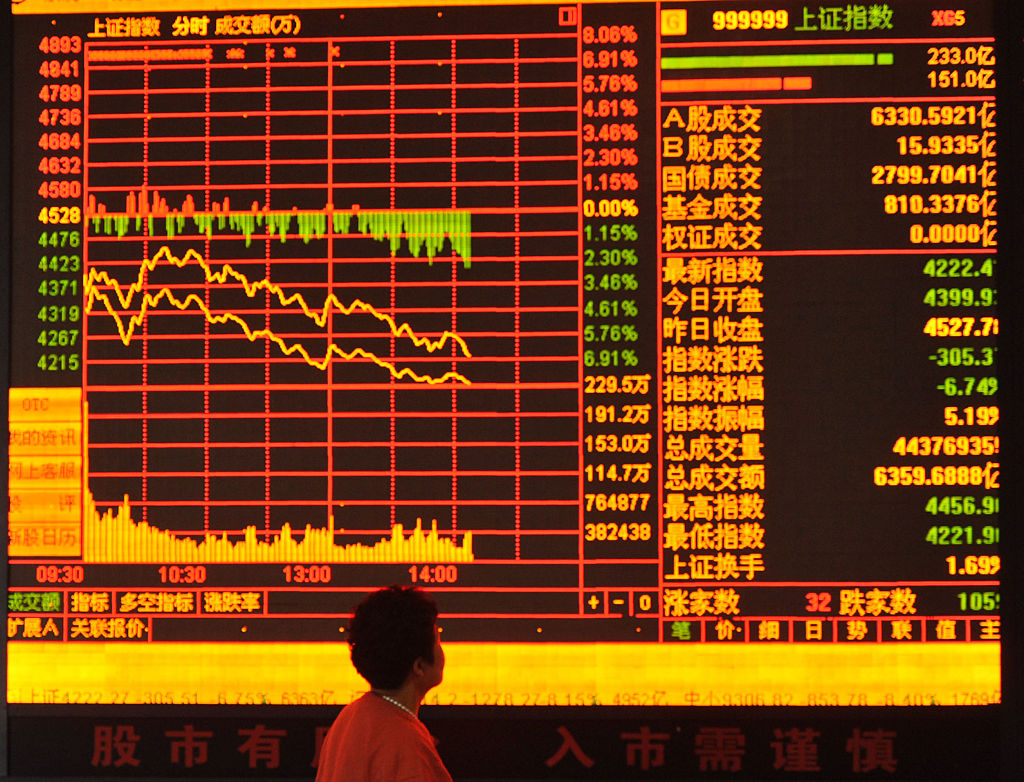
Recently, the decline of China’s A-shares has been persistent, with technology stocks emerging as the most heavily impacted sector. On November 16, all three major A-share indices closed lower, with the ChiNext index plummeting by 4.37% and the STAR 50 index dropping over 5%. In total, more than 4,300 individual stocks in the market experienced declines, with 68 stocks hitting the daily limit down. Sectors such as AI computing power, optical communications, semiconductors, and printed circuit boards (PCBs) faced concentrated sell-offs.
As technology stocks continued to spiral downward sharply, numerous investors took to social media to share their experiences of margin calls and forced liquidations. Some reported complete financial ruin, while others noted that despite repeatedly injecting additional margin, they were still unable to avert forced liquidation. The phrase “technology stocks facing a wave of limit downs, many investors experiencing liquidations” rapidly became a trending topic on Weibo. This turmoil was transpired against the backdrop of the sudden resignation of NVIDIA’s founder, Jensen Huang, as the company’s CEO, which further intensified market concerns regarding the future of the AI industry and subjected previously high-flying AI concept stocks to greater selling pressure.
By the market’s close on November 16, the Shanghai Composite Index had declined by 0.87% to 3,602.57 points, the Shenzhen Component Index fell by 2.53% to 10,690.78 points, the ChiNext index had dropped by 4.37% to 2,320.02 points, and the STAR 50 index was down 5.16% to 1,213.68 points. The total trading volume on both exchanges reached 1.48 trillion yuan (RMB). Throughout the Shanghai and Shenzhen markets, 4,019 individual stocks saw declines.
In terms of sector performance, components, CPOs, semiconductors, electronic chemicals, and storage chips recorded the most substantial losses. Notably, the components sector suffered heavy hits, with companies like Huadian Co., Hengtong Technology, Shenzhen South Electronics, and Shengyi Technology touching their daily limit down. Companies in the CPO sector also experienced notable declines, with over 30 stocks, including Zhongji Xuchuang, Tianfu Communication, and Shijia Photonics, dropping more than 10% on that day. The semiconductor sector exhibited weakness as well, with companies like Suiruan Technology, Moir Line, and Liyang Chip among those leading the losses.
An article from a financial news outlet described the situation in A-shares as one where “any stock connected to technology is plummeting,” with investors lamenting in various chat platforms. The light module, PCB, and semiconductor segments were identified as areas particularly hard hit.
On social media platforms, many investors shared personal accounts of their margin call experiences. Some stated that they had lost everything, while others mentioned that despite adding more collateral, they still faced liquidation. There were also warnings from fellow investors advising against rushing to buy the dip, highlighting that the speed of declines was too rapid, resulting in significant leverage-related liquidations.
This wave of selling did not begin on November 16. The previous trading day, November 13, saw all three major A-share indices also decline. The Shanghai Composite Index closed at 3,634.35 points, down 0.59%; the Shenzhen Component Index decreased by 2.05%, and the ChiNext Index fell by 3.32%, with the STAR 50 Index retreating by 2.30%.
On that day, over 4,700 stocks on the Shanghai and Shenzhen exchanges fell, with 34 stocks hitting their daily limit down. The sectors experiencing concentrated selling included AI computing power, semiconductors, and communication equipment, with technology stocks showing especially pronounced declines.
The communications sector dropped nearly 5%, while the electronics sector fell 3.75%, with components and communication equipment among the hardest-hit sectors. Notable stocks such as Shengyi Technology, Huadian Co., and Shenzhen South Electronics hit their daily limit down, while leaders in the AI optical communications industry chain, such as Zhongji Xuchuang, Xinyi Sheng, and Tianfu Communication, also saw significant declines.
On that particular day, Tianfu Communication fell approximately 10.94%, Zhongji Xuchuang declined about 8.39%, and Xinyi Sheng was down roughly 8.76%. All these firms are key players in the AI data center and high-speed optical communication industry chain.
This sell-off in technology stocks is closely linked to the news of Jensen Huang’s unexpected resignation.
On November 12, NVIDIA announced Huang’s resignation from his positions as President, CEO, and Board member, effective immediately. The company’s Chief Financial Officer, Colette Kress, has been appointed as the interim CEO.
Huang led NVIDIA for 33 years, making him one of the most influential figures in the development of the global AI industry. Under his leadership, NVIDIA became not just the core supplier in the global AI chip market, but also established a vast technological ecosystem encompassing GPUs, software, and data centers.
Following the announcement, NVIDIA’s stock price plummeted by over 14% at the opening of U.S. markets but ultimately closed down by 4.34%. The market expressed concerns over the abrupt leadership change and questioned whether the company’s future technological and business strategies could maintain continuity.
Since many Chinese AI computing and electronic manufacturing companies are connected within NVIDIA’s supply chain, the news quickly rippled through to the A-share market. Companies involved in optical modules, PCB production, and electronic components, as well as server supply chains faced significant impact.
Prior to Huang’s resignation, A-share technology stocks had already started to show signs of retraction.
Analysis from a financial publication on November 13 indicated that in the trading days leading up to that week, the tech sector had exhibited clear rebounds, but the subsequent two trading days saw sharp sell-offs in the afternoon sessions. Following Huang’s resignation announcement, the market shifted from previously anticipated trading patterns to a revaluation of the event itself, further exacerbating the sell-off of computing hardware and components within the AI industry chain.
It is notable that prior to the announcement, AI concept stocks had experienced a significant uptrend, and some companies had accumulated substantial gains.
In addition to Huang’s departure, investors also began reassessing the investment outlook for the global AI sector. In recent years, tech giants have poured significant capital into building AI data centers, fueling demand for GPUs, high-speed optical modules, servers, and semiconductor equipment dramatically. However, whether these investments can continuously translate into corporate revenue and profit remains a pressing concern for the market.
As the valuations of AI industry stocks rely on sustained high growth expectations, once the market starts doubting whether investment returns can meet expectations, related stocks may face valuation corrections. In this context, the event of Huang’s resignation has magnified investor anxieties.
When the market experiences continuous declines and individual stocks hit their daily limits down, the risks for leveraged investors are further amplified.