
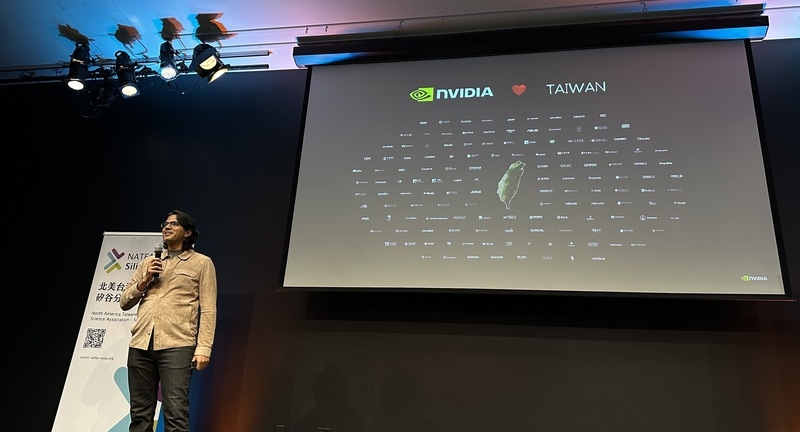
The U.S.-Taiwan High-Tech Forum, organized by the National Science Council of the Executive Yuan of the Republic of China in collaboration with the North America Taiwanese Engineers Association – Silicon Valley (NATEA-SV), recently took place in Silicon Valley. The forum featured Deepu Talla, the Vice President of Robotics at NVIDIA, as the keynote speaker. During his address, Talla elaborated on the future prospects of robotics technology, continuing the discussion on artificial intelligence (AI) initiated by NVIDIA’s founder, Jensen Huang. He emphasized NVIDIA’s affection for Taiwan and reaffirmed its critical role within the NVIDIA supply chain.
Held on November 14 at the Computer History Museum in Silicon Valley, the forum focused on topics such as AI agents, robotics, and sovereign AI. Talla’s participation showcased his insights drawn from NVIDIA’s overarching AI development strategy. He presented a comprehensive overview of computational infrastructure and model ecosystems, transitioning to how agent-based AI could accelerate robotics development alongside the progress and challenges of scaling Physical AI for commercial applications.
In his speech, Talla reiterated the framework proposed by Huang regarding the AI industry’s structure and technological ecosystem, which includes the concept of the “AI five-layer cake.” This framework encompasses essential elements from energy and chips to infrastructure, models, and applications.
Throughout his presentation, Talla made numerous references to Taiwan, underscoring its indispensable role in NVIDIA’s supply chain. He showcased a presentation slide stating “NVIDIA Loves Taiwan,” reflecting the longstanding and robust collaborative relationship between NVIDIA and Taiwan.
As he concluded his remarks, Talla once again expressed, “NVIDIA loves Taiwan,” receiving enthusiastic applause from the attendees, which consisted of professionals from the tech industry.
Wesley Chu, the Executive Director of the Taiwan Center for Technology Innovation at Stanford University, emphasized in an interview that Taiwan’s hardware demand remains strong. He advocated for the necessity of leveraging Taiwan’s existing strengths while actively expanding into global markets, particularly the U.S. market.
Xu Zengru, the head of the technology division at the Taipei Economic and Cultural Office in San Francisco, pointed out that the technological cooperation and exchanges between Taiwan and the United States are particularly close. He expressed confidence that no matter how geopolitical situations or industry dynamics evolve, the strong ties within the Taiwan-U.S. technology sector would remain unchanged.
Bill Chung, the organizer of the NATEA U.S.-Taiwan High-Tech Forum, remarked that recent developments have sparked a broader discussion about corporate operating models. He noted that the role of founders in the growth of companies and how firms can maintain long-term growth amid changes in leadership would be potential topics for future forums.
This event not only highlighted the advancements and collaborative efforts in the tech industry but also reinforced Taiwan’s strategic significance in the global technology landscape. As the relationship between Taiwan and the U.S. deepens, such forums will play an essential role in fostering dialogue and innovation in the high-tech sector.