
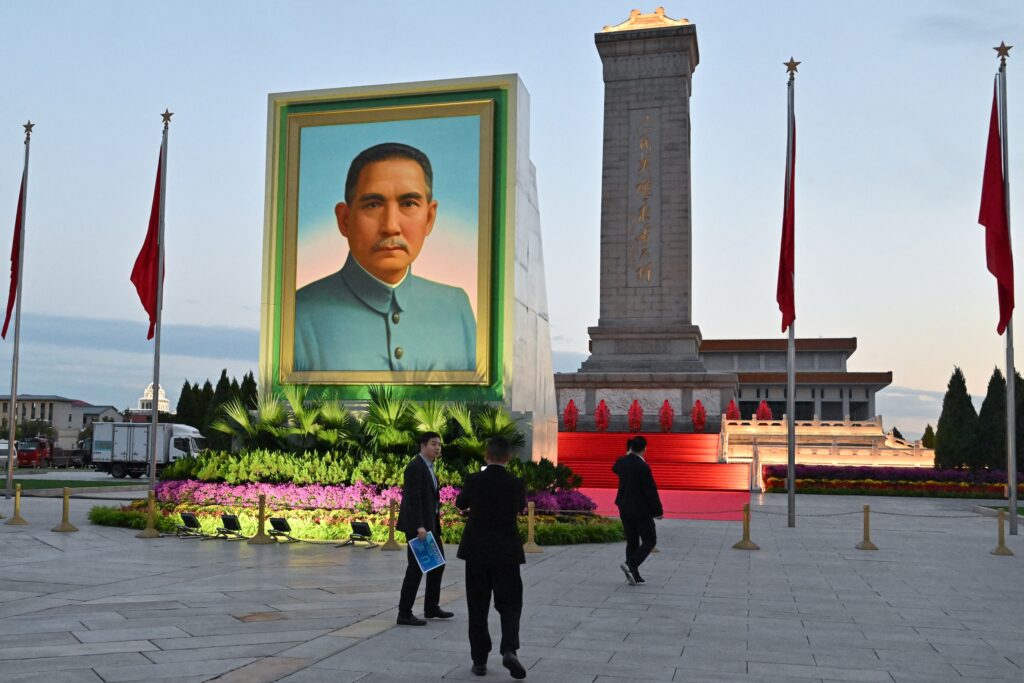
On November 12, 2026, Taiwan commemorated the 160th anniversary of the birth of Sun Yat-sen. In this context, Chinese Communist Party leader Xi Jinping delivered a speech that largely concentrated on the Taiwan issue, claiming that Sun Yat-sen was a steadfast defender of national unity and asserting that the Communist Party is the most loyal inheritor of his legacy. However, Australian scholar Yuan Hongbing remarked that the Communist Party’s veneration of Sun is intertwined with its deceptive political maneuvers aimed at Taiwan.
During a memorial meeting in Beijing, Xi maintained that the Communist Party is the strongest supporter, most dedicated collaborator, and most faithful successor to Sun Yat-sen’s revolutionary cause. He reiterated that Sun was unwavering in maintaining national unity and ethnic solidarity, and that he firmly opposed any division of the nation or its people. Xi stressed that resolving the Taiwan issue and achieving complete national reunification is the Communist Party’s self-proclaimed “historic mission.”
Within the official narrative of the Communist Party, Sun Yat-sen is hailed as a “great national hero, a staunch patriot, and a pioneering figure of the Chinese democratic revolution.” Yuan Hongbing, a legal scholar with expertise in cross-strait relations, pointed out that Xi’s elevation of Sun serves as a tool for the Communist Party to conduct United Front operations aimed at conquering free Taiwan.
Yuan explained that Xi Jinping and the Communist Party are adept at expressing lofty ideals while concurrently engaging in unscrupulous actions. As the first provisional president of the Republic of China, Sun Yat-sen is celebrated by the Communist Party as a founding figure while, paradoxically, since 1949 they have declared the government he established has been eradicated. This duplicity illustrates the Communist Party’s deceptive political schemes.
Sun Yat-sen was born in 1866 during the late Qing Dynasty and spearheaded numerous uprisings, ultimately leading the 1911 Xinhai Revolution which overthrew the Qing Dynasty and founded the Republic of China. Eventually, the Republic faced defeat in the civil war against the Communist Party, retreating to Taiwan in 1949.
During the authoritarian rule of the Kuomintang in Taiwan, Sun was officially recognized as the “Father of the Republic.” However, in the 2000s, as Taiwanese local identity grew stronger, the public began to reevaluate his life and contributions more objectively. The Communist Party has taken to holding grand celebrations on significant anniversaries of Sun’s birth. Additionally, his large portrait is prominently displayed in Tiananmen Square during major Communist Party holidays.
Yuan further stated that there is no unconditional love or hatred in this world. He highlighted that Sun’s establishment of the three major policies—alliances with Russia and the Communist Party, and support for agrarian and labor sectors in 1924—was instrumental in shaping the legacy of the Xinhai Revolution, which subsequently fell under Soviet influence. This allowed a significant number of Communist Party members to infiltrate the Kuomintang, enabling the Communist Party to expand at a time when it was relatively weak. This historical connection explains why the Communist Party continues to hold Sun in high regard today.
In his speech, Xi Jinping frequently emphasized that “compatriots across the Taiwan Strait and all Chinese children at home and abroad” should unite against “Taiwan independence” and work toward reunification. However, this rhetoric incited backlash among Chinese netizens overseas.
One commentator, known as “Brother Tony,” expressed frustration, stating: “Your Excellency, please show some mercy and stop ‘calling out’ demands that bind overseas Chinese! Thanks to the Communist Party’s pitting of enemies against each other, the reputation and living space of overseas Chinese have become as vulnerable as that of rats in the street.” He lamented that unless the current treatment of citizens under the Communist regime improves—with a more equitable sharing of wealth and better living conditions—there will continue to be transnational criminals and poorly-educated individuals causing harm worldwide.
Independent commentator Cai Shenkun questioned Xi’s strategy for achieving reunification. He pointed out that Xi’s professed commitment to peaceful means was merely a repeated sentiment voiced during the 160th-anniversary celebrations, lacking any new proposals for reunification beyond the long-standing “one country, two systems” framework. Cai argued that this approach is discredited, given that “one country, two systems” was a solemn promise made to Hong Kong by Deng Xiaoping, yet Xi has dismantled the freedoms and rule of law there, turning the promise into a jest.
Critics argue that the Communist Party’s approach to Taiwan contradicts Sun’s ideals of popular sovereignty. While Xi referenced a vision of “the world is for everyone” in his speech, Sun emphasized that the nation should not be governed by a single party.
A blogger identified as “Sydney Idle Person” remarked, “The Republic of China that Sun Yat-sen personally established still exists. In Taiwan, his portrait hangs in the Presidential Office, and citizens vote for their president. It was the Communist Party itself that expelled the Republic from the mainland. The Taiwanese government recently advised citizens against participating in Beijing’s commemorative events, stating that the Communist Party distorts Sun’s legacy.”
A video of a young girl reciting Sun Yat-sen’s words on Douyin garnered millions of views, but the lack of comments raised questions about whether the blog’s owner or the platform itself had disabled comments. There are many who fear that anyone reciting Sun’s affirmations in Tiananmen Square today would almost certainly be arrested.
Yuan Hongbing told that since Taiwan held its first public, free election for president in 1996, it has joined the ranks of free democratic nations worldwide. He asserted that Xi Jinping’s resurgence of communism on an international scale seeks to conquer free Taiwan. According to Yuan, Xi aims to utilize Sun Yat-sen as a propaganda tool, misleading both the world and the Taiwanese people.
Although Xi did not mention a commitment to refrain from using military force in his speech, Yuan emphasized that the Communist Party has never abandoned military solutions to the Taiwan question. He warned that employing warfare to resolve the Taiwan issue is a fundamental strategy of Xi’s expansion of communist totalitarianism.
On that same day, authorities in Taiwan did not host any memorial ceremonies. The Mainland Affairs Council pointed out that if the opposite side genuinely commemorates Sun Yat-sen, they should recognize the objective reality of the Republic of China he founded, respect the lifestyle of Taiwan’s free democracy, and endeavor to achieve the ideals of democracy and civil rights that Sun pursued throughout his life. The Council advocated for the brave promotion of political reform and democratization in mainland China.
The Kuomintang, currently the largest opposition party in Taiwan and founded by Sun Yat-sen, stated that commemorating him requires taking historical responsibility and that both sides should create happiness for the people while handling cross-strait relations peacefully.
An article in The Economist noted that ten years ago, when Xi called on “all Chinese who revere Sun Yat-sen” to unite, the competition over his legacy was less intense. Yet as the 160th anniversary approached, cross-strait relations had become increasingly tense, making Sun a focal point of political contention between the two sides.
According to Voice of America, analysts in Taiwan are worried that as the discrepancies in historical understandings widen, the grand narrative of Sun Yat-sen’s vision for a greater China may become a tool for the Communist Party to divide the Taiwanese populace.