
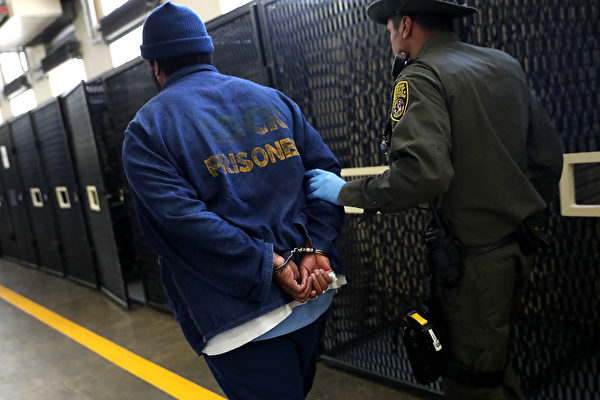
California Governor Gavin Newsom’s recent announcement to reduce the sentences of 548 death row inmates has sparked significant backlash from victims’ families and prosecutors alike. Among those affected in Los Angeles County are 162 inmates, including one notorious serial killer responsible for the deaths of 14 individuals. On Thursday, November 12, the Los Angeles County District Attorney publicly expressed support for legal challenges against Newsom’s “one-size-fits-all” approach to sentencing reductions.
On November 5, Newsom declared his intention to exercise his gubernatorial powers to reclassify capital punishment sentences into “life imprisonment without the possibility of parole.” This action does not abolish the death penalty in California, but rather modifies the status of current death row inmates.
In response to this controversial decision, the non-profit organization “Criminal Justice Legal Foundation” (CJLF) organized a press conference in front of the California State Capitol, where it announced plans to legally challenge the governor’s decision. Representatives from various organizations, including “Crime Victims United,” the California Police Association, the California District Attorneys Association, the California Chief Probation Officers Association, and the California Sheriff’s Association, were present at the event.
Los Angeles County District Attorney Nathan J. Hochman voiced his office’s strong support for CJLF’s legal challenge. He criticized the governor’s decision for excluding victims’ families from the conversation and for disregarding the will of California voters, jurors, and judges.
The CJLF highlighted concerns that California has been moving towards more lenient legislation regarding life sentences without the possibility of parole in recent years. If policies continue to relax, coupled with Newsom’s sweeping sentence reductions, individuals previously sentenced to life without parole could potentially seek release in the future.
Hochman shared similar apprehensions, referencing the infamous Menendez brothers case, where the brothers were sentenced to life without parole in 1996 for murdering their parents. Nearly three decades later, changes in California law provided them an opportunity to apply for parole.
Hochman emphasized that the governor cannot assure that these death row inmates will not eventually be released due to changes in the law after their sentences are converted to life imprisonment. He reminded the public that California voters have twice voted to retain the death penalty for the most heinous crimes. He further contended that the blanket reduction of sentences overlooks the decisions made by juries and judges in individual cases and fails to adequately consider the prolonged suffering experienced by victims’ families.
In a public letter, Newsom acknowledged the “unspeakable pain” that death row inmates have brought to victims, their families, the community, and the entire state. However, he stated, “As the governor, I believe the state should not take lives in the name of morality.”
The Los Angeles County District Attorney’s office revealed that of the 548 death row inmates in California, 162 are from Los Angeles County. Approximately 70% of these inmates have been convicted of multiple serious crimes, including notorious serial killers like Chester Turner and Michael Gargiulo.
Chester Turner, approximately 59 years old, is one of the most brutal serial killers in American history. Between 1987 and 1998, he raped and strangled 14 women in Los Angeles, including one pregnant victim, whose unborn child did not survive. He was sentenced to death in 2007 and again in 2014.
Turner primarily committed his crimes in the Figueroa Corridor area of South Los Angeles and is referred to by prosecutors as the “Southside Slayer.” After assaulting his victims, he would often strangle them and dispose of their bodies in alleys and abandoned garages.
Another high-profile serial killer is about 50-year-old Michael Gargiulo, colloquially known as the “Hollywood Ripper.” He was sentenced to death in 2021 for the murders of two Southern California women and attempted to kill a third, using extremely violent methods.
Hochman urged the California Supreme Court to adhere to a case-by-case review process and oppose blanket reductions for all death row inmates. He noted that more than 60% of the cases on the reduction list involve defendants convicted of multiple serious crimes, stating that these cases require prior review by the California Supreme Court before any sentencing modifications can take effect.