
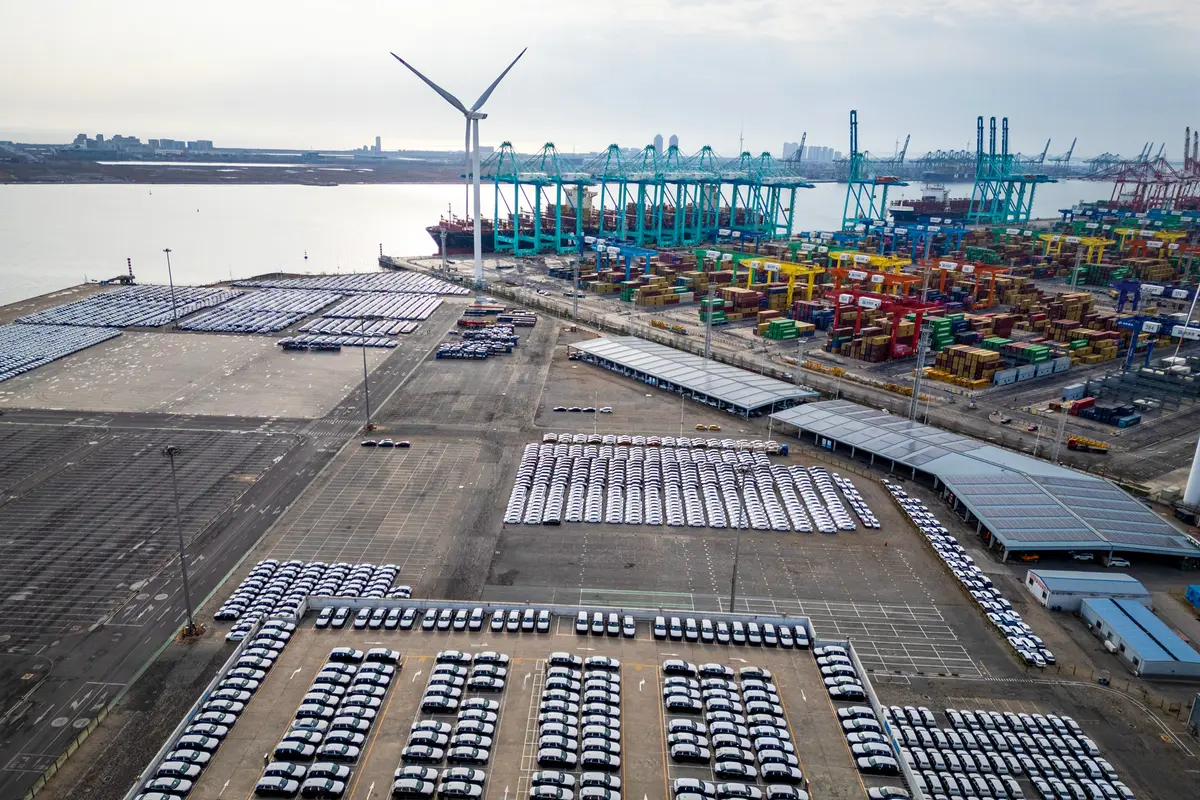
On Monday, October 19, the China’s economic data released by the Communist Party showed that exports have become the main driver of growth, offsetting the impact of domestic consumers “tightening their purse strings.” However, experts are questioning that the surge in China’s net exports is not a reflection of a strong and profitable export sector, but simply another way of expressing the weakness in domestic demand.
Some analysts interpret China’s economic data for this year as a “dual-track” economy: with a sluggish domestic economy, while the export economy performs strongly, creating a certain balance between the two. Over the past three months, the significant increase in Chinese exports, supported by industrial production necessary to sustain exports, has maintained China’s economic growth; meanwhile, consumer spending has stalled, and investments have sharply declined. As a result, amidst deteriorating domestic demand, the Chinese economy has increasingly relied on commodity exports.
Michael Pettis, a China expert at the Carnegie Endowment for International Peace, posted on X platform, stating that although China’s net exports have indeed surged, it does not imply that the export industry itself has promising development prospects.
He explained that if the export industry were highly profitable, then the analysts’ description might make sense; however, the reality is that the profit margins in China’s export industry are not high—although comparatively better than the domestic market (where, except for a few industries, companies generally struggle to make a profit).
“If we exclude direct and indirect subsidies, a significant portion of China’s exports actually ‘squanders’ economic value; these losses are eventually capitalized in the form of increasing debt, reflected in the balance sheet,” Pettis wrote.
He further elaborated that when an economy’s output far exceeds the level that domestic consumption or investment can absorb, it either has to choose to export the excess or cut domestic production. Considering China’s current high actual unemployment rate (especially among young people), Beijing has no choice but to push for the former, even if it entails certain economic costs.
Across China, concerns about the economy are mounting. The long-lasting downturn in the real estate market shows no signs of improvement; stable jobs are becoming increasingly harder to find, especially for young people; many seem to be hoarding cash to prepare for potential tougher times ahead.
China’s reliance on overseas exports for economic growth has, in turn, heightened tensions with its trading partners. In September, Chinese exports surged by 36%, benefiting from robust demand for items like electric vehicles and machinery, putting China on track to achieve a trade surplus of over $1.2 trillion this year, surpassing last year’s record.
On the other hand, in the first three quarters of this year, China’s fixed asset investment (covering expenditures on properties, factories, roads, etc.) decreased by 7.2% year-on-year, with only real estate investment plummeting by 21%.
Consumer spending remains weak. As an indicator of household expenditures, retail sales in September grew by 1.1%; while this growth is higher than August’s 0.4%, it still lags behind the 3% from the same period last year.
From the demand side, during the October holiday period, per capita tourism spending dropped to its lowest level in four years; simultaneously, discussions on social media about intense work schedules, low wages, and inadequate labor rights protection are becoming more frequent.
“In other words, the surge in China’s net exports is not a reflection of a strong and profitable export sector. If one must rely on debt expansion, ongoing subsidies, and export growth to avoid contraction in domestic production, then the surge in net exports is essentially just another way of expressing the weakness in domestic demand,” Pettis added.
Analysts at ANZ Bank in their report on China’s economic data released on Monday stated, “This year’s growth data highlights deeper challenges in the medium to long term rebalancing.”
They noted, “The escalating trade tensions, protectionist measures, and geopolitical frictions pose significant risks to future growth,” adding, “China’s economy is far more sensitive to changes in the external environment than policymakers had hoped.”