
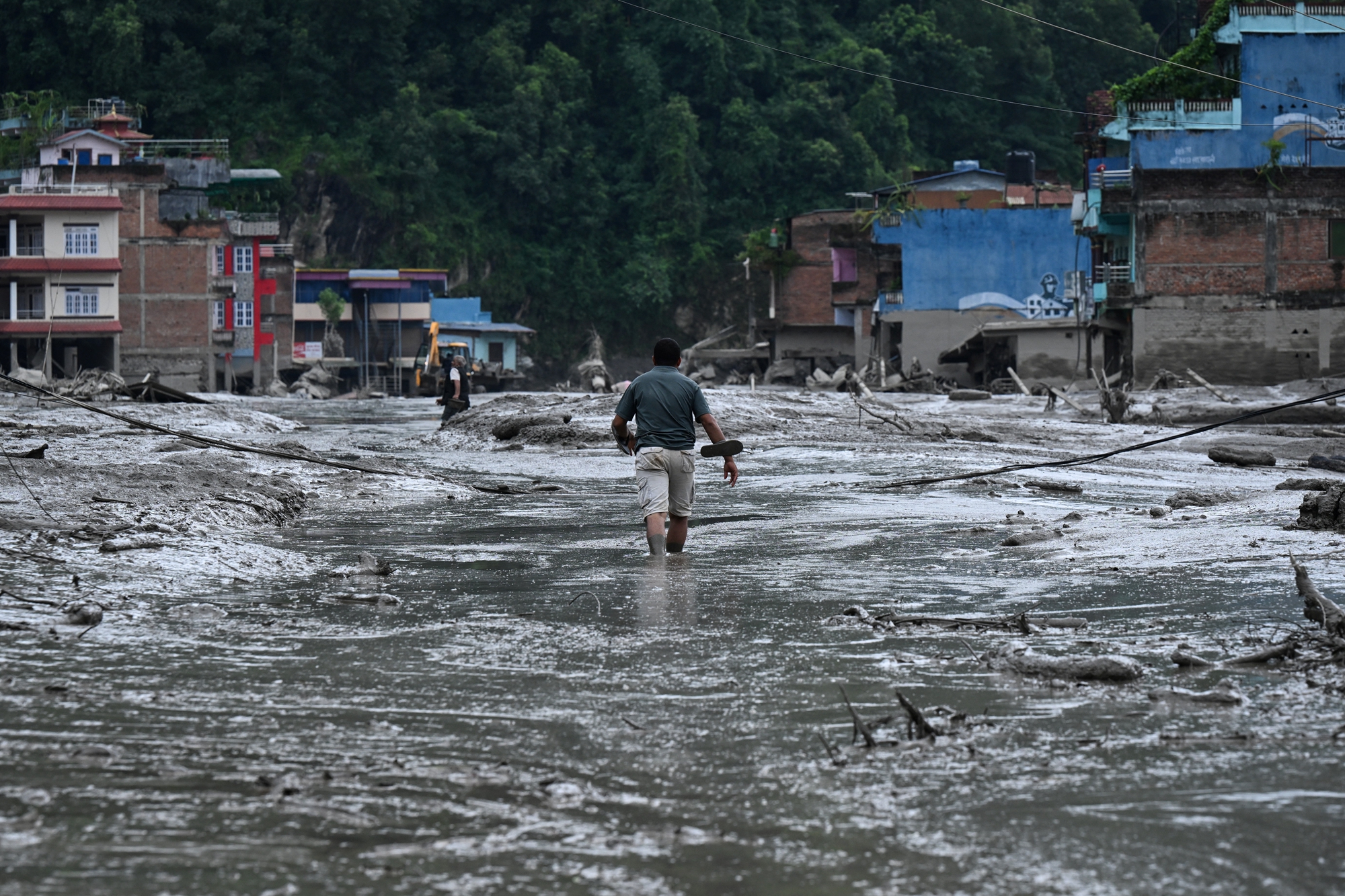
On Saturday (August 29), due to heavy rain and thick fog, rescue operations for the flood disaster in Nepal were temporarily suspended. Nepal sought foreign assistance for tunnel rescue and DNA testing expertise. The flood, triggered by a glacier collapse, has resulted in the deaths of 626 people in Nepal and 7 in Tibet, with nearly 3,000 people missing. Nepal estimates that the reconstruction after the disaster may require 4 to 5 billion US dollars, close to ten percent of the country’s total economy.
This disaster began on Wednesday when a glacier collapsed, sending a large amount of rocks, ice, mud, and debris rushing down the river systems in the Himalayan region, engulfing buildings, bridges, power stations along the way, and destroying border facilities connecting Tibet and Nepal.
Officials in the severely affected Rasuwa region, like Narendra Pariyar, informed Reuters, “Due to rain and fog, search and rescue operations have been temporarily halted.” One of the current focuses is to arrange land transportation to bring rescued pilgrims to the capital, Kathmandu.
Nepal’s Foreign Minister Shisir Khanal stated that they do not currently need general rescue assistance from outside but require more specialized technical support, including rescuing people trapped in tunnels, restoring transportation and communication in areas where bridges have been destroyed, identifying bodies, DNA testing, and long-term body preservation.
“For areas where we lack sufficient expertise and technical knowledge, we have made requests in the hope of receiving specialized services and technical assistance,” Khanal told Reuters late on Friday.
Currently, around 2,426 people are missing on the Nepalese side. The latest data released by China’s official news agency Xinhua on Saturday showed that there are still 554 people missing on the Tibetan side.
Among the missing are at least 540 foreigners, with many being pilgrims from India.
The landslide dam lake formed after the flood continues to threaten downstream rescue efforts. On Friday, one of the lakes overflowed, temporarily halting rescue operations.
China’s Ministry of Water Resources stated on Saturday that satellite images show a lake at the confluence of two rivers near the China-Nepal border is slowly draining. As of Saturday morning, its water surface area had decreased to 99,000 square meters, a decrease of 21,000 square meters from Thursday, reducing the risk of dam failure.
However, there is another larger body of water below the glacier collapse site. Engineers estimate its area to be over 120,000 square meters, but its depth is currently unknown.
Officials from Nepal’s Disaster Management Department warned that the risk of flooding will persist until both lakes are completely drained.
This tragedy has also had a severe impact on Nepal’s economy. Finance Minister Swarnim Wagle stated that the initial estimates for reconstruction costs are between 4 and 5 billion US dollars.
“This is only an estimate. Losses and damages are currently being assessed,” Wagle said.
Reuters noted that this amount is close to ten percent of Nepal’s total economy. Although lower than the approximately 9 billion US dollars spent on reconstruction after the 7.8 magnitude earthquake in Nepal in 2015, the recent flood has damaged several critical hydropower facilities, with the affected projects accounting for over 12% of the country’s electricity capacity. The subsequent economic impact could be quite severe for Nepal, which heavily relies on remittances, tourism, and hydropower.
India has currently sent three flights carrying about 60 tons of relief supplies such as blankets, medicines, food, and water purification tablets to Nepal, and plans to dispatch tunnel rescue teams and medical teams.
India has also offered to send disaster response teams, provide prefabricated bridges and technical teams to assist in restoring transportation.