
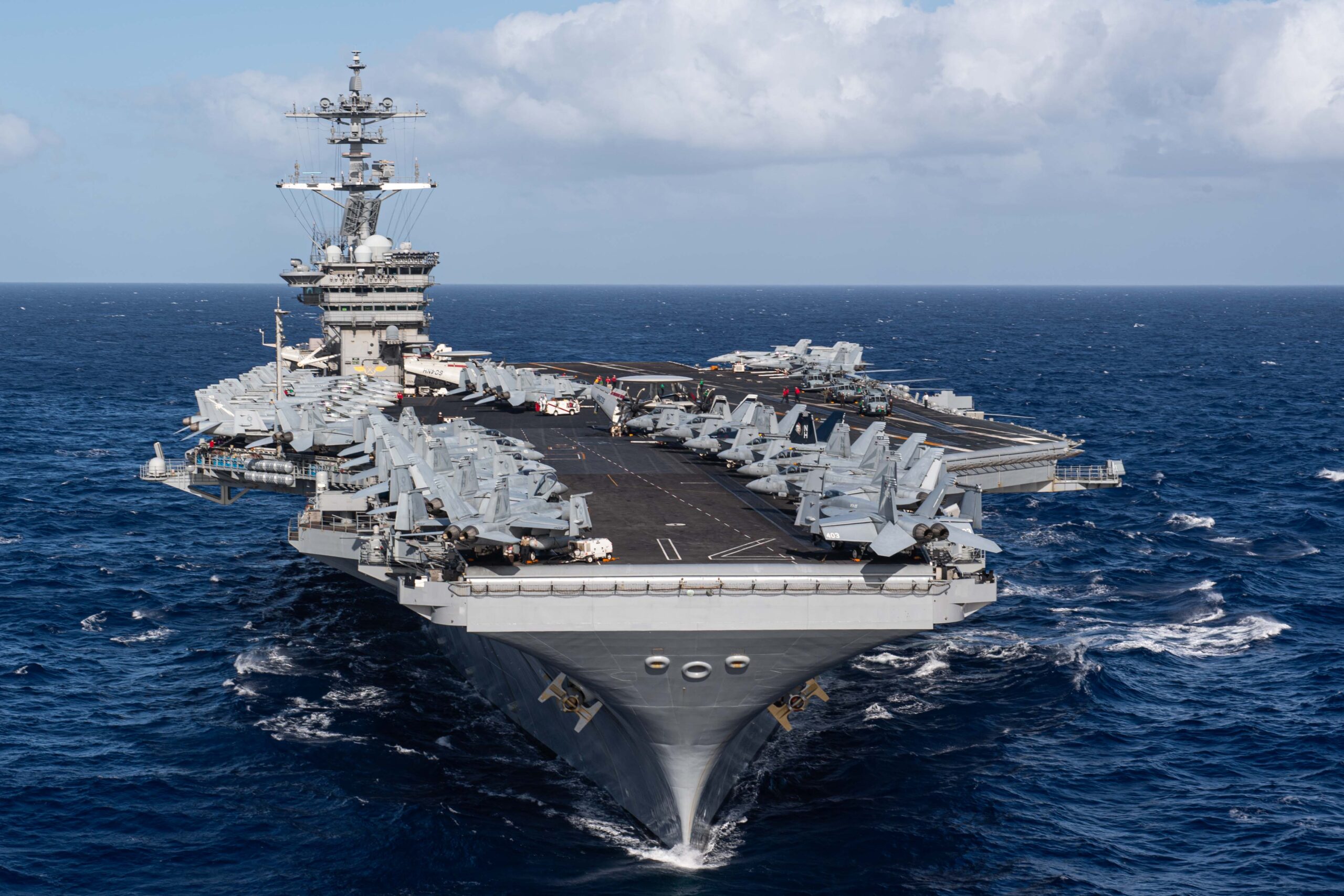
The USS Theodore Roosevelt aircraft carrier is set to leave the San Diego port and head to the Middle East, as the conflict between the United States and Iran continues. Since the start of the “Operation Epic Fury” on February 28th, the U.S. has been deploying aircraft carriers in the Arabian Sea to carry out strike missions against Iran and subsequently imposed a naval blockade on Iranian ports.
The deployment of the USS Roosevelt is intended to replace the USS George Washington, which entered the U.S. Fifth Fleet’s area of responsibility just last week. Families of the crew members of the Roosevelt carrier strike group have begun preparing for a deployment period of at least 7 months.
“They know they will be there for more than 7 months,” said U.S. Navy Master Chief John Perryman to the USNI News. Perryman added, “Their commanders have informed them to plan for an 8-month cycle.”
Admiral Daryl Caudle, the Navy’s Chief of Operations, also stated, “I personally lean towards a 7-month deployment period. I usually do not support extending deployments, and I strongly oppose it. But the enemy also has a say (meaning the battlefield situation is not solely determined by us).”
On Wednesday, Perryman told reporters that the Navy is doing its utmost to alleviate the pressure faced by deployed sailors and their families during what is the longest deployment period in decades.
According to the aircraft carrier deployment database of the USNI News, the average deployment length of U.S. military aircraft carriers has reached 8.5 months since Hamas launched terrorist attacks on Israeli civilians on October 7, 2023.
The USS Gerald R. Ford recently concluded a record-breaking 326-day deployment in May of this year, surpassing the post-Cold War record. The USS Abraham Lincoln followed suit with a deployment period of 279 days.
Despite the nearly year-long deployment of the Ford, it made several port calls in the Caribbean Sea and the Mediterranean during its mission. In contrast, the crew of the Lincoln did not have such opportunities, as they did not make any port calls during their 8.5-month deployment.
Caudle explained, “This fundamentally makes the experience of the Ford sailors better than that of the Lincoln sailors. This is not due to the operational mission itself, as the two ships carry out similar combat strike missions, but it is about the ability to make port calls and have opportunities for rest and recuperation.”
The Navy has established a logistics support chain to sustain the presence of the two carrier strike groups in the Arabian Sea. Caudle is currently working with Admiral Kurt Renshaw, Commander of the U.S. Fifth Fleet, to determine the timing and locations for port visits for the carriers deployed to the Arabian Sea. Ports in Africa, India, and even Singapore are being considered to allow the carrier strike groups to rest.
While the conflicts in the Middle East are ongoing, the U.S. Navy is also committed to expanding its operations in the Western Pacific to counter the threat posed by China.
Caudle stated, “Just considering the vast expanse of the Pacific, from a mathematical perspective, it requires deploying more forces. If these forces cannot come from the navy units deployed in the frontlines, then I must request additional forces.”
The U.S. Navy is awaiting the passage of a supplemental appropriation bill by Congress to make up for the funds previously used from the “Operations and Maintenance” account to address the conflict with Iran.