
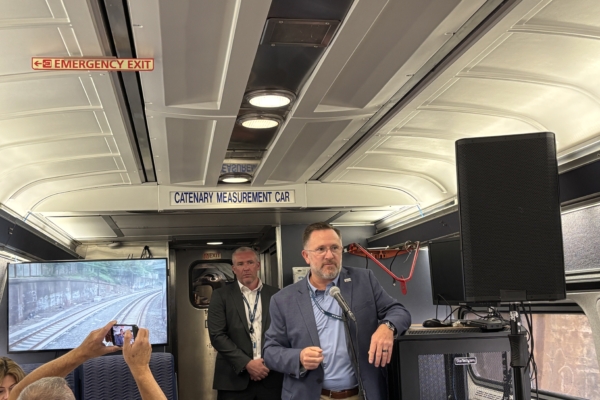
On August 17th, Amtrak held a completion ceremony for the East River Tunnel 2 rehabilitation project at the Penn Station in New York. This tunnel, which was opened in 1910, suffered damage during Hurricane Sandy in 2012 and underwent a 14-month closure for repairs starting in May 2025 before resuming operations.
The United States Railroad Corporation has four river-crossing tunnels, two of which were damaged by hurricanes. Last year, despite calls from the Metropolitan Transportation Authority (MTA) for “in-place repairs” – meaning no interruption in service during peak hours and repairs only being done at night and on weekends – Amtrak still proceeded with the necessary closure of tunnels for maintenance.
Byl Herrmann, the interim CEO of Amtrak, stated that the East River Tunnel sees approximately 450 Amtrak, Long Island Railroad, and New Jersey Transit trains pass through it each day. Without fully closing the damaged tunnels, the reconstruction would not be possible; due to aging and erosion from seawater, comprehensive rehabilitation was necessary.
Jim Mathews, the President and CEO of the Rail Passengers Association, also mentioned that if construction were only done at night and on weekends, the project could be delayed by 13 years and costs could increase by about three times. With the complete closure of the entire tunnel for construction, the major renovations were completed within about 14 months.
Janno Lieber, Chairman and CEO of the Metropolitan Transportation Authority, criticized Amtrak, stating that due to Amtrak’s repairs and maintenance activities, Long Island Railroad peak-hour services were temporarily cut by 20% during construction. To prevent emergencies in the other three tunnels, the MTA requested Amtrak to have rescue train sets on standby. Despite incidents like fires, service disruptions, and train impacts during the first tunnel repair, the actual impact was lower than anticipated.
During the construction, workers dismantled internal facilities of Line 2 all the way to expose the tunnel walls, removing 24,000 feet of steel tracks, 8,000 tons per cubic yard of ballast, 8,000 wooden ties, and concrete bench walls on both sides of the tunnel totaling 24,000 feet in length. The dismantled concrete was enough to pave a layer over 4 feet thick in an American football field.
Subsequently, the construction team rebuilt the concrete bench walls, laid new tracks, and updated drainage, power supply, communication, signaling, lighting, and emergency safety systems. The project retained the century-old tunnel’s main outer shell but essentially rebuilt the internal railway facilities from scratch. Herrmann stated that this sets the foundation for safe and reliable operations for the next 100 years.
David Fink, Director of the Federal Railroad Administration, mentioned that during the test train runs, there was minimal shaking, and improvements in lighting and emergency evacuation conditions were evident.
Officials from the United States Railroad Corporation emphasized their confidence in the next phase of maintenance plans. The repair work for the second damaged tunnel is set to begin slightly later in the fall of this year, with an expected completion by the end of 2027. Warren LeBeau, Vice President of Infrastructure Delivery at Amtrak, mentioned that due to the experience gained by the team in dismantling old facilities, adjusting designs, scheduling processes, and test runs for Line 2’s project, Amtrak will continue to utilize these practices to improve efficiency and strive for faster completion.