
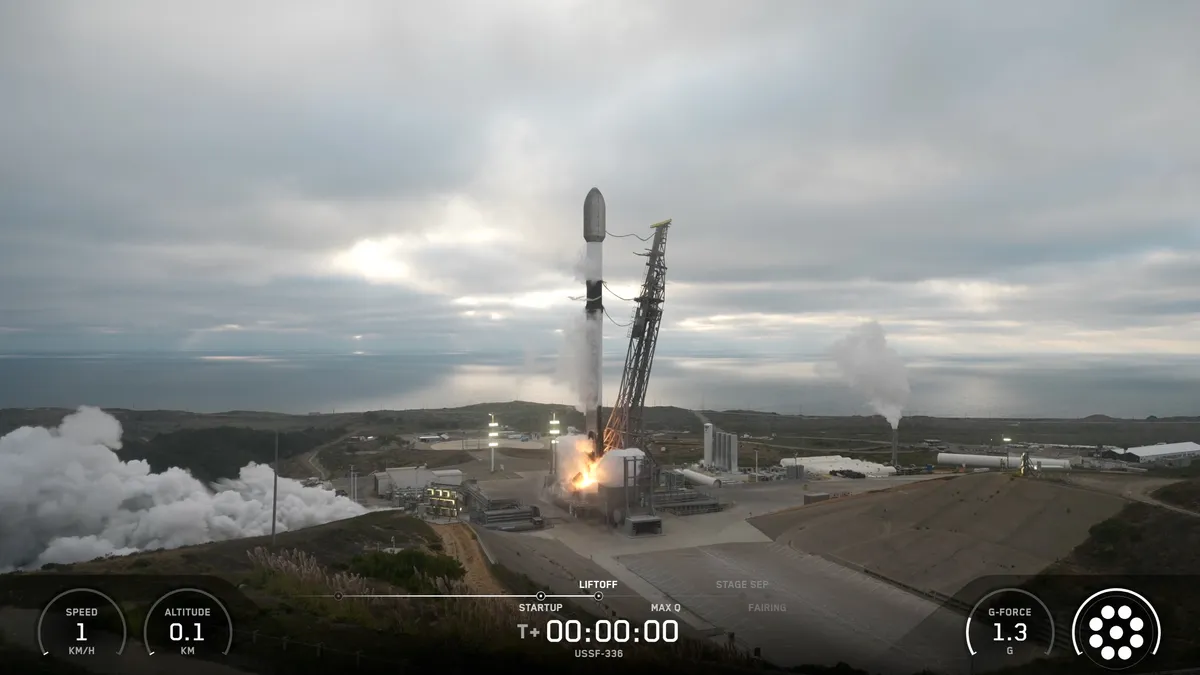
On August 15, local time, the US space exploration technology company SpaceX successfully launched two Falcon 9 carrier rockets within 38 minutes, greatly reducing the record it set on August 31, 2024, by shortening it by 27 minutes.
This launch spanned the east and west coasts of the United States. The first Falcon 9 rocket took off at 9:12 p.m. Eastern Time from the Cape Canaveral Space Force Station in Florida, successfully deploying 8 satellites for the Louisiana-based telecommunications company Globalstar into near-earth orbit. Within 56.5 minutes of the rocket’s ascent, all 8 satellites were successfully deployed into orbit within 6 minutes, according to SpaceX officials.
While the first Falcon 9 was heading to near-earth orbit, 38 minutes later at 9:50 p.m. Eastern Time, another Falcon 9 took off from Vandenberg Space Force Base in central California to carry out a classified mission for the US Space Force under the codename “USSF-366.”
Due to the highly classified nature of the “USSF-366” mission for national security reasons, no information regarding payload deployment times or specific orbit parameters has been disclosed by officials.
Mission details revealed by the space launch information website NextSpaceflight indicate that based on the landing location of the rocket’s first stage booster, the orbital characteristics of this mission completely match the deployment region of the previous “Starlink 15 Group” satellites. This launch likely involved the deployment of a batch of classified near-earth orbit satellites for national security using SpaceX’s custom-made “Starshield” satellite platform tailored for government agencies.
As per standard practice for all military classified launches, SpaceX ended the official live broadcast shortly after the first stage booster landed.
Both launches on Saturday evening successfully achieved the landing of the first stage boosters. The Falcon 9 first stage booster for the Globalstar mission safely returned to land at Cape Canaveral approximately 8 minutes after launch, marking its 14th successful flight. Meanwhile, the first stage booster for the US Space Force’s “USSF-366” mission precisely landed on SpaceX’s drone ship “Of Course I Still Love You” in the Pacific Ocean around 8.5 minutes after launch. To date, this rocket has completed 18 launch and recovery missions.
Following the successful dual launches, SpaceX has now completed a total of 96 Falcon 9 launches in 2026, with approximately 75% dedicated to Starlink broadband network deployment missions. The total number of satellites in orbit has now reached nearly 11,000.