
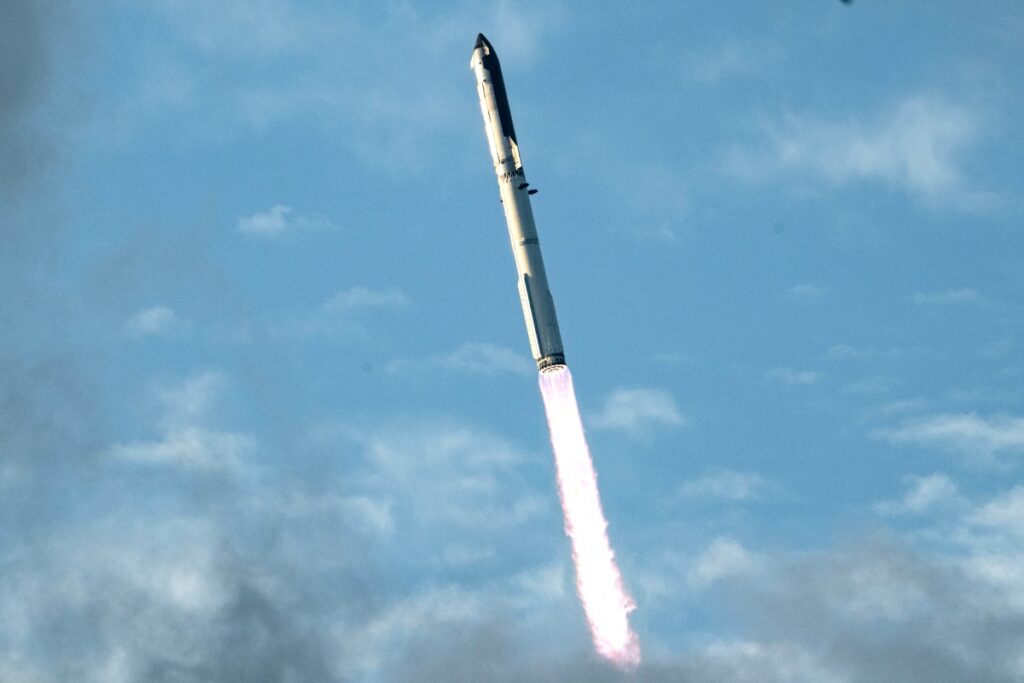
On November 13, 2026, in the evening, SpaceX, the American aerospace manufacturer and space transport services company, accomplished a major milestone by successfully launching the largest and most powerful rocket ever built, known as the “Starship,” from its Starbase facility located near the U.S.-Mexico border in Texas. This launch marks the highly ambitious 15th test flight for SpaceX.
After receiving final clearance from the Federal Aviation Administration (FAA) and ascending successfully, SpaceX embarked on a mission that lasted 22 hours. During this mission, the team was set to undertake a historic feat unprecedented in rocketry: utilizing a launch tower called “Mechazilla” alongside a pair of robotic arms affectionately nicknamed “chopsticks.” The objective was to execute an aerial “dual capture” of both the first stage booster and the second stage spacecraft, thereby achieving complete recovery of the entire rocket.
However, the test flight soon met with some unexpected turns. Although the Super Heavy booster performed well during the initial ascent, successfully passing through the crucial moments of “Max Q”—the point of maximum aerodynamic pressure— and executing a “hot staging” separation thanks to the thrust from the upper stage’s own engines, SpaceX ultimately decided to forego the capture of the booster by the launch tower. Instead, it allowed the booster to splash down in the Gulf of Mexico. This decision suggests that the engine problems previously encountered by Starship V3 during earlier test flights may not have been entirely resolved.
If the mission proceeds as planned, it could herald the first time in human spaceflight history that every component of an orbital rocket is recovered for reuse. SpaceX had already successfully captured and recovered the first stage booster of the Super Heavy three times prior, but this test flight represents a significant leap as it attempts to capture the upgraded production variant of the booster, which stands 72 meters (236 feet) tall, as well as the upper Starship spacecraft, measuring 52 meters (171 feet). Combined, these two stages reach a towering height of 124 meters (407 feet).
In the realm of aerospace, there has always been a distinction between rockets and spacecraft. SpaceX aims to construct a vehicle that serves as both a rocket and a functioning spacecraft. Lars Blackmore, the Senior Mars Landing Engineer at SpaceX, highlighted that traditionally, in space launches, the second stage rocket responsible for pushing the spacecraft into orbit is separate from the crewed vehicle itself. The latter typically relies on parachutes to land and be recovered at sea. However, the second stage rocket—a costly component—burns up upon re-entry or crashes into the ocean. Historically, no rocket has boasted a reusable second stage. Starship, on the other hand, amalgamates both functions by being a spacecraft capable of carrying satellites and astronauts while also serving as the second stage rocket.
SpaceX is renowned for its reusable Falcon series rockets, but each flight has necessitated discarding the second stage. Hence, if the second stage spacecraft can also be completely recovered during this mission, it would represent the attainment of the “holy grail” of fully reusable rocket technology.
According to Kiko Dontchev, SpaceX’s Vice President of Launch Operations, combining scalable infrastructure with the complete reuse of rockets is crucial for facilitating an exponential increase in launch frequencies—from zero to 10, to 100, to 1,000, and eventually reaching 10,000 and then 100,000 launches. Elon Musk, CEO of SpaceX, expresses that such high-frequency and stable launch rhythms will pave the way for constructing a lunar base and sending humans to Mars.
The challenge of recovering the spacecraft proves significantly tougher than that of retrieving the booster. The Super Heavy booster returns at a speed of approximately 6,000 kilometers per hour, while the Starship spacecraft, upon completing its orbital mission, will re-enter at speeds exceeding 20 times the speed of sound, reaching up to 28,163 kilometers per hour. It will dive into Earth’s dense atmosphere from the vacuum of space, enduring extreme heat and aerodynamic pressure, ultimately executing a controlled vertical landing within the “chopsticks” of the Mechazilla launch tower.
This test flight will utilize the latest iteration of the prototype—the Starship V3. The Starship had previously faced a series of issues with engines shutting down prematurely or failing to reignite. The first 14 test flights saw the spacecraft end up in the ocean or in ruins. NASA’s Artemis program manager, Jeremy Parsons, had previously disclosed that SpaceX has prepared permanent hardware improvements and upgraded Raptor engines for this 15th test.
The flight plan outlines critical milestones over the course of 22 hours, including:
Ascent and Booster Recovery (T-0 to T+6 minutes 35 seconds):
Approximately 2 minutes and 20 seconds after liftoff, the Super Heavy booster will separate from the upper spacecraft. At 6 minutes and 35 seconds post-launch, the booster reignites 13 engines to return to the Mechazilla launch tower in South Texas, where it will be captured by the “chopsticks.”
Orbital Insertion and Satellite Deployment (T+26 minutes 10 seconds to T+1 hour 15 minutes):
The spacecraft will ignite its engines to reach an altitude of approximately 275 kilometers. It will then deploy 26 advanced Starlink internet satellites, a process that will take around 40 minutes.
Earth-Orbit Flying and Health Checks (T+1 hour 27 minutes to T+20 hours 41 minutes):
The spacecraft is set to orbit the Earth 15 times, during which SpaceX will conduct three system health checks. Should any anomalies arise, the company reserves the option to deorbit the spacecraft and have it splash down near Hawaii or the Chilean coast early.
Historical Spacecraft Capture (T+21 hours 35 minutes to T+22 hours 32 minutes):
If all goes according to plan, the spacecraft will execute its deorbital burn on Saturday. After enduring extreme temperatures during atmospheric reentry, it will decelerate and rotate to a vertical position approximately 22 hours and 32 minutes after launch, landing precisely in the Mechazilla launch tower’s robotic arms. To ensure safety, regulators have designated a vast area from the Gulf of Mexico to the south of Cuba as a no-fly zone during ascent, and the area surrounding the launch site will be cleared before the spacecraft’s return.
The outcome of this test flight is not only crucial for SpaceX but also holds significant implications for the timeline of America’s return to the Moon. NASA has paid SpaceX billions of dollars for plans to use the Starship for crewed lunar landing missions. In this competitive arena, Blue Origin, led by Jeff Bezos, stands as another formidable contender.
Plans are in place for astronauts to rehearse rendezvousing with both Blue Origin’s Blue Moon lander and the Starship during the Artemis III mission, set for next summer. These operations are designed to set the foundation for the first crewed lunar landing under Artemis IV, planned for as early as 2028. NASA anticipates making a final decision on whether to select Musk’s or Bezos’s lander one year prior to the lunar mission.