
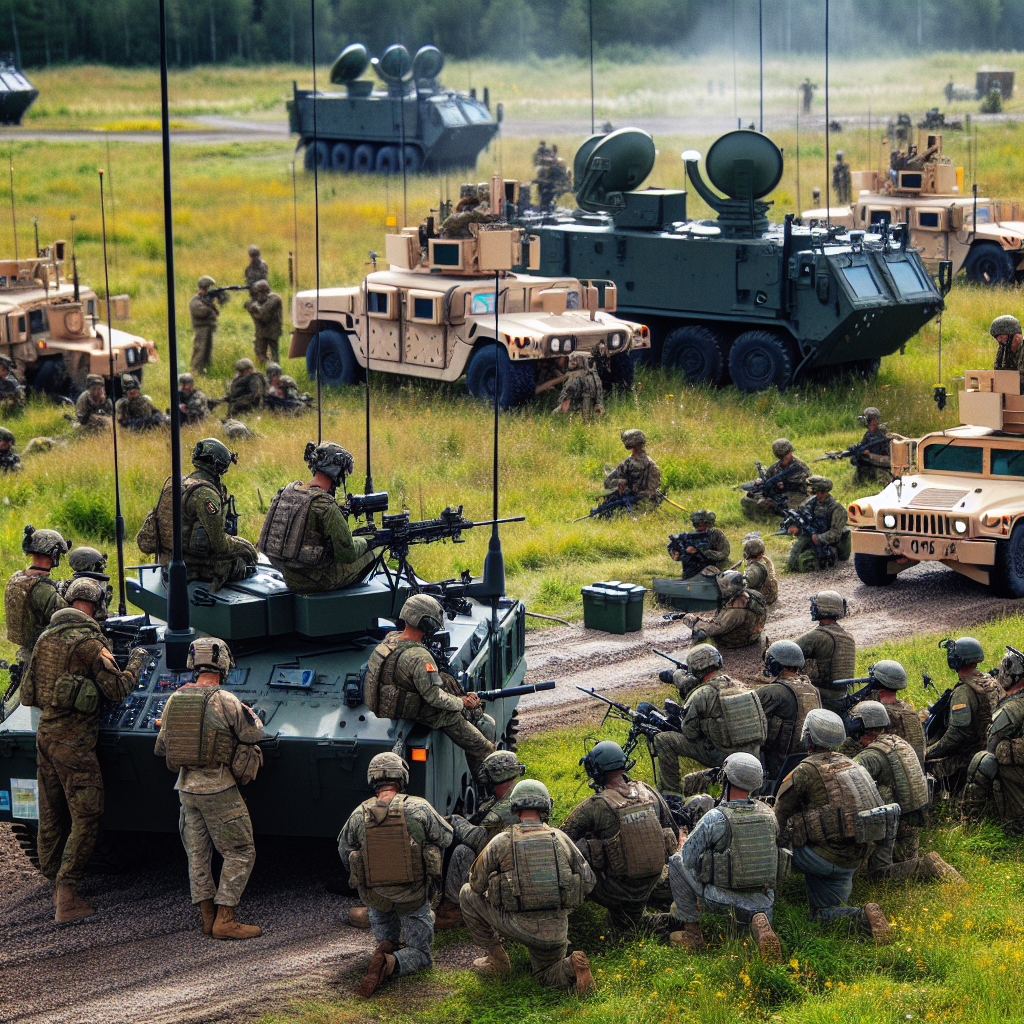
The annual military exercise “Northern Strike” in Michigan, United States in August recently concluded, with over 500 soldiers from Taiwan participating, according to US media reports, drawing high attention.
Defense strategy experts believe that the US actively exposing the participation of Taiwanese soldiers in “Northern Strike” is aimed at dispelling doubts about Taiwan’s relationship with the US. The hands-on “multi-domain operations” training by the US military has provided Taiwan with invaluable combat experience, effectively deterring the Chinese Communist Party (CCP) and preventing Beijing from reckless actions.
According to a report by the US Department of Defense’s “Stars and Stripes,” the “Northern Strike” mobilized 7,500 American service members, including over 500 soldiers from Taiwan.
Taiwan has quietly sent personnel to participate in “Northern Strike” since at least 2021. This time marks the first public disclosure by the US regarding the number of Taiwanese military personnel participating, and it is the largest number in years.
In response to the US’s proactive disclosure of Taiwanese military personnel participating in the exercise, Deutsche Welle reported that according to long-term US policy, the Pentagon generally does not publicly mention Taiwan’s participation in US exercises to avoid backlash from the CCP.
Regarding US media reports claiming that over 500 Taiwanese soldiers participated in the US military’s “Northern Strike” exercise, Zhu Fenglian, spokesperson for China’s Taiwan Affairs Office, emphasized on the 27th that China firmly opposes any form of military contact between the US and Taiwan. Chinese Ambassador to the US, Liu Pengyu, also lodged a protest, stating that China resolutely opposes military contacts between the US and Taiwan.
The South China Morning Post on Sunday (August 24) pointed out that this unusually high-profile move is not only to deter Beijing but also to counter the increasing distrust of the US within Taiwan during the second term of Donald Trump’s presidency. Analysis suggests that as internal distrust towards the Trump administration in Taiwan escalates, the US’s public announcement aims to demonstrate that the US “stands with Taiwan.”
An earlier report by the Washington-based Marshall Foundation stated that the Trump administration imposed a 20% temporary tariff on Taiwan and raised questions about US pressure on Taiwan Semiconductor Manufacturing Company (TSMC) to increase investment in the US, weakening Taiwan’s favorable view towards the US.
In April of this year, a US think tank released a survey showing a decline in trust in the US among Taiwanese, with the percentage of Taiwanese with a negative view towards the US jumping from 24.2% last year to 40.5%. Those who view the US as an unreliable ally increased by 13.9% from the previous year.
In response, former Dean of the Political Warfare Institute at Taiwan’s National Defense University, Yu Zongji, told the Epoch Times that this was a crucial indicator of the US’s commitment to Taiwan’s security. He never believed that President Trump would stand idly by in a Taiwan Strait crisis; even President Biden has publicly stated five times that the US would not rule out the use of force to protect Taiwan in the event of conflict.
“The reason is the geopolitical importance of Taiwan, chip manufacturing, and its significant impact on the global economy, and so on. Although President Trump’s strategic approach to the Russia-Ukraine conflict made people feel that the US was reluctant to intervene directly, Ukraine is a secondary country of interest to the US, while Taiwan is crucial to US national interests,” Yu Zongji said.
Lin Yingyu, Assistant Professor at Tamkang University’s Institute of Strategic Studies, told the Epoch Times that the US’s proactive disclosure this time confirms that cooperation between Taiwan and the US goes beyond mere observers or academic exchanges to highly interactive military training cooperation. There is a trend of increased personnel training in military exercises.
According to the Stars and Stripes, this annual exercise held in Michigan’s five Great Lakes region this year has shifted its operational simulation scenarios from Europe to the Indo-Pacific region, highlighting US’s high level of concern over potential conflicts in the Indo-Pacific region.
The report also mentioned that the US has recently been announcing Taiwanese officers going to the US for exchanges, such as Air Force Commander Wu Jiaxing inspecting Alaska in June this year, and a group of Taiwanese Army officers and soldiers participating in training on the High Mobility Artillery Rocket System (HIMARS) in Oklahoma last year.
Su Ziyun, head of the Taiwan Institute of National Defense Strategy and Resources, told the South China Morning Post, “The US is expanding land force training, including NATO allies and the National Guard, through exercises like ‘Northern Strike,’ assisting the Taiwan military in gaining combat experience.”
Su Ziyun believes that this symbolizes the mutual trust between Taipei and Washington politically, and this mutual trust will continue to increase in the future.
Yu Zongji further pointed out that this time the Michigan National Guard assisted in training Taiwan’s reserve forces in the latest urban warfare tactics, UAV three-dimensional space combat, providing Taiwan’s military with important hands-on combat experience, strengthening Taiwan’s reserve combat capabilities significantly, which holds extraordinary significance.
“Michigan is a state situated in the center of the Great Lakes, which are as vast as oceans, resembling the operational environment of Taiwan surrounded by seas on all sides. This year, there was a particular exercise on using a floating dock concept for logistics support, aiding Taiwan to ensure uninterrupted logistical supplies of energy, fuel, ammunition, food, medicine, etc., in the event of a CCP incursion and blockade. This is crucial,” Yu Zongji said.
According to a report by Japan’s Nikkei on August 24, the Pentagon is considering establishing a new “multi-domain command” in Japan to integrate land, sea, air, space, and cyber capabilities, strengthening the ability of US forces in Japan to address the growing threats from the CCP in the Indo-Pacific, effectively deterring the CCP’s increasing military provocations. This is part of the US Army’s active promotion of modernization.
Yu Zongji believes that this deliberate exposure by the US this time also highlights that the US is assisting Taiwan’s ground forces to possess experience in “multi-domain operations.”
Taiwan’s mainland lacks the conditions to practice such cross-domain and multi-domain operational modes. He mentioned that the current hands-on training provided by the US can significantly enhance Taiwan’s international reserve combat power. This will convey a very strong deterrence signal to the CCP, preventing Beijing from engaging in reckless actions to initiate a war.
It is worth noting that the Michigan National Guard pointed out earlier this August that the CCP has been closely monitoring the state’s exercise situation, and in 2023, five Chinese citizens studying at the University of Michigan were caught taking photos at a military base at midnight.
The Executive Yuan of Taiwan recently passed the central government’s general budget for 2026, with defense spending hitting a historic high of NT$949.5 billion (US$31 billion), accounting for 3.32% of the country’s GDP.
The BBC analysis suggests that Taiwan’s move aims to respond to US pressure. While this may not fully satisfy the US this time, it will at least temporarily explain that more commitments will be made in the future.
In a Reuters report, it was mentioned that the US government has taken note of the budget cuts passed by the legislature controlled by opposition parties, the Kuomintang (KMT), and the Taiwan People’s Party, which could impact defense spending.
Three informed sources in Taiwan confirmed that US officials urged Taiwanese legislators during their visits to not obstruct defense spending, especially the upcoming special defense budget expected to be presented to the legislature later this year. In March this year, Republican Senator Dan Sullivan expressed concerns about budget cuts to Taiwan’s defense by the legislature, singling out the Kuomintang (KMT) for playing a risky game.
In a rare move on Monday night (August 25), the American Institute in Taiwan (AIT) posted two consecutive posts on Facebook, one featuring AIT Director Brent Christensen meeting with Taiwan’s Minister of Defense, Chiu Kuo-hung, and the other showing AIT officials meeting with five members of the Kuomintang to discuss US-Taiwan defense cooperation.
Regarding AIT’s proactive invitation to the Kuomintang lawmakers for a meeting, Yu Zongji believes that President Trump has clearly demanded that Taiwan must increase defense spending. Brent Christensen is acutely aware that if Taiwan wants to pass the defense budget next year accounting for 3.32% of the GDP, they must have the cooperation of KMT members. Given that the Legislative Yuan has a majority of blue camp parties, the US is now ensuring that KMT members do not impede progress.
“This is not just a policy proposal of the ruling party, the Democratic Progressive Party, but also a very serious demand from the US for Taiwan’s defense spending,” Yu Zongji said.
Yu Zongji emphasized that both the Democratic Progressive Party and the Kuomintang should have a consensus since the main threat comes from the CCP.