
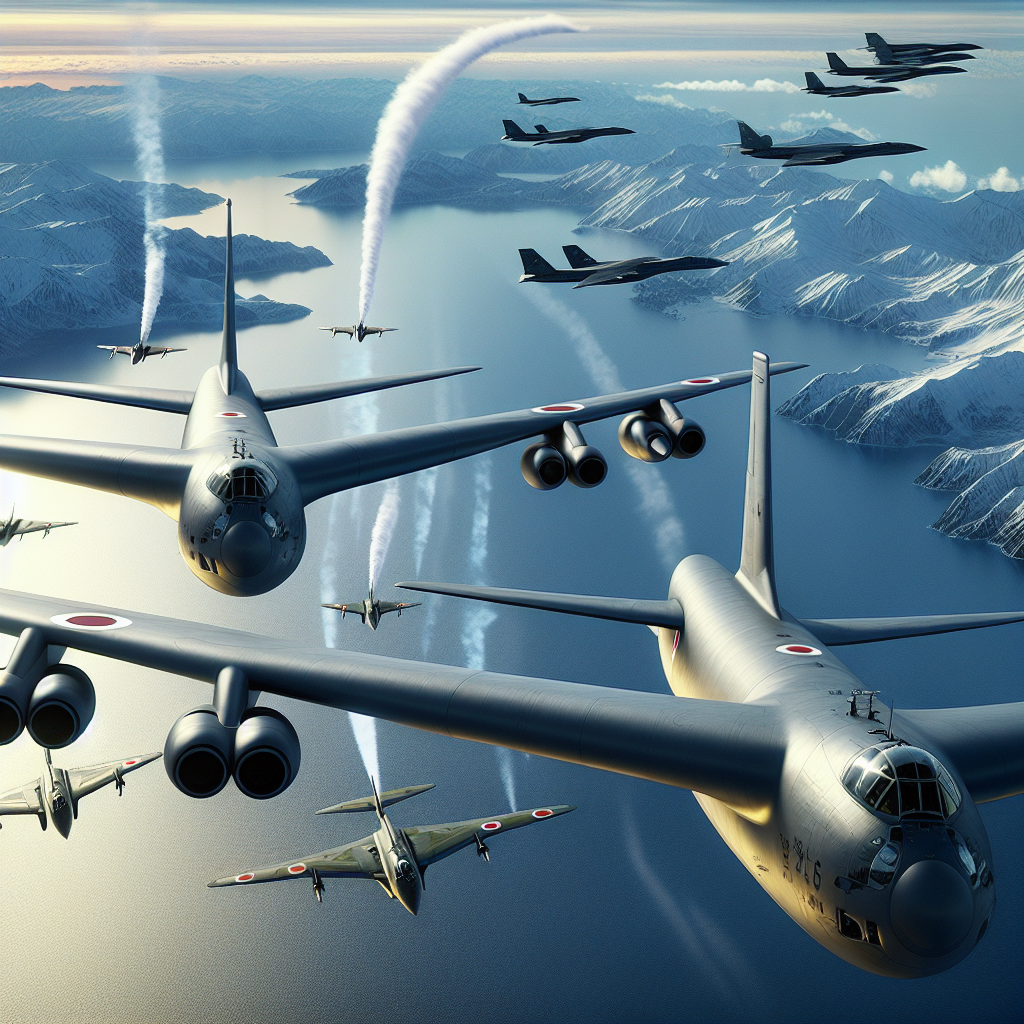
Two US military bombers with nuclear strike capability conducted formation flights with Japanese Air Self-Defense Force aircraft over the Sea of Japan on Wednesday, December 10th. Japan stated that this action was in response to recent joint military exercises by China and Russia in the airspace near Japan and South Korea, demonstrating the deterrent and response capabilities of the US-Japan alliance.
The Japanese Ministry of Defense issued a statement on Thursday, December 11th, emphasizing that the US and Japan “reaffirmed their firm determination to deter any attempt to unilaterally change the status quo through the use of force” during this joint training. Both countries confirmed that their forces remained on high alert with a readiness to respond promptly.
According to information released by Japan, the exercise involved two US B-52 strategic bombers, three Japanese F-35 stealth fighters, and three F-15 air superiority fighters. This was the first time that the US military had explicitly demonstrated its military presence in the region following a military exercise conducted by China last week.
The US-Japan joint exercise was quickly initiated following the strategic bomber flights by China and Russia over the East China Sea and Western Pacific on Tuesday, December 9th. The day before, both Japan and South Korea scrambled fighter jets in response.
Additionally, a Chinese aircraft carrier group has been active in the waters south of Japan recently. Tokyo reported that multiple Japanese aircraft were illuminated by radar from Chinese carrier-based aircraft. Washington criticized China’s actions as “not conducive to regional peace and stability” and emphasized the “firm and unwavering” US-Japan alliance.
The Chief of Staff of the Joint Staff of the Japan Self-Defense Forces, Hiroaki Uchikura, stated in a regular press conference that the joint bomber operation by China and Russia was a “clear demonstration of military intimidation against Japan,” posing a “serious concern” to Japan’s security.
The Japanese Ministry of Defense revealed that NATO Secretary-General Mark Rutte recently held discussions with the Japanese Defense Minister regarding the joint cruise of Chinese and Russian military aircraft in East Asia, expressing “serious concerns” about this action.
The South Korean military also stated that on Tuesday, Chinese and Russian military aircraft entered its Air Defense Identification Zone (ADIZ), prompting South Korean fighter jets to be scrambled in response.
Around Taiwan, Chinese military aircraft and vessels have shown continuous escalation. The Taiwan Ministry of National Defense reported on December 11th that for the past two days, they had detected 27 instances of Chinese military aircraft and numerous vessels conducting exercises near Taiwan, including H-6K bombers with nuclear strike capability. The previous night, a formation of J-16 and H-6 aircraft flew over southern Taiwan into the Western Pacific for long-range training.
Taiwan’s Ministry of National Defense data indicates that since 2020, the number of Chinese military aircraft approaching Taiwan has increased annually, with the number of sorties exceeding a thousand each year, reflecting Beijing’s ongoing high-intensity military pressure on democratic Taiwan governance.
In recent years, joint Chinese and Russian military aircraft formations appearing in the airspace around Japan have gradually increased in frequency, particularly during sensitive periods in the regional situation. This action is seen as a means for China and Russia to showcase their military presence and exert pressure.
Tensions between Japan and China have escalated in recent times. Last month, Japanese Prime Minister Sanae Takamichi’s hypothetical remarks on how Japan would respond if China attacked Taiwan drew strong rebuke from Beijing, making the Taiwan Strait issue a focal point of bilateral diplomatic friction.
China claims Taiwan as part of its territory and does not rule out the use of force to take it back. Given that Taiwan is only over a hundred kilometers away from Japanese territory, and the maritime traffic routes around Taiwan are vital lifelines for Japan’s energy and cargo transport, changes in the situation in the region affect Japan’s security interests.
(This article references reporting from Reuters)