
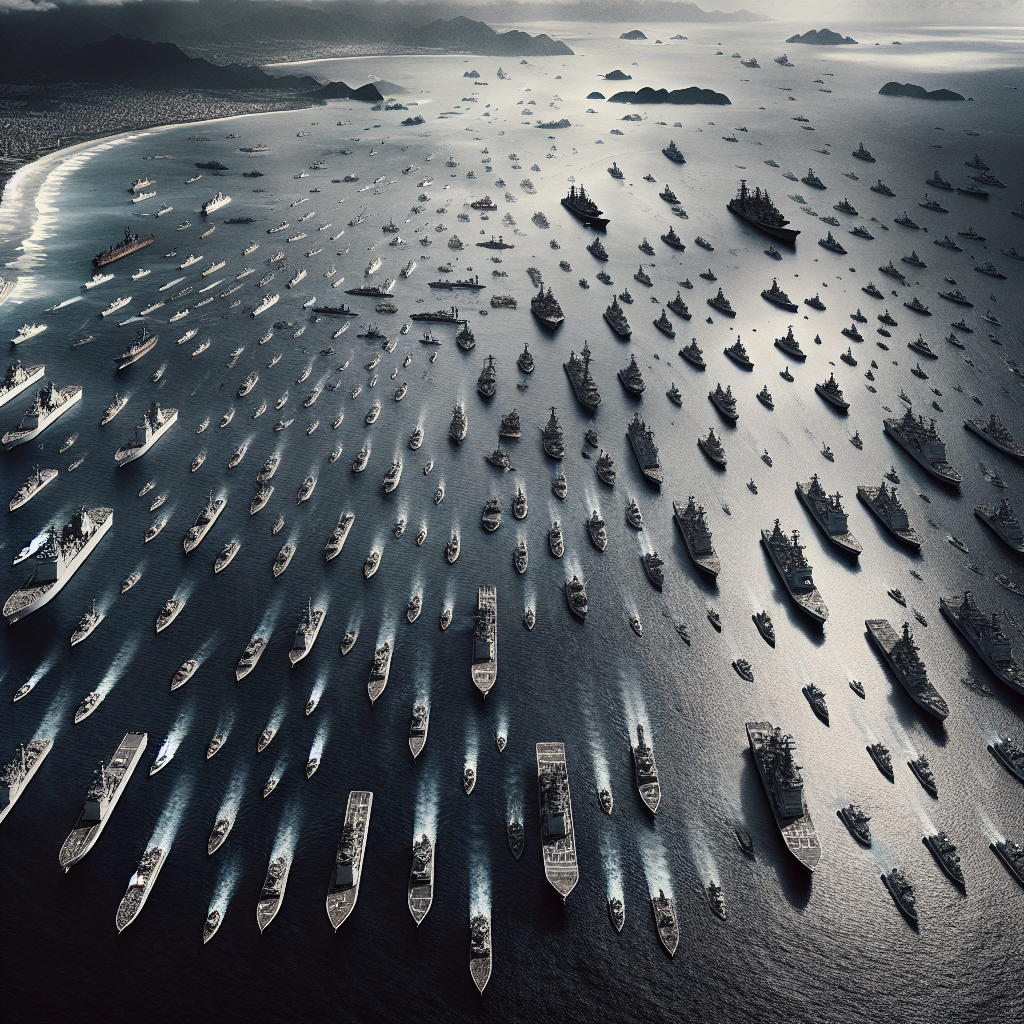
Recent sources have reported that the Chinese Communist Party (CCP) has assembled over 100 warships and coast guard vessels in the waters of East Asia, describing it as an “unprecedented” show of force. Both Taiwan and Japan have expressed concern over this development. Experts suggest that this military activity comes at a time of increasing tensions in the region due to the warming of relations between the United States, Japan, and Taiwan, reflecting the multiple diplomatic and strategic pressures facing the CCP that will further tighten relationships with the US and neighboring countries.
According to four sources and intelligence reports reviewed by Reuters, the CCP initiated this maritime force gathering in mid-November, surpassing the large-scale maritime deployments at the end of 2024, with at one point over 100 navy ships and coast guard vessels, marking the largest scale in history.
The participating vessels in the military exercises span from the southern Yellow Sea, through the East China Sea, the disputed South China Sea region, to the western Pacific Ocean, including the waters around the Taiwan Strait and the eastern Philippines. Although the military has not officially announced it as a large-scale exercise, activities have involved simulated fighter jet attacks on foreign vessels and training to deter intervention.
Taiwan’s National Security Bureau Director, Chai Ming-yan, confirmed that the CCP has four naval task forces active in the Western Pacific, but did not provide specific details.
In response, Taiwan’s Presidential spokesperson, Kuo Ya-hui, stated that the CCP’s military actions spreading from the southern Yellow Sea, East China Sea, South China Sea all the way to the western Pacific Ocean are indeed a “threat to the region.” She emphasized that the President has instructed the Ministry of National Defense and National Security agencies to fully understand and promptly report the situation to ensure “national security without worries.”
The Presidential Office urged the CCP to act as a responsible major power and to exercise restraint in its behavior. The Ministry of National Defense stated that through joint intelligence surveillance means, the military can effectively monitor the movements of the CCP’s forces and respond appropriately.
In Tokyo, Defense Minister Taro Kono, when asked about the CCP’s activities in the East China Sea, stated that Japan has taken note of the relevant reports and is “closely watching” the CCP’s military movements, but declined to comment on specific deployments.
Information released by Japan’s Ministry of Defense Joint Staff Office showed that on November 11, three ships including the Type 055 missile destroyer “Anshan,” Type 054A missile frigate “Linyi,” and Type 903 integrated supply ship “Dongping Lake” sailed through the Osumi Strait into the Pacific Ocean in two groups. Additionally, the frequency of CCP coast guard vessels entering the waters of the Senkaku Islands (called “Diaoyu Islands” by China) has noticeably increased.
November and December have historically been peak periods for CCP military exercises, but the military has not announced any large-scale formal exercises.
Researcher at the Taiwan Institute for National Defense and Security Studies, Chung Chih-tung, believes that this military gathering by the CCP is a comprehensive display in response to ongoing pressure on Japan and Taiwan.
Chung Chih-tung told Epoch Times that the targeting of this deployment is evident. Previously, Japanese Prime Minister Taro Kono made comments on Taiwan and adopted a tough stance against the CCP, while Taiwan also allocated a special defense budget, which the CCP expressed dissatisfaction with through military exercises.
Military commentator Mark analyzed the multiple factors behind this military exercise from a broader perspective: in addition to the CCP’s customary peak period for naval training at the end of the year, firstly, facing recent remarks by the Japanese Prime Minister on Taiwan, the CCP is continuing to exert pressure diplomatically and militarily, but Japan has not relented.
Secondly, Taiwanese President Lai Ching-te proposed a military special budget of about $40 billion USD to strengthen defense and purchase weapons from the US. Furthermore, President Trump recently signed the “Taiwan Assurance Act,” posing a challenge to the CCP’s long-standing insistence on the so-called “One China Principle.”
The final factor mentioned by Mark is the continual decline in the Chinese economy, high unemployment rates, and growing public discontent. He analyzed that the CCP’s constant stirring of international focus to shift domestic pressure on public opinion, but its frequent military intimidation is leading to closer relations between the US, Japan, and Taiwan.
The CCP’s large-scale military assembly occurs against the backdrop of heightened tensions in Sino-Japanese relations and the deepening institutionalization of US-Taiwan relations.
Japanese Prime Minister Taro Kono stated during parliamentary questioning on November 7 that a military conflict in the Taiwan Strait could be seen as a threat to Japan’s survival, prompting a strong reaction from the CCP, with official media intensively criticizing Taro Kono.
However, the CCP’s pressure has not led Japan to back down. A survey conducted by Yomiuri Shimbun from November 21 to 23 showed that support for the Kono Cabinet reached 72%, marking an exceptionally high performance among Japanese cabinets.
Japan not only refuses to compromise but accelerates its defense capabilities enhancement. On November 20, the ruling Liberal Democratic Party of Japan announced the initiation of the revision of the “Three Security Documents.” Taro Kono instructed to speed up the growth rate of the defense budget, aiming to reach 2% of GDP by 2025, which would then become the world’s third-largest defense budget.
As for US-Taiwan relations, on December 2, Trump officially signed the “Taiwan Assurance Act,” which requires the US State Department to submit a review report at least every five years, assessing how to deepen US-Taiwan relations and evaluate the possibility of lifting previous interaction restrictions. The Act supports normalizing arms sales to Taiwan, helping Taiwan enhance its defense capabilities, and assisting Taiwan in participating in international organizations.
On the same day, both the CCP’s Ministry of Foreign Affairs and Taiwan Affairs Office stated that the Taiwan issue is the “first uncrossable red line” in Sino-US relations and urged the US to stop official interactions with Taiwan.
Regarding the impact on regional security of this large-scale deployment, Chung Chih-tung emphasized that the CCP’s series of military exercises from the Yellow Sea through the East China Sea to the South China Sea validates Japan’s previous concept of a “single theater.”
He pointed out, “Any occurrence in the Taiwan Strait, East China Sea, or South China Sea is not only limited to that area, but will affect the entire East Asia region.”
Chung Chih-tung further analyzed that this deployment highlights the CCP’s attempt to change the current regional order, but it will also provoke a collective counteraction from neighboring countries.
From a shipping perspective, the Taiwan Strait handles at least one-fifth, sometimes up to half, of global shipping, while the South China Sea sees one-third of global maritime trade. Chung Chih-tung stressed that conflicts in these regions would affect the world, not just the neighboring countries.
He believes that the CCP’s deployment in coastal areas actively prepares to break through the island chain, deter Japan, Taiwan, and the Philippines while demonstrating its deterrence to countries like the US, “showcasing its regional deterrence capabilities.”
Mark analyzed the CCP’s moves from a broader international perspective. He said that the CCP’s purpose in this action is to challenge the existing international order. Xi Jinping has always emphasized the “Rising in the East and setting in the West” and the future new order, attempting to make the US “hesitant or dare not act lightly” in supporting Taiwan through showcasing naval power.
Mark characterized the CCP’s actions as “militarism combined with nationalism, somewhat like the Nazis,” calling it “Nazi Communism.”
However, Mark stated that the CCP’s external provocations will have a counterproductive effect. He analyzed that with only North Korea, Russia, and Iran as staunch allies, the CCP’s military display is making neighboring countries more vigilant and continuously increasing military spending, sparking a new round of arms race.
He believes that this approach will ultimately make East Asian countries wary of the CCP, causing countries around the South China Sea to distance themselves, leading to closer relations between the US and the first island chain countries – Japan, South Korea, Taiwan, and the Philippines.