
Chinese artists’ biggest dilemma is the pervasive content censorship by the CCP, which hinders their ability to freely express themselves and create works reflecting the realities of national affairs and livelihoods, forcing them to seek inspiration from ancient history or romantic themes. Even when some painters go abroad, they are still constrained by factors like cross-border persecution by the CCP.
However, a Chinese couple in Los Angeles has been able to paint with their hearts, courageously depicting sensitive topics that Chinese people care about but cannot voice.
Last weekend (November 29th and 30th), Geoffrey Jin and Gloria Wang held a “Democracy & June 4th Themed Art Exhibition” at the June 4th Museum in Los Angeles, showcasing nearly twenty digital paintings focusing on bitter and bloody political themes, leaving the audience in awe of the power of art.
Wang grew up in a family with a strong atmosphere of free thinking, where her grandfather studied in England. She graduated in media studies and faced suppression multiple times for her expressions in China.
Jin, coming from a design background, has a family history of persecution by the CCP: His grandfather was an official in the Nationalist Government’s intelligence department and was arrested after the CCP took power, disappearing without a trace; his father was also oppressed and falsely sentenced to six years in prison.
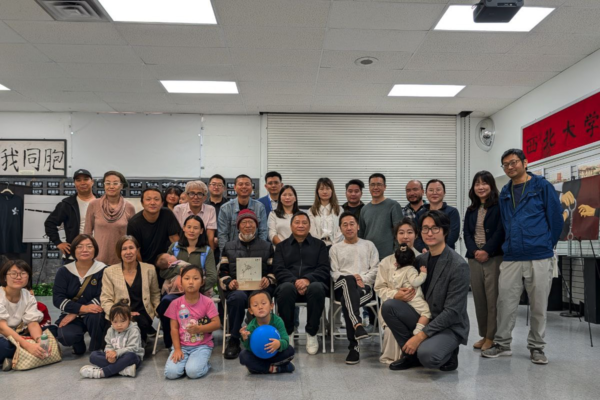
The art exhibition opened on Saturday morning, with over twenty guests in attendance, including veteran founder of the Chinese Democratic Party Zhu Yufu, Director Wang Dan and Executive Director Jin Hui of the June 4th Museum, along with Geng Guanjun, an executive member of the Los Angeles branch of the Chinese Democratic Party. The couple first shared the inspiration behind their creations.
Prior to moving abroad, due to the CCP’s omnipresent content control, Wang had already left the journalism industry. She said, “I had enough of that life with news guidelines telling us what we can or cannot say.”
When asked why she supports her husband in creating these sensitive works, Wang stated, “I think what needs to be said should be said, we shouldn’t be afraid.” She added, “These things should be reported and documented; it’s the most basic professional ethics and qualities for a journalist.”
All the artwork created that day was done on a digital drawing board. While the themes were familiar to people, the visual impact was stronger than mere words.
Jin explained that in the design industry, there is a saying: when designing, you mustn’t directly express what you want to say in words; you can ‘hide’ it, allowing viewers to discover what you want to convey from the art. Therefore, for each piece they create, they spend days contemplating and infuse more details into the artwork.
The artist couple pointed out that artists are the most sensitive elites, and their inspiration comes from their perception of reality. However, under the high pressure from the CCP, artists face tremendous difficulties, with even the right to speak freely being deprived.
Wang revealed that when conceptualizing the artwork, they often had sleepless nights: “Every person in the painting fills me with sadness because these real people are either disappeared or under surveillance; if they were in a free and democratic society, they would have a bright future.”
The first painting one sees upon entering the hall is a portrait of “Coder Huang” from the Overseas Chinese community—a familiar figure known for spreading civic knowledge through computer technology and ultimately sentenced to seven years in prison.
Wang expressed her admiration for Huang, who anonymously and rationally taught people about human rights.
The painting depicting “Ink-splashing Lady” Dong Qiongyao adopts a Japanese manga style. It features three figures: a restrained and struggling Dong Qiongyao in the middle, a gloomy-eyed mental hospital staff member on the upper left, and a tearful Dong father Dong Jianbiao on the upper right. The scene is forcefully impactful, making the audience empathize with the family’s persecution.
The digital silhouette “Tank Man,” reflecting the spirit of June 4th, was particularly commended by the leader of the 1989 Democracy Movement, Wang Dan. The image shows three people lifting a tank together. Wang explained that in reality, three individuals couldn’t lift a tank, symbolizing the concept of “One gives birth to two, two gives birth to three, three gives birth to everything”: unity is key, as more people stepping forward can change China’s history.
Upon viewing the exhibition, Chinese Democratic Party member Liu Fang felt that images are more moving than words. The artwork that struck her the most was the painting of three students raising a tank: “I really like this style reminiscent of prints, as if sculpted into everyone’s memory.”
Wang Dan expressed that two aspects of the exhibition particularly moved him: “First, the two artists were born around 1989, yet they are willing to express memories of historical truths, which is very inspiring to me; second, using art as a form of expression is something we greatly anticipate.”
He was pleased with the June 4th Museum hosting this art exhibition: “This is a great help to the museum itself.” ◇