
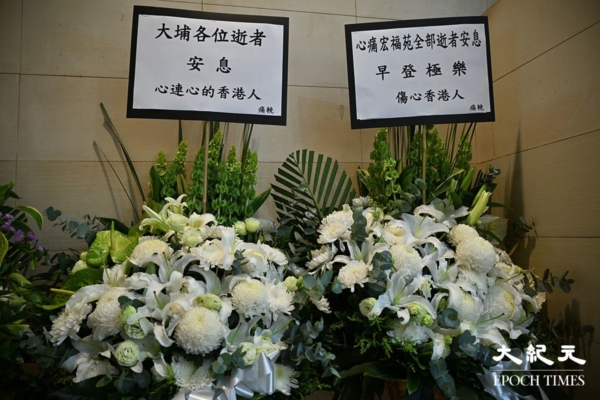
Hong Kong Legislative Council elections will proceed as scheduled on December 7th despite concerns of the significant impact caused by the tragic fire at the Grand Promenade in Tai Po. The largest party in the Legislative Council, the Democratic Alliance for the Betterment and Progress of Hong Kong (DAB), is embroiled in controversy related to the fire, with the party acknowledging the grave situation and issuing an urgent call for support. Amidst the public’s mourning, interest in the elections remains low.
The five-alarm fire at the Grand Promenade on November 26th led to the suspension of election campaign activities by the Hong Kong government. However, on December 2nd, Chief Executive Carrie Lam announced that the LegCo elections would proceed on the 7th as planned.
Subsequently, the DAB took to Facebook to express support for the scheduled elections and refuted ongoing online accusations against the party as baseless and part of an organized effort to undermine their campaign. With the DAB facing a severe electoral landscape, they urge citizens to come out and vote on Sunday to support them, emphasizing that every vote counts.
On December 4th, the DAB released a video declaring the election situation as critical. Party Chairman Chen Keqin criticized those attempting to tarnish the DAB’s image and called on voters to show their support at the polls.
The DAB’s official Facebook page straightforwardly states, “Election Situation: Severe and Urgent.”
Currently holding 19 seats in the Legislative Council, the DAB has 26 party members running in the upcoming elections.
The primary cause of the Grand Promenade fire was attributed to maintenance issues. Many residents had expressed dissatisfaction with the exorbitant maintenance projects approved by the previous owners’ corporation.
According to a report by Reuters on December 5th, local residents asserted that authorities had acknowledged the use of substandard building materials in the renovation projects in the higher floors of the North Tai Po area, resulting in the fire. The residents expressed anger and shock over the revelation.
In an interview with Epoch Times on December 1st, Lin Song, a political scientist and journalism educator from Hong Kong now residing in Australia, highlighted the public demand for accountability regarding the use of these safety nets during the construction, questioning potential profiteering motives behind the decisions. He expressed disappointment in the DAB, a pro-establishment party, for its lack of responsibility in the matter and its past promotion of the maintenance projects.
Concerns have been raised over DAB member Wong Bik-kiu, who previously served as an advisor to the owners’ corporation of the Grand Promenade in the last term and defended the maintenance projects, facing harsh criticism from netizens after the fire. The DAB released a statement condemning the online defamation and vowed not to tolerate any illegal actions by their members, including Wong.
As the public struggles to recover from the tragedy, interest in the elections has waned.
Mr. Lau, 82, noted, “This incident will certainly impact voter turnout… (Hong Kongers) are not interested and lack enthusiasm for the elections.” May Li, 48, echoed similar sentiments to Reuters, stating that “everyone is feeling very heavy-hearted now” and questioning how elections could proceed in such circumstances, suggesting a potential postponement.
On December 5th, Hong Kong’s Sing Tao Daily reported the somber atmosphere in the society following the Grand Promenade fire, with election fervor noticeably subdued. The DAB faces a barrage of online attacks and perceived challenges from pro-establishment parties in light of the fire incident, impacting the party’s electoral prospects in the region-direct elections.
Moreover, based on sources within different political parties, the outlook on voter turnout is pessimistic, and uncertainties loom over whether the previous 30% voter turnout rate can be sustained.
Legislative Council members noted that the pain from the fire is still raw, leading the government to adopt a cautious approach in election promotion to avoid stoking public anger. Government initiatives promoting voter participation among civil servants have also reportedly decreased in intensity.
The current registration of voters has decreased by 330,000 this year. Political figures estimate that maintaining the 1.35 million voter count from 2021 could yield a turnout of 32.63%, exceeding the previous 30.2% rate. Conversely, a reduced number of registered voters may result in a significant decline in voter turnout if the rate remains at 30%.
The ongoing LegCo elections in Hong Kong mark the 8th session and the 2nd session following the conclusion of the anti-extradition movement and the implementation of new electoral regulations.
In 2019, Hong Kong witnessed a year-long anti-extradition movement, followed by the enforcement of the National Security Law in 2020. The government’s revisions to the Legislative Council election procedures require candidates to demonstrate loyalty to China and Hong Kong, aligning with the Communist Party’s principle of “patriots governing Hong Kong”.