
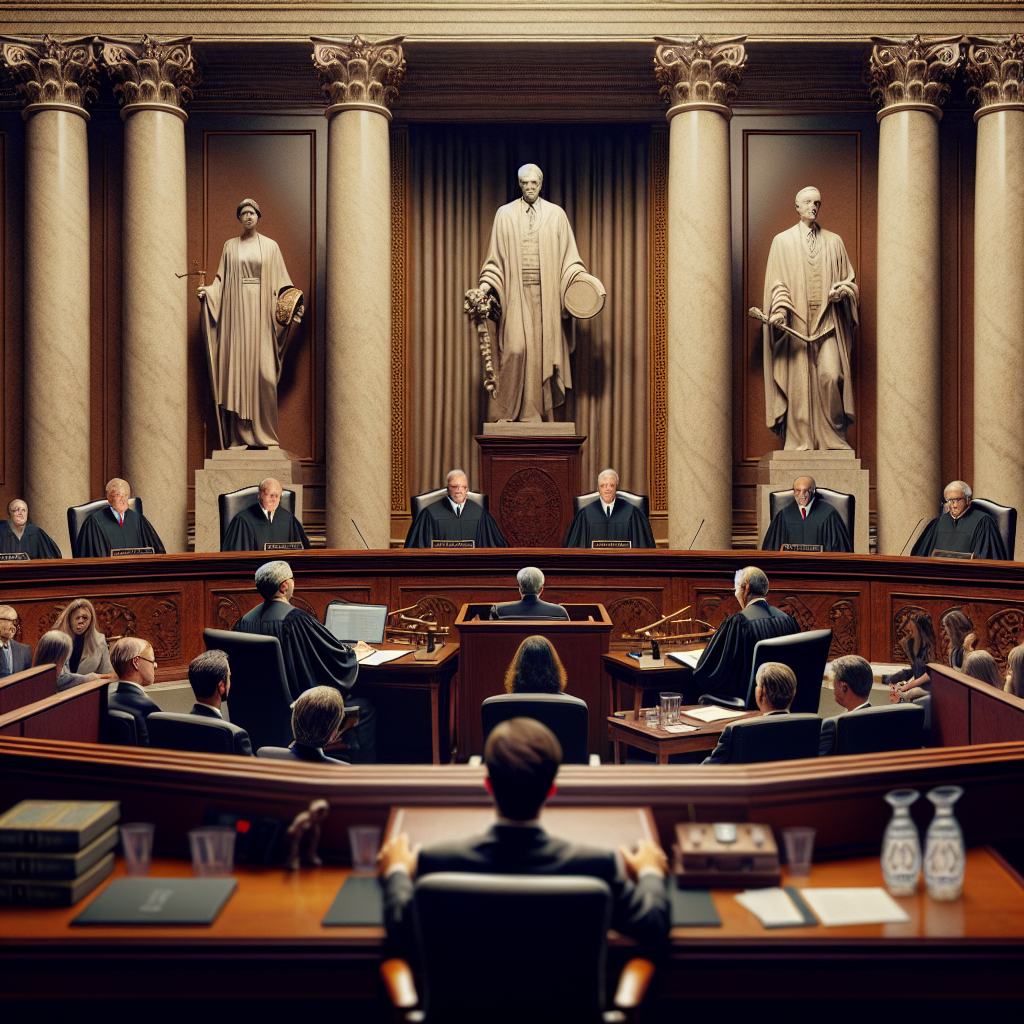
On Tuesday, December 9, the United States Supreme Court held a debate for over two hours on an appeal filed by the Republican Party. The appeal sought to overturn the limits on party and candidate “coordinated expenditures” in federal elections (Congressional and Presidential elections). At least four conservative justices seemed to lean towards the plaintiffs’ viewpoint.
The case is known as “NRSC v. FEC” (National Republican Senatorial Committee v. Federal Election Commission). It was brought forth by the National Republican Senatorial Committee (NRSC), the National Republican Congressional Committee (NRCC), former Ohio Senator Vance (current Vice President), and former Congressman Steve Chabot.
In 2024, the Sixth Circuit Court of Appeals in Cincinnati upheld the restrictions, prompting the Republican Party to appeal to the Supreme Court.
The appellants argued that the limitations imposed by the Federal Election Commission (FEC) under the 1971 Federal Election Campaign Act on “coordinated expenditures” (expenditures cooperatively made by parties and candidates) violated the First Amendment’s freedom of speech.
These restrictions set limits on the amount parties can spend in coordination with candidates, aiming to prevent large donors from circumventing individual contribution limits by channeling unlimited funds through parties to specific candidates. If coordinated expenditures are not constrained, it essentially eliminates the cap on individual political donations to a particular candidate.
Republicans argued that these limits restrict their ability to campaign, violating the core rights of the First Amendment and should be overturned.
On the other hand, supporters of the restrictions believe that limiting coordinated expenditures between party committees and candidates is based on the theory that unlimited spending would foster corruption, allowing wealthy individuals to gain excessive political influence through donations.
Under the Trump administration-led Federal Election Commission, there has been a shift in position to support the elimination of these restrictions.
Sarah Harris, a lawyer for the Trump administration, stated that the initial cap set by Congress was not to prevent genuine corruption but to make an “upper limit judgment” on how much campaigns should spend.
At least four conservative justices expressed agreement with the plaintiffs’ viewpoint during the hearing. Justice Brett Kavanaugh pointed out that the current laws have significantly weakened parties compared to external political groups, which could have a negative impact on constitutional democracy.
Chief Justice John Roberts, Justice Amy Coney Barrett, and Justice Neil Gorsuch’s stances remain unclear.
The three liberal justices tended to uphold the restrictions. Justice Sonia Sotomayor warned that removing the cap on coordinated expenditures would leave no limits at all, leading to complete lack of control.
She cited an example where the biggest donor to the incumbent president would immediately receive “sweet” government positions or contracts after the elections, raising concerns of quid pro quo.
As of 2025, the current limits on coordinated expenditures are as follows: for Senate campaigns, $127,000 in smaller states and nearly $4 million in California; for House campaigns, $127,000 in single-district states and $63,600 in other states.
Republicans argue that in this era of unlimited spending by super PACs, parties are at a clear disadvantage. During the 2024 election cycle, conservative super PACs spent approximately $1.8 billion compared to nearly $800 million spent by liberal super PACs.
The Supreme Court is expected to make a ruling by the end of June 2026, just before the November 2026 midterm elections, as the Republican Party seeks to maintain control of both chambers of Congress. The outcome of this case could profoundly impact the future landscape of American campaign funding and is being closely watched by all sides.