
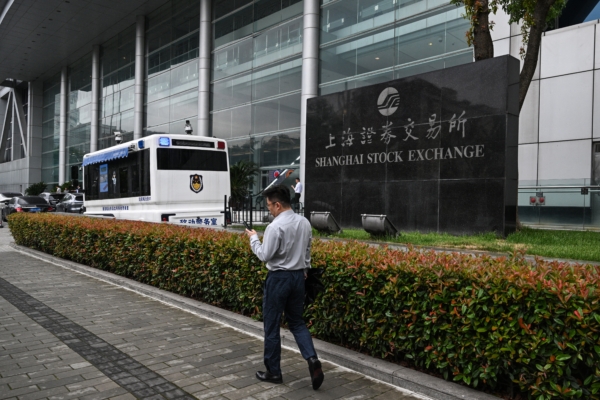
On December 9th, the A-shares experienced a general decline with over 4000 stocks in the red, resulting in a total transaction volume of 1.904 trillion yuan (RMB) in both Shanghai and Shenzhen markets, marking a daily decrease of 132.7 billion yuan.
At the close of the market, the Shanghai Composite Index fell by 0.37% to 3,909.52 points, while the Shenzhen Component Index dropped by 0.39% to 13,277.36 points. On the other hand, the ChiNext Index rose by 0.61% to 3,209.60 points. Over 4000 individual stocks across the market witnessed a decline. The total transaction volume in Shanghai and Shenzhen exceeded 1.904 trillion yuan, down by 132.7 billion yuan compared to the previous day.
In terms of sector performance, there were more decliners than gainers. Leading the gains were the commercial retail, telecommunications services, and photovoltaic equipment sectors, while the biggest losers came from the non-ferrous metals, pharmaceutical retail, precious metals, steel industry, energy metals, fertilizer industry, and coal industry sectors.
The top three industries with the highest net inflows of main funds were electronic components, photovoltaic equipment, and commercial retail, with inflows of 3.364 billion yuan, 1.223 billion yuan, and 1.018 billion yuan respectively. On the other hand, the top three industries with the highest net outflows of funds were internet services, non-ferrous metals, and software development, with outflows of 4.447 billion yuan, 4.376 billion yuan, and 4.358 billion yuan respectively.
The movement of A-shares has always been a topic of great interest to the public.
Independent commentator “Lao Xu Shi Ping” commented, “The market has been experiencing a net outflow these days, with scattered hotspots and a lack of sustainability. The atmosphere is stagnant, except for those fiercely speculated stocks, where it’s either CPO day or PCB day every day, or occasionally CRO day, or the frenzy of lifting low-value junk stocks or major financial stocks. It depends on whether retail investors dare to chase. Without volume, ultimately, there will be a downward trend!”
The head of the Technical Department at Tianyuan Huijin (Fujian) Precious Metals Investment Co., Ltd., financial advisor Li, posted, “Some always think ‘just wait a bit longer for a rebound,’ only to go from a small loss to a deep trap. There are also those who think ‘I’ve already lost so much, cutting losses would be a shame,’ and watch helplessly as their account numbers get worse.
“In fact, setting a stop loss is not admitting defeat but rather installing a ‘safety valve’ for investment, just like wearing a seatbelt when driving. It’s not about predicting accidents but about preemptively blocking potential fatal risks. It helps you preserve the bottom line of your capital and seize the opportunity for a turnaround next time: by stopping losses in time this time, you’ll have ammunition to catch a real good market next time.
“Don’t let the market sentiment drag you down, don’t let luck erode your capital. Today, I’ll remind once again: set your stop loss line, execute when it hits, it’s more effective than any ‘bottom fishing technique’.”