
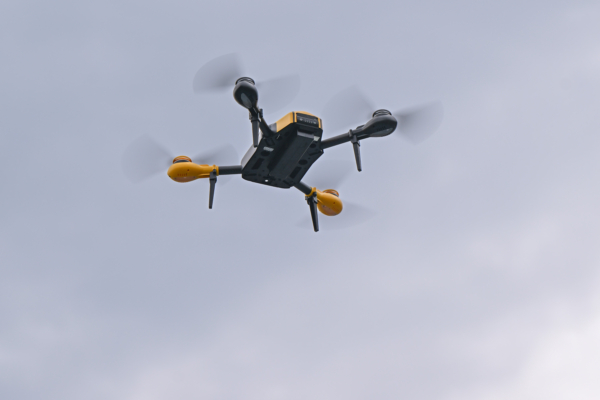
Recently, a netizen in Shanghai shared on social media that he was taken away by the police within half a minute of test flying his newly purchased DJI drone at home, under suspicion of unauthorized flying. The netizen stated that the police brought him to the police station where he was interrogated for several hours. The case was eventually closed with a determination of “misoperation,” but the entire experience left him shocked.
On December 1st, a netizen with the username @jackygu2020 wrote on the social media platform Threads that he flew the drone indoors for about twenty seconds to test it, confirmed its normal operation, and then turned it off. However, shortly after, two police officers showed up at his door and took him to the police station. He claimed that the evidence presented by the authorities included indoor photos taken by the drone, flight path records, as well as chat logs and logistics information related to his purchase of the drone.
The most discussed aspect of this incident is the technical details mentioned by the netizen. He mentioned that he did not have the Wi-Fi on and there was no GPS signal at his home during the test flight, yet the police were still able to access the photos and flight records captured by the drone, as well as quickly retrieve his purchase records and chat content. He expressed bewilderment and a sense of being “terrified.”
A network technology analyst in Shenzhen, Hua Min, confirmed that under current technical conditions, such data retrieval is entirely possible. He explained, “Drone applications typically generate flight logs, thumbnails, and other data automatically during device activation, test flights, or power-ups, and then transmit them back to the manufacturer’s servers once the phone is connected to the Internet.”
Hua Min also pointed out that even for devices exported to the United States or Europe, the serial numbers, phone-bound accounts, and operator data of such devices could be synchronized in the background. He said, “Once an account is linked to a phone number, the operator’s big data will automatically enter the public security detection system.”
He told the reporter that in cases he has dealt with, many domestically produced electronic devices, as long as they have internet connectivity, theoretically grant manufacturers remote management permissions, including widely used “Made in China” routers.
Recently, many regions in mainland China have deployed low-altitude monitoring systems that can detect drone radio signals, identify device types, and locate operators. Upon detecting suspected “irregular” flights, the system can automatically alert local police for investigation.
Cracking down on illegal drone flying is a priority in Shanghai. The term “black flying” refers to the flying behavior of drones (or other low-altitude aircraft) that have not been approved, filed, or violate management regulations. The netizen mentioned that upon further investigation, he discovered that Shanghai has been cracking down on illegal drone flying on a large scale recently. Due to Shanghai’s high-density urban airspace, most areas are designated as no-fly zones. Even within permitted airspace under air traffic control, flying without approval could still be deemed illegal.
He expressed that if he had been test-flying outside in the community or on a balcony, he might have been detained immediately. He also mentioned that there have been numerous similar cases around him.
Public security departments across China have recently been publishing notices of cracking down on illegal drone flying. According to official reports, cities like Beijing, Guangzhou, and Chengdu have established routine monitoring systems. Some areas have included unauthorized flying into public security penalties, and those with severe offenses may even face criminal risks.
The most controversial aspect of this incident is how the police obtained the netizen’s flight data and photos. Professional Sun Daping pointed out that domestic drone manufacturers generally provide “necessary data” to law enforcement agencies under regulatory requirements. He explained, “Although many data are generated by user devices, once the phone is connected to the Internet, it could be synchronized to the cloud. And if requested by the police, data such as e-commerce shopping and logistics information, platform chat records, and RF detection locations must also be provided.”
The information provided by the netizen shows that the police integrated data from multiple platforms in a short period, including drone flight logs and cached photos, e-commerce shopping and logistics information, platform chat records, and RF detection locations. Sun Daping stated, “These details indicate a high level of technical integration in China’s drone management, raising concerns and even panic among the public about data retrieval transparency and boundaries.”
With the increasing popularity and production volume of drones, various regions in China are intensifying the construction of the so-called “low-altitude defense network” to strengthen real-time control of civilian drones.
Scholar Zhang Yang from Tsinghua University told the reporter that the netizen’s experience shows that even a brief indoor test flight could trigger monitoring systems and lead to police intervention. He said, “If he had been test-flying on a community rooftop instead of at home, he might have ended up in detention immediately.” He believes that the boundaries of local law enforcement authority are becoming increasingly blurred.