
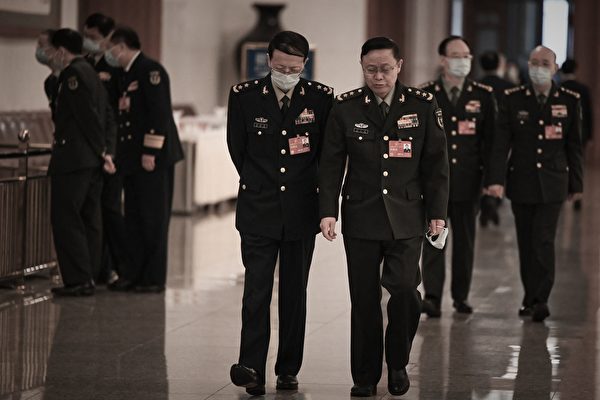
In recent times, there has been frequent turnover among the top leadership at the National Defense University, which is touted as the highest military institution of the Chinese Communist Party. Rumors are circulating about multiple officials falling from grace, though the exact situation remains unclear. There are reports indicating that there is a sense of unease among the faculty and staff at the university, as no one is certain who might be the next to face repercussions, leading to a reluctance among lower-ranking individuals to engage with the leadership of the institution.
According to news from the Chinese Embassy in North Korea’s official website, on October 25th, more than 140 individuals including Major General Xia Zhihe, the political commissar of the National Defense University, attended an event at the embassy while visiting North Korea. This suggests that Xia Zhihe has succeeded Zhong Shaojun as the political commissar of the National Defense University.
Independent commentator Du Zheng wrote an article for Taiwan’s media “Up Media” on December 11th, pointing out that Zhong Shaojun, who is considered a close associate of Xi Jinping within the military, attended the Fourth Plenum in October and quietly resigned without any new appointment afterwards, indicating that he has been handled discreetly.
Zhong Shaojun had only recently transitioned from the position of Director of the General Office of the Military Commission to the role of political commissar at the National Defense University in April of last year, a move that was not publicly disclosed. In August of this year, the Ministry of Defense of Singapore’s website revealed that officials from that country had met with Zhong Shaojun during his tenure as the political commissar at the National Defense University. However, this information was suppressed within China.
Zhong Shaojun’s predecessor as the political commissar of the National Defense University was General Zheng He.
Public records show that Zheng He, born in November 1958 in Shanghai, graduated from the Battle Tactics Department of the Frunze Military Academy in Russia. He had a long career in the Nanjing Military Region, holding positions such as the commander of the 31st Group Army, the commander of the 91st Division, and the deputy chief of staff of the Nanjing Military Region. After Xi Jinping took over the military, Zheng He served as the second director of the Military Training Department of the General Staff Headquarters, the Deputy Commander of the Chengdu Military Region, the Minister of Training Management of the Central Military Commission, the President of the Academy of Military Sciences in January 2017, the President of the National Defense University in June 2017, and finally the political commissar in August 2021.
Du Zheng believes that Zheng He’s background in the 31st Group Army of the original Nanjing Military Region is a hallmark of Xi Jinping’s trusted military personnel. Notably, several key figures from the 31st Army, such as former Vice Chairman of the Military Commission He Weidong and Commission Member Miao Hua, have already faced repercussions. While there is no clear information indicating Zheng He’s involvement in any issues, considering he has reached the retirement age, the fact that he has not been appointed to a position following retirement suggests that the situation might not be favorable.
The National Defense University has seen several high-ranking officials facing troubles. For instance, former National Defense University President General Wang Xibin (served from 2007 to 2013) was implicated in a job-related crime and fell from grace in February 2017.
Former National Defense University political commissar General Liu Yazhou (served from December 2009 to January 2017) retired prematurely in early 2017 before reaching the age of 65, and he was not given any position in the National People’s Congress or the Chinese People’s Political Consultative Conference as per usual practice.
Liu Yazhou, born in 1952, is the son-in-law of former Chinese President Li Xiannian. Towards the end of 2021, there were reports of him being investigated. In March 2023, the Hong Kong-based “Ming Pao” reported that Liu Yazhou was allegedly involved in significant corruption through foundations and associations, accumulating substantial wealth through illicit means.
Chinese political analyst Wang Juntao disclosed to “Epoch Times” on March 15, 2024, that after confirming with Liu Yazhou’s relatives, Liu Yazhou had been sentenced to life imprisonment.
However, there has been no official information released regarding Liu Yazhou’s case.
Both former and current Presidents of the National Defense University, including former President and current Minister of Equipment Development Xu Xueqiang, and current President Xiao Tianliang, were absent from the Fourth Plenum in October. Xu Xueqiang was also missing from the commissioning ceremony of the Fushun aircraft carrier in Sanya on November 5.
Independent commentator Cai Shenkun, with connections within the Chinese Communist Party system, revealed to Epoch Times on October 18th that Minister of Equipment Development Xu Xueqiang, National Defense University President Xiao Tianliang, and Political Commissar Zhong Shaojun have been relieved of their duties. He further mentioned that hundreds of generals are lining up for review as well. He noted that the so-called “Xi family army” that emerged after the 20th National Congress has essentially been purged.
According to informants cited by Du Zheng, there is a sense of anxiety among the personnel at the National Defense University currently, as the constant high-level changes are difficult to predict. Not knowing who might be next in line for repercussions has created an atmosphere where no one is eager to align themselves with those in power.
Established in January 1986 through the merger of the Military Academy, Logistics Academy, and Political Academy, the National Defense University has been recognized as the highest military institution within the Chinese People’s Liberation Army. Following the military reforms initiated by Xi Jinping in July 2017, the restructured National Defense University incorporated components from the original institution, the Nanjing Political College, the Xi’an Political College, the Art College, the Logistics College, the Shijiazhuang Army Command College, and the Armed Police Political College, along with professional training responsibilities from the Equipment Academy foundation.
There are three military academies that are directly under the leadership of the Central Military Commission of the Chinese Communist Party, namely the National Defense University, the Academy of Military Sciences, and the National University of Defense Technology. Prior to the military reforms under Xi Jinping, both the National Defense University and the Academy of Military Sciences were at the level of a major military region, while the National University of Defense Technology was at the level of a deputy major military region. Since the reforms, these three institutions have been downgraded by half – the National Defense University and the Academy of Military Sciences are at the sub-theater level, while the National University of Defense Technology is at the theater level. The National Defense University has always been regarded as the premier military institution within the Chinese Communist Party.