
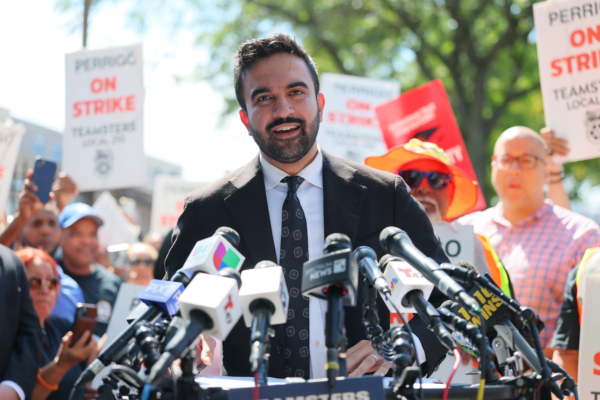
The latest opinion poll shows that socialist and Queens district state assemblyman Zohran Mamdani maintains a significant lead in the New York City mayoral election, leading former governor Andrew Cuomo by a substantial 21 percentage points.
According to a survey released on Tuesday, September 16 by the Marist Institute for Public Opinion, in a four-way race scenario, Mamdani garnered 45% of the support, followed by Cuomo at 24%, Republican candidate Curtis Sliwa at 17%, incumbent mayor Adams at only 9%, with 5% of voters still undecided on their support.
In the Democratic primary in June, Cuomo won most of the Black districts, but the latest poll shows that nearly half of Black voters (47%) now support Mamdani, while Cuomo only has 26% support, Adams 11%, and Sliwa at just 5%.
If Adams were to withdraw from the race, Mamdani’s lead among the overall electorate would narrow to 16 percentage points (46% to 30%). In a hypothetical head-to-head matchup, Mamdani would still maintain a 10-point lead over Cuomo, with 49% to 39%.
Mamdani’s performance stands out among young voters and liberal voters. Among voters under the age of 45, 62% support Mamdani, with only 14% supporting Cuomo. Among liberal voters, 86% of “very liberal” and 65% of “liberal” voters support Mamdani, while moderate voters lean towards Cuomo (35% to 31%); conservative voters mostly support Sliwa (42%), followed by Cuomo at 24%, Adams at 16%, and Mamdani at 14%.
In terms of ethnic distribution, Mamdani has the support of 51% of non-white voters, leading Cuomo 39% to 26% among white voters; more than half (52%) of Hispanic voters support him.
Despite Cuomo’s fierce criticism of Mamdani’s position on Israel, including his support for boycotting Israel, Jewish voters remain divided: 35% support Mamdani and 35% support Cuomo.
Mamdani leads his opponents in all five boroughs, with a notable 33 percentage point lead in the most populous borough of Brooklyn.
The survey was conducted from September 8 to 11, interviewing 885 potential voters through phone calls, text messages, and online questionnaires, with a margin of error of plus or minus 4.1 percentage points.