
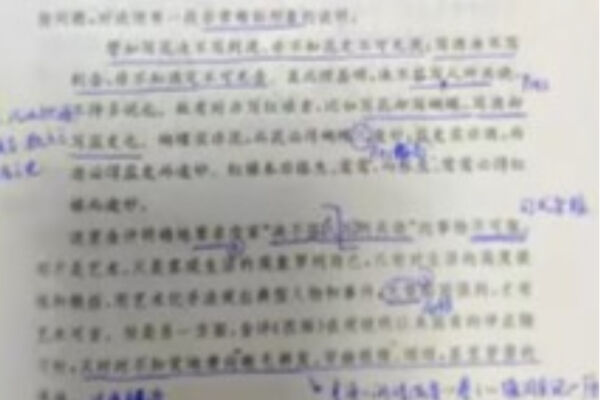
Recently, mainland China education blogger “Beida15Teacher” revealed on social media that two major ancient book publishers in China – Shanghai Ancient Books Publishing House and China Bookstore – have published a large number of errors in their editions of “The Story of the Western Wing” and “A New Account of the Tales of the World,” sparking public outcry. In response, these two publishing houses issued apologies and admitted to editorial quality issues in the books, announcing a comprehensive recall.
According to “Beida15Teacher” in a video posted on December 2nd, he stated, “The prestigious Shanghai Ancient Books Publishing House, well-known for the ‘Guoxue Diancang’ series, has at least 5 punctuation errors, 8 grammatical errors, 2 sentence structure errors, and 3 content errors within just 4 pages of the preface of ‘The Story of the Western Wing’… and countless non-standard expressions, each one more outrageous than the last!”
He gave examples such as missing punctuation in the phrase “jue bu rong xie ren suo gong xiao,” which should be corrected to “jue bu rong xie, ren suo gong xiao,” and “er hua bi de hu die er yu miao” should be “er hua bi de hu die er yu miao.” He showcased all the errors marked in the book, stating, “The sheer number of errors is shocking!”
Apart from the preface, the blogger also mentioned that in the introduction, there were 12 errors in just over 300 words, some of which were severe and critical mistakes.
The blogger expressed, “This ‘Guoxue Diancang’ version of ‘The Story of the Western Wing’ by Shanghai Ancient Books Publishing House has been in publication for nearly 10 years, with 11 printings, and yet after a quick read, I found over 300 various bizarre errors.”
In the video posted on December 5th, the blogger stated that the other ancient book publishing “giant,” China Bookstore, had just as many “basic errors” in their edition of “A New Account of the Tales of the World.” For example, in “Wang Ziyu Xue Ye Fang Dai,” “yin qi tang huang” was written as “yin qi shang huang,” and “huan nai fa chu hou qu zhi, hao jia li” was incorrectly written as “huan nai fa chu hou qu zhi, hao jia li fu.”
The blogger lamented, saying, “In this ‘Recommended Reading Series for Language Classes,’ the two thin booklets of over 100 pages each have at least 30 errors!”
The video quickly gained widespread attention online. Many netizens criticized, asking, “What are these people doing?” “Is this the level of professional editing?” “Are these publishing houses taking advantage of the readers’ lack of education?” “I have completely lost confidence in the quality of books from major publishing houses.”
Others commented, “Those in education and culture are lacking culture, and this statement still holds true.” “People nowadays are impatient, focused solely on making money, without emphasizing diligence.” “Every industry is cutting corners, and our culture has been completely degraded by them.”
Under public pressure, on December 6th, China Bookstore issued a notice for recall, citing editorial quality issues in the book “A New Account of the Tales of the World (Student Edition),” requesting all distributors to remove the book from shelves and return them to the publisher.
On December 7th, Shanghai Ancient Books Publishing House issued a recall notice, apologizing for the editorial quality issues in “The Story of the Western Wing,” stating that they had informed distributors to fully recall the book on December 3rd.
China Bookstore and Shanghai Ancient Books Publishing House are referred to as the “two giants” of ancient book publishing in China. China Bookstore is headquartered in Beijing and is a state-owned enterprise engaged in book publishing and distribution, as well as one of the largest publishers of ancient literature.
Shanghai Ancient Books Publishing House is also a state-owned enterprise, claiming to focus on publishing high-quality ancient texts, data integration, and original academic research works. It is indirectly supervised by the Shanghai State-owned Assets Supervision and Administration Commission.