
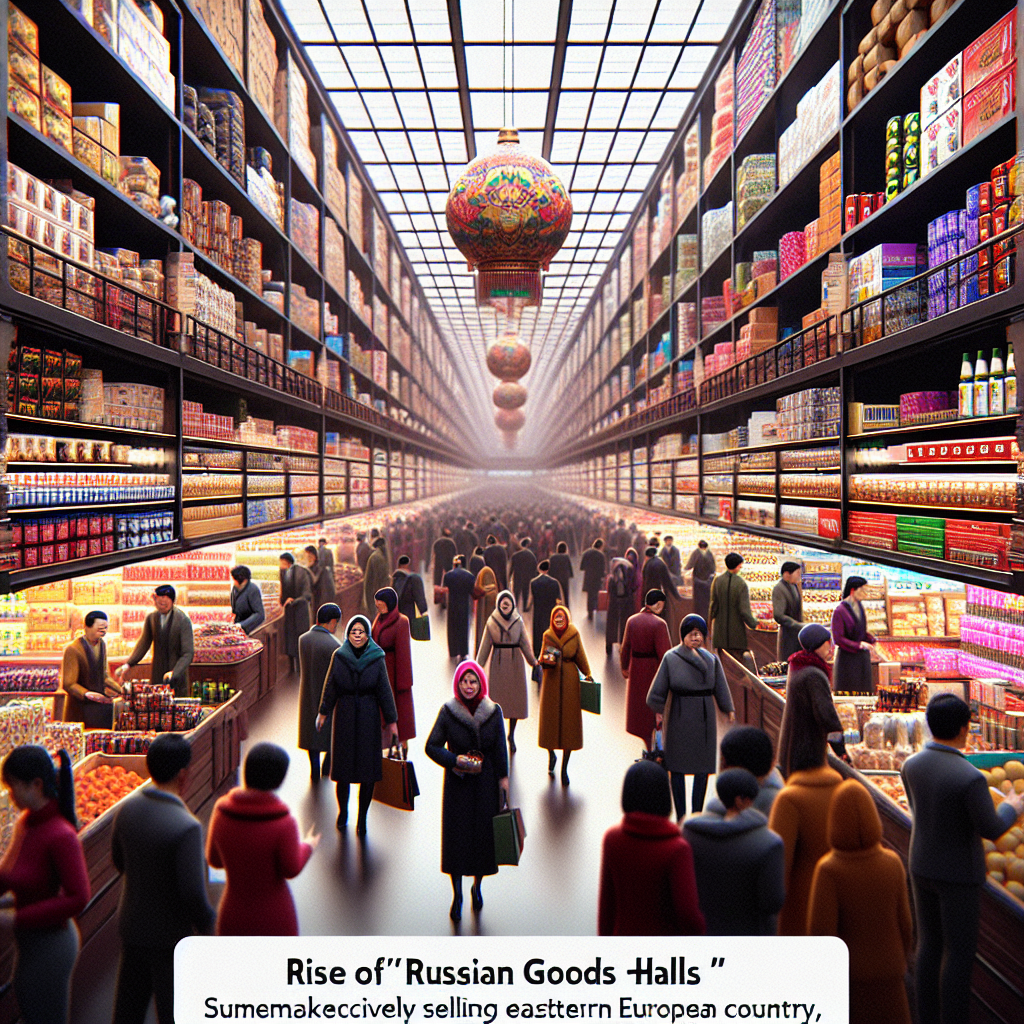
After the outbreak of the Russia-Ukraine war, under the influence of the Chinese Communist Party’s pro-Russian political propaganda, many “Russian Goods Halls” or Russian supermarkets with the selling point of so-called “hardcore Russian goods” have emerged throughout mainland China. However, recently, the dark side of their involvement in counterfeit goods has been exposed.
These “Russian goods stores” play Russian music and even hire Russian staff. Since the end of last year, several Russian bloggers in China have visited various stores and found that many of the goods in the Russian Goods Halls are not actually from Russia. Some of the “Russian goods” are unheard of in Russia, or they come from Northeast China and Central Asia and Eastern Europe. Some authentic Russian goods are priced several times higher in China than in Russia.
A Russian blogger living in Shanghai recently posted a video on social media claiming, “I’ll show you how Chinese people deceive Chinese people.” She visited a “Russian goods hall” in Shanghai and found that none of the goods were actually from Russia but were local specialties from Northeast China with a Russian flair. She identified several “Russian goods” that she had never seen in her homeland and was later asked to leave by the staff.
Another blogger in Guangdong discovered at a “Russian goods hall” that a brand of instant noodles commonly bought in Russia was being sold for 2 yuan locally but marked up to 10 yuan in Guangdong. The red wine was from Armenia, and the “Tiramisu Russian-style cake” was produced in China. The bloggers mentioned that only about half of the goods sold in the store were genuinely from Russia.
A video circulating on social media showed a Russian woman quietly revealing to a blogger in a Yunnan-based Russian supermarket labeled as “hardcore Russian goods” that many of the products were fake. She pointed out that most of the items were made in China, with exaggerated prices and inaccurately translated Russian text on the labels.
The woman pointed out a product labeled as Russian honey, stating, “The color indicates that this is not honey but sugar.”
The Russian woman also noticed some chocolate from Russia but marked up significantly compared to prices in Russia. She picked up a piece of chocolate and said, “This is very cheap in Russia, only about ten yuan.” However, in this Russian supermarket, the price tag indicated 68 yuan.
The store offered various products such as Russian durian candy, coffee, and tropical fruit products. A Chinese blogger pointed out that since Russia has a cold climate, it is impossible for them to produce these tropical fruits.
Following various netizens exposing fake Russian goods, authorities in Hangzhou, Zhejiang, and Nanning, Guangxi, have recently taken action to “rectify” the situation.
According to reports from CCTV and other mainland media, the “Russian goods halls” indeed have few actual Russian imports. Many products come from countries in Central Asia and Eastern Europe such as Kazakhstan and Armenia, while others are sourced from Heilongjiang and Hebei provinces in China. By slapping on Russian labels and printing the packaging with Russian text, these counterfeit goods can bring in multiple times the profit.
According to personnel from the Russian goods halls, joining a Russian supermarket can yield profit margins of 40% to 60%. By utilizing the operation of “export to re-import,” substantial profits can be obtained.
Reports from Lanjing News revealed that approximately 80% of the products provided by multiple Russian goods hall franchise headquarters were Russian imports, while the remaining 20% were products manufactured in China. Items such as ham, bread, and some milk powder are produced in Northeast China.
Industry insiders disclosed to Interface News that some Chinese businesses export large packages of milk powder to Russia, re-import them, label them as imported milk powder, and sell them to Chinese consumers.
Ming Pao reported on January 6, 2025, that the wave of genuine and fake Russian goods in the mainland began to surge due to the Russia-Ukraine war. Russia, isolated by the West because of the conflict, has China as one of its few remaining trade partners. Under the background and rhetoric of the China-US rivalry and “limitless China-Russia friendship,” many mainland Chinese citizens who purchase Russian goods have encountered deception.
New Tang Dynasty Television recently stated that the Chinese government’s lax monitoring of counterfeit goods has led to low international trust in Chinese products. Substituting domestic products as imports under the guise of imported goods could constitute consumer fraud.
Qin Peng, the host of “Qin Peng’s Observations,” believes that the current economic downturn in China is related to the rise of counterfeit economies like selling fake Russian goods and regional protectionism.
According to data from QCC (Qicha Cha), in the past two years, the number of Russian import goods stores in China has continued to increase. By December 18, 2024, a total of 841 stores had been registered, exceeding the annual registration figure for the entire 2023. Currently, there are 3,532 companies in China related to Russian goods.
However, as some of the dark secrets of the fake Russian goods are exposed, industry insiders have bluntly stated, “Many Russian goods halls are bound to close next year.”