
Heytea opened its franchise in late 2022 and experienced explosive growth, with a 280% increase in the number of stores within a year. However, due to profit troubles, the company has seen a net decrease of over 600 stores in just one year, leading to many early franchisees exiting the business.
Heytea, a chain tea brand in mainland China, was founded by Nie Yunchen in 2012. It is currently operated by Shenzhen Meixixi Catering Management Co., Ltd., with its headquarters based in Shenzhen. Heytea is considered a benchmark for high-end and mid- to high-end tea drinks.
Over the past year, many Heytea stores have closed nationwide. According to media reports and social media information, Heytea stores have been shutting down in Shandong, Guangdong, Hebei, Jiangsu, among other regions. Monitoring data from JiHai Brand showed that in October, first-tier cities such as Shanghai and Chongqing also saw Heytea stores closing down.
The contracts of the first batch of Heytea franchisees are gradually expiring. In the current ecosystem, whether both sides will choose to renew the contracts remains unclear.
According to Dahe Finance, a Heytea franchisee named Li Hua (pseudonym) stated, “If you make money, continue; if you lose money, close down.” He has voluntarily closed a mall store with losses amounting to over one million yuan.
In 2025, several Heytea stores closed in the Henan region. In Zhengzhou, Heytea stores in Zhengzheng Zhenghonghui, Zhengzhou University, and Zhengzhou Xi’aas College disappeared. Additionally, in the county-level market, the Huai Bin Oscar store has also been withdrawn.
According to JiHai Brand monitoring data, in October 2024, Heytea had a total of 4,610 stores nationwide. By October 2025, the total number of stores had decreased to 3,930, with a net decrease of 680 stores within a year. Based on YiLan Business statistics, by October 2025, Heytea had a total of 3,903 stores, a decrease of 711 stores compared to the same period last year, representing a 15.41% year-on-year decrease.
Some of the closed Heytea stores were franchise stores, with the longest operating for only three years. In November 2022, after maintaining a 10-year direct operation model, Heytea opened up for franchises, introducing partnership businesses and expanding partnership stores in non-first-tier cities with appropriate store types.
Within about a year of opening up for franchises, Heytea stores experienced explosive growth. On January 2, 2024, Heytea released its 2023 annual report, indicating that by the end of 2023, Heytea had surpassed 3,200 stores, with over 2,300 of them being partnership stores, representing a 280% year-on-year growth in store scale.
The success of the first store attracted further investment from Li Hua, who subsequently opened five to six more stores in popular business districts in his city. However, the situation of these stores was completely different from the first one. “The return on investment is very poor. All the stores combined have not yet broken even,” Li Hua said.
According to official data, in China, Heytea’s partnerships include single-store and multi-store cooperation models, with a theoretical gross profit margin of around 60% for partnership stores. In the single-store cooperation model, apart from store rent and decoration costs, the initial investment budget for partners is around 300,000 yuan. If a store’s monthly income reaches 60,000 yuan, the partner also needs to pay a 1% operation management fee.
Reportedly, the three major core contradictions of Heytea’s franchise system are as follows: firstly, the high cost and low profit squeeze high investment thresholds. Early franchisees had total store investments exceeding 1 million yuan (such as Li Hua mentioned in the interview). The headquarters imposed material price hikes of around 40% on franchise stores, significantly squeezing the store profit margin.
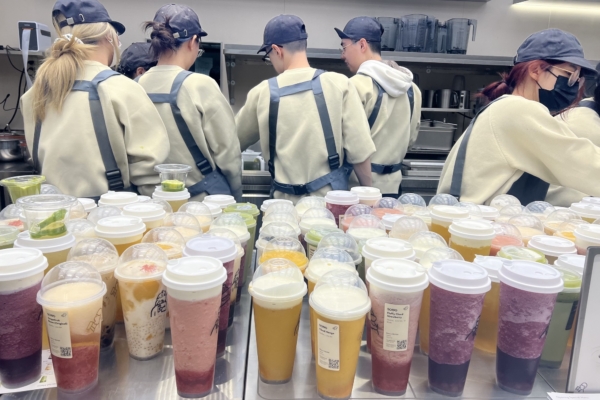
Secondly, there is low operating efficiency. Heytea heavily relies on manual labor, resulting in slow cup serving speed. During the period of intense delivery subsidies, Heytea stores had difficulty competing with other tea drink brands that rely on equipment for standardized cup preparation.
Thirdly, there are imperfect systems and hidden risks. Heytea persistently operated with direct management for ten years before opening up for franchises at the end of 2022. The “various imperfect systems” during the initial franchise opening laid the groundwork for subsequent problems. The expansion speed of store scale did not match the headquarters’ operational efficiency and supply chain capabilities, leading to unstable products in franchise stores, damaging the brand value.