
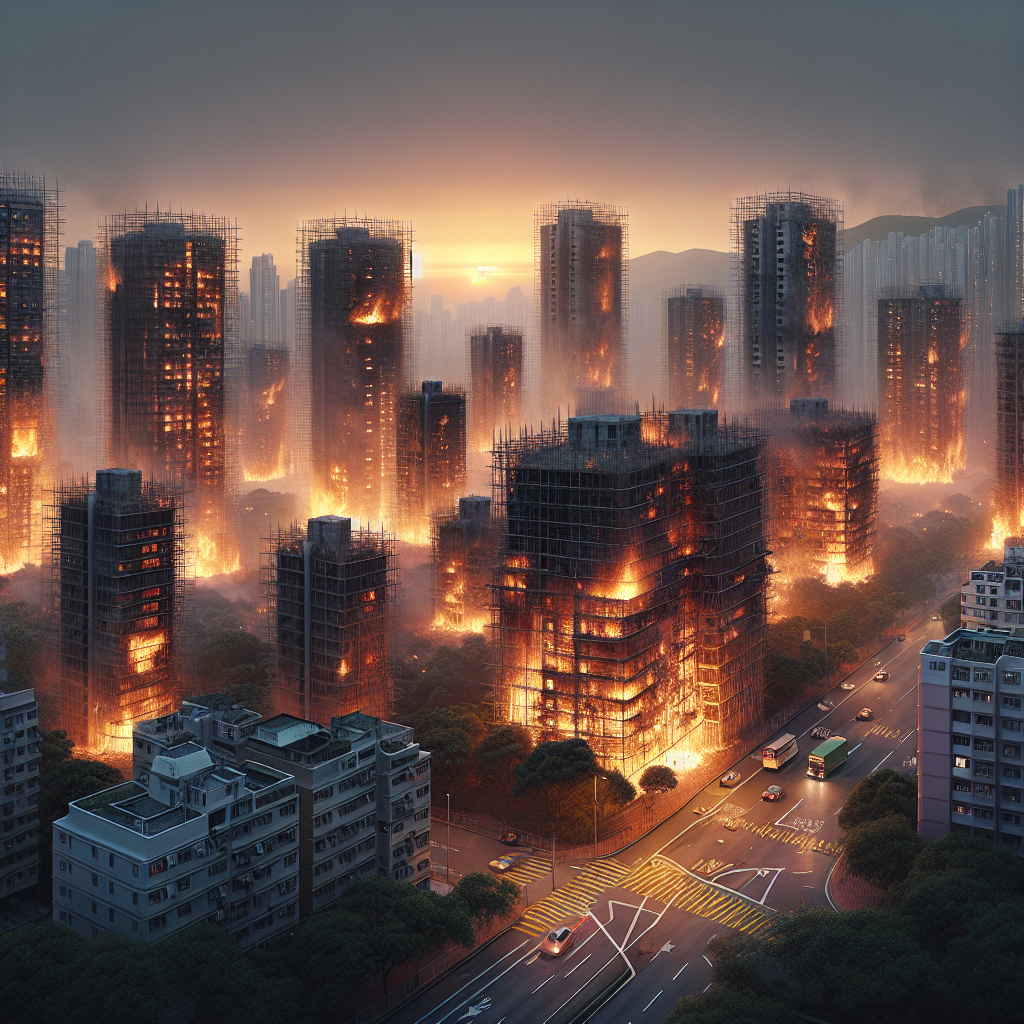
On November 26th, a massive fire broke out in the seven buildings of Hong Kong’s Wang Fu Garden, claiming over a hundred lives. Although the official investigation into the cause of the fire has not been completed, many have pointed fingers at the bamboo scaffolding, foam insulation, exterior protective netting, and the malfunctioning fire alarm system. In this article, we will explore the potential causes of the Hong Kong fire and also examine if the United States faces similar issues. It’s essential to be aware of the potential risks around us and take preventive measures.
The deadly fire in Hong Kong occurred in the Wang Fu Garden located in the Tai Po district of the New Territories. The fire was first reported to the Hong Kong police at 14:52 on the 26th and escalated from a level one to a level four fire alarm within an hour. By 18:22, the fire alarm had been raised to the highest level five, indicating that the fire was “completely out of control.” The fire burned rapidly between the densely packed high-rise buildings and was not almost completely extinguished until 10:18 on the 28th, lasting for 43 hours. As of now, the Hong Kong government has confirmed 159 fatalities, 79 injuries, and 31 individuals missing.
Regarding the cause of the fire, Hong Kong officials stated that the fire is believed to have started from the scaffolding and netting on the lower floors of the Wang Chang Court exterior wall, with the source still under investigation. The government has mentioned that firefighting personnel are continuing to excavate debris on the fire floors, conducting preliminary analysis on the burn situation, collecting samples, and inspecting the power supply and operation status of the fire alarm system at the time of the incident.
Official sources also mentioned that the police have arrested 15 engineering professionals on suspicion of deliberate shutdown or tampering with the fire alarm system and have detained six contractors for alleged fraud. Even though the investigation report is not yet finalized, the government has issued orders to suspend external wall renovation work on buildings undergoing major repairs, demanding the immediate removal of scaffolding nets if present and halting wall construction until further inspection and certification.
Despite the pending investigation report, several factors such as the nets, fire alarm system, foam insulation, and plastic panels have been highlighted as significant concerns. However, while many had previously raised suspicions about the bamboo scaffolding as a potential fire hazard, the official announcements did not mention any inspection or scrutiny related to it. This suggests that the Hong Kong government may have already made preliminary judgments regarding the cause of the fire, seemingly absolving the bamboo scaffolding from blame.
Analyzing the Wang Fu Garden fire in Hong Kong, it is apparent that several factors contributed to the high casualties. There are primarily four major issues:
Firstly, the renovation materials did not meet regulatory standards. During the major repairs, bamboo scaffolding was erected outside the buildings, covered with green protective nets. Preliminary investigations revealed that some of the nets did not meet fire safety standards and were highly flammable, with the authorities admitting non-compliance with fire regulations. Once the fire ignited on the exterior wall, it spread upwards and sideways along the bamboo scaffolding and plastic nets, engulfing seven buildings.
Moreover, to isolate dust and noise, repair contractors improperly sealed many residents’ windows with materials such as foam insulation, highly flammable and capable of rapidly aiding in the spread of fire, leading to the entire community turning into a hell.
Secondly, the firefighting equipment and alarm systems malfunctioned. Surveillance footage showed residents desperately trying to activate the fire alarm devices, but the alarms remained silent, forcing them to inform each household individually. The fire department’s preliminary investigation revealed that while the system was not shut down, the alarms failed to sound, marking it as a crucial aspect of the investigation. Additionally, Wang Fu Garden, constructed in the 1980s, lacked modern high-rise standards like automatic sprinkler systems and refuge floors, making evacuation extremely challenging for residents in thick smoke and high temperatures.
Furthermore, as mentioned earlier, the police arrested several individuals on charges of tampering with the fire alarm system and providing false statements to the fire department, indicating not only outdated equipment but possible deliberate manipulation or concealment.
Thirdly, shortcomings in construction projects and corruption suspicions. Various media outlets and experts pointed out that the scaffolding, window sealing materials used in the external wall projects, likely did not meet specifications and may have been counterfeit fire-retardant materials to cut costs or make profits. Reports indicated that some contractors and subcontractors involved had poor safety records but still secured the major repair project.
Even the pro-Beijing media outlet “Ta Kung Pao” reported extensively on the prevalence of bid-rigging among Hong Kong construction companies over the past decade, leading to fewer reputable firms. “Hong Yip Construction,” contracted for the Wang Fu Garden exterior refurbishment, was known as the bidding “victor,” despite being involved in multiple violations of the Occupational Safety and Health Ordinance at least 10 times between 2022 and 2025. However, this report was quickly removed.
Fourthly, institutional and regulatory failures. Residents had raised complaints about the construction two years ago, warning of fire risks, but authorities turned a blind eye or dismissed the concerns. The catastrophic fire served as a severe blow to Hong Kong Chief Executive Li Ka-ching. Post-incident, the government admitted non-compliant nets and issued an urgent order to inspect all large estates undergoing renovation with exterior scaffolding.
This incident exposed pre-existing vulnerabilities in the inspection, acceptance, and regular checks, allowing substandard projects to proceed without detection. Several commentaries have highlighted that Hong Kong has long relied heavily on document approvals and self-certification by companies for building and fire safety, with limited actual spot checks. The event laid bare the fragility of the entire system, with even pro-government individuals criticizing the excessive emphasis on political loyalty in recent years, leading to the loss of checks and balances by lawmakers and the media.
After analyzing the Hong Kong fire, it is essential to reflect on similar issues in American buildings and apartments. However, it is crucial to clarify that the objective is not to insinuate, “Hong Kong fires can happen anywhere; look at the problems in the U.S. too! Don’t just blame Hong Kong.” The aim is to understand the reasons behind past disasters and examine what precautions can be taken to prevent future tragedies in the U.S.
From a regulatory perspective, the United States has relatively stringent fire safety regulations for high-rise buildings. For instance, automatic sprinkler systems are required early and widely. American high-rise structures have long adhered to NFPA (National Fire Protection Association) standards, such as NFPA 13 (sprinkler design) and NFPA 101 (life safety codes), adopted directly or as templates by many countries.
Furthermore, many cities mandate that newly constructed high-rises must have full sprinkler systems, fire detection, emergency broadcasts, fire partitions, which are considered high standards globally. High-rise evacuation route designs emphasize having at least two independent enclosed escape stairwells, automatic fire door closure, pressurized stairwells, or smoke exhaust designs. International Building Codes (IBC) and National Fire Protection standards serve as models for many countries with modifications.
Hence, the United States excels globally in high-rise architecture and fire safety. However, this does not imply absolute safety in American buildings. The issue lies in the fact that while regulations have become stricter over the past 30-40 years, many buildings in the U.S. were constructed 50-100 years ago and continue to adhere to outdated regulations, lacking sprinkler systems or modern smoke containment designs.
Numerous 1960s-1980s apartments and rental buildings did not have mandatory full sprinkler installations at the time. Unless undergoing significant structural modifications, many places remain quite unsafe.
Moreover, larger cities like New York, Boston, and San Francisco usually have relatively robust enforcement of fire regulations, inspecting for violations such as blocked fire separation, corridor clutter, illegal electrical alterations, etc. However, smaller cities and county governments in suburban areas often have limited resources and conduct inspections only upon receiving complaints.
At the building and apartment level, many communities are reluctant to increase Homeowners Association (HOA) fees or allocate additional funds, delaying repairs on exterior walls, waterproofing, and structures. This results in outdated firefighting equipment and fire-resistant building materials unable to be updated, posing invisible threats to residents. Therefore, if you notice low HOA fees before buying a property, it may not always be a good sign and could signify neglected maintenance issues.
Before purchasing a property, individuals can review various documents such as engineering records, meeting minutes, and others to identify past upgrades and potential problems within the building. Encountering building issues after moving in can be a significant nuisance.
There are several common human-related issues in fire safety, including obstructed fire doors or wedged open doors, non-functional smoke detectors, cluttered hallways, and unauthorized partitions. These issues represent potential fire hazards.
On January 9, 2022, a fire broke out in a 19-story high-rise apartment in the Bronx, New York, dating back to 1972, claiming 17 lives, including 8 children, marking one of the most severe residential fires in New York in decades. The official cause was an electric heater in one unit malfunctioning and igniting a fire.
In theory, high-rise structures are designed to be non-combustible. Fortunately, the primary fire did not spread to other units, but the fire doors (which should have automatically closed) malfunctioned, keeping doors open during evacuation. Additionally, doors in stairwells also had faults, allowing thick smoke to ascend through the stairwells and corridors, filling the entire building, leading to most casualties from smoke inhalation rather than burns.
In 2022, another unfortunate incident occurred in Philadelphia, a public housing apartment fire, where a fire ignited on January 5th in a three-story rowhouse in the Fairmount community, managed by the city government, resulting in 12 fatalities. Subsequent investigation revealed several smoke detectors had no power or were removed, rendering them ineffective.
Over the past twenty years in the U.S., there have been ten incidents of fatal residential fires claiming ten or more lives, with one of the most significant being the 2016 Oakland “Ghost Ship” warehouse party fire, claiming 36 lives, primarily due to illegal alterations in an industrial warehouse, unauthorized electrical connections, extensive flammable materials, and the absence of formal escape routes and automatic sprinkler systems, resulting in substantial casualties.
The common features in these fires include occurrences during nighttime or early morning when residents are asleep, malfunctioning or insufficient smoke detectors, hindered escape routes with iron bars or limited exits, and factors like electric heaters, candles, antiquated wiring leading to ignition.
Annually, the National Fire Protection Association in the U.S. compiles statistics on “multiple-death incidents,” with the 2024 report citing the Bronx high-rise fire among the most deadly cases in recent years. The report also identified prevalent issues such as faulty alarms, blocked exits, malfunctioning fire designs, high-density occupancy, among others.