
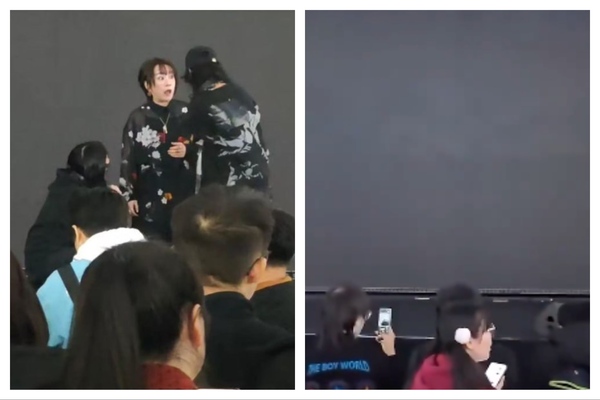
Japanese singer Maki Otsuki encountered a sudden interruption of stage music and lighting while singing the classic theme song “Memories” from “One Piece” in Shanghai. The incident, which occurred at a large-scale performance on November 28, caused a stir in both China and Japan as the footage spread widely on social media platforms.
After a few days of silence, Maki Otsuki spoke out on Instagram on December 1. She expressed her regret for not being able to personally thank the audience who eagerly awaited her performance. She stated in both Japanese and English that she will continue to convey her singing through music to those in need and hopes to make more friends through her songs.
During the performance of the “One Piece” song, the background music, lighting, and large screen visuals suddenly disappeared while the audience was singing along in unison. Faced with this unexpected situation, Maki Otsuki momentarily showed a surprised expression and exclaimed, “Wow,” to ease the awkwardness before being signaled to leave the stage by staff.
Maki Otsuki later reposted her agency’s statement explaining that the performance was forced to stop due to “force majeure.” The organizers also announced the cancellation of the scheduled performances on November 29 and 30 on Weibo.
The incident has also attracted attention from Japanese media. Senior TBS TV anchor Shinichiro Azumi commented on the situation, suggesting that from the leaked videos, Maki Otsuki seemed to have been halted during her performance. He speculated that if this involved official intervention, it might have a propaganda nature related to “cognitive warfare.” He also referenced past cases where images of Chinese officials were widely circulated, drawing similarities in propaganda logic.
Senior Japanese media personality and executive director of a think tank focusing on Indo-Pacific strategy, Akio Yajima, pointed out on social media that Maki Otsuki’s experience is seen as part of a trend where several Japanese performers have encountered obstacles during their performances in China recently. He noted that numerous Japanese concerts, stage plays, and events in China have been abruptly canceled or postponed, often attributed by the authorities to “force majeure.”
Japanese Prime Minister Sanae Takai’s remarks on “Taiwan’s matter” on November 7 have caused a stir in China, leading to continued tension in Sino-Japanese relations. Consequently, various Japanese events such as concerts, movies, and musicals scheduled to be held in China have been interrupted, canceled, or postponed. The Chinese side has not provided specific explanations but has cited “force majeure” as the reason.
Besides cultural exchanges, the movement of personnel between the two countries has also been affected. Following China’s official restrictions on travel to Japan in mid-November, some Chinese airlines have started reducing the number of flights to Japan.
According to a report by the “Nikkei” newspaper, as of November 27, Chinese airlines have decided to cancel 904 out of the originally planned 5,548 flights to Japan in December (approximately 16%), with further reductions expected. The reduction in flight routes has led to a significant drop in ticket prices for flights between China and Japan, with some round-trip tickets between Kansai and Shanghai dropping to as low as 8,500 yen, less than half the price compared to the same period last year.