
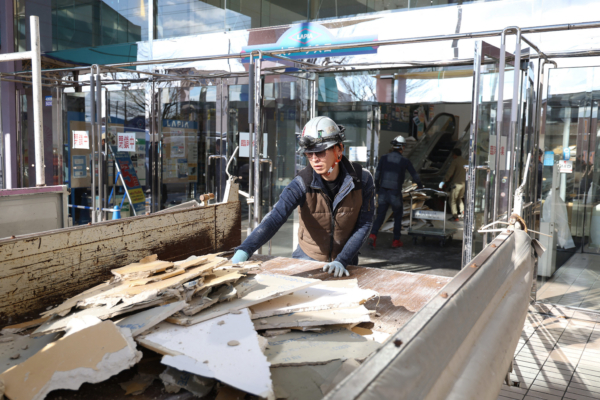
A strong 7.5 magnitude earthquake struck late on Monday (December 8) in northeastern Japan, with the epicenter located 80 kilometers east of the Oga Peninsula in Aomori Prefecture, at a depth of 54 kilometers. This powerful quake resulted in 33 injuries and damage to multiple buildings in Hokkaido, Aomori, and Iwate Prefectures.
Of particular concern is the issuance of the “Hokkaido-Sanriku Offshore Earthquake Watch” by the Japan Meteorological Agency (JMA) for the Kuril Trench and Japan Trench region.
The JMA stated that in the following week, there is a possibility of earthquakes similar in magnitude to or even stronger than the recent one occurring in this region. Drawing lessons from the March 11, 2011 Great East Japan Earthquake (311), the Japanese government established the “One-Week Large Earthquake Watch” mechanism to issue relevant information once a magnitude 7 earthquake occurs in the relevant trench.
The JMA assessed that during the issuance of the “Offshore Earthquake Watch,” vigilance must be maintained for the possibility of subsequent strong earthquakes of magnitude 8 or higher.
According to the Japanese government, globally, around one percent of cases following a magnitude 7 earthquake may lead to a subsequent massive magnitude 8 earthquake; based on this risk assessment, the authorities set the alert period for the “Offshore Earthquake Watch” to one week. This is the first time the JMA has issued this warning since the establishment of this system in 2022.
The warning covers a wide area, including 182 cities and towns in seven prefectures in Hokkaido, Tohoku, and Kanto regions.
Fumihiko Imamura, a professor at the International Research Institute for Disaster Science at Tohoku University, stated that in the surrounding area of this earthquake’s epicenter, 7 magnitude earthquakes have occurred approximately every 20 to 30 years, and this current activity is considered part of this series of seismic events.
The earthquake was recorded with strong “6+” intensity in Hachinohe City, Aomori Prefecture, reaching a level where it is difficult to stand or move without crawling.
Regarding the specific disaster situation, as of Tuesday morning (December 9), besides the 33 injured, Aomori Prefecture confirmed at least 14 buildings damaged (including 7 residences).
In Kita-Tsugaru Village, Aomori Prefecture, at the Odanosawa Fishing Port, it was confirmed that there was subsidence of the ground, causing electric poles to tilt. In a shopping center entrance in Hachinohe City, part of the ceiling fell, prompting the temporary closure of the mall. In Hidaka Town, Hokkaido, a woman in her 70s fell and suffered a serious injury, breaking a bone, when she got out of her car in the parking lot of an evacuation center. Additionally, several people in various areas suffered minor injuries from falls.
Given the potential threat of subsequent earthquakes, Prime Minister Saonae Takai urged the public to remain vigilant for about a week. The government requested residents to maintain a state of alertness to immediately evacuate once they feel shaking while continuing social and economic activities.
Although the “Offshore Earthquake Watch” does not require people to evacuate in advance, during the one-week alert period, authorities advised the public to confirm shelter locations and routes, prepare emergency kits, secure furniture, and ensure the availability of food, water, and basic sanitation facilities.
Following the earthquake, tsunami warnings were briefly issued by the JMA for Hokkaido, Aomori, and Iwate Prefectures, predicting tsunamis up to 3 meters high. However, observed tsunami heights were lower, reaching a maximum of 70 centimeters in Kuji Port, Iwate Prefecture, and 50 centimeters in Urakawa-cho, Hokkaido. All tsunami warnings and advisories were lifted at 6:20 on Tuesday morning.
In terms of infrastructure, nuclear power plants operated by Tohoku Electric Power and Hokkaido Electric Power reported no abnormalities.
After the earthquake, power was briefly interrupted for thousands of households but was restored on Tuesday morning. Certain East Japan Railway Company lines experienced temporary suspension or delays.