
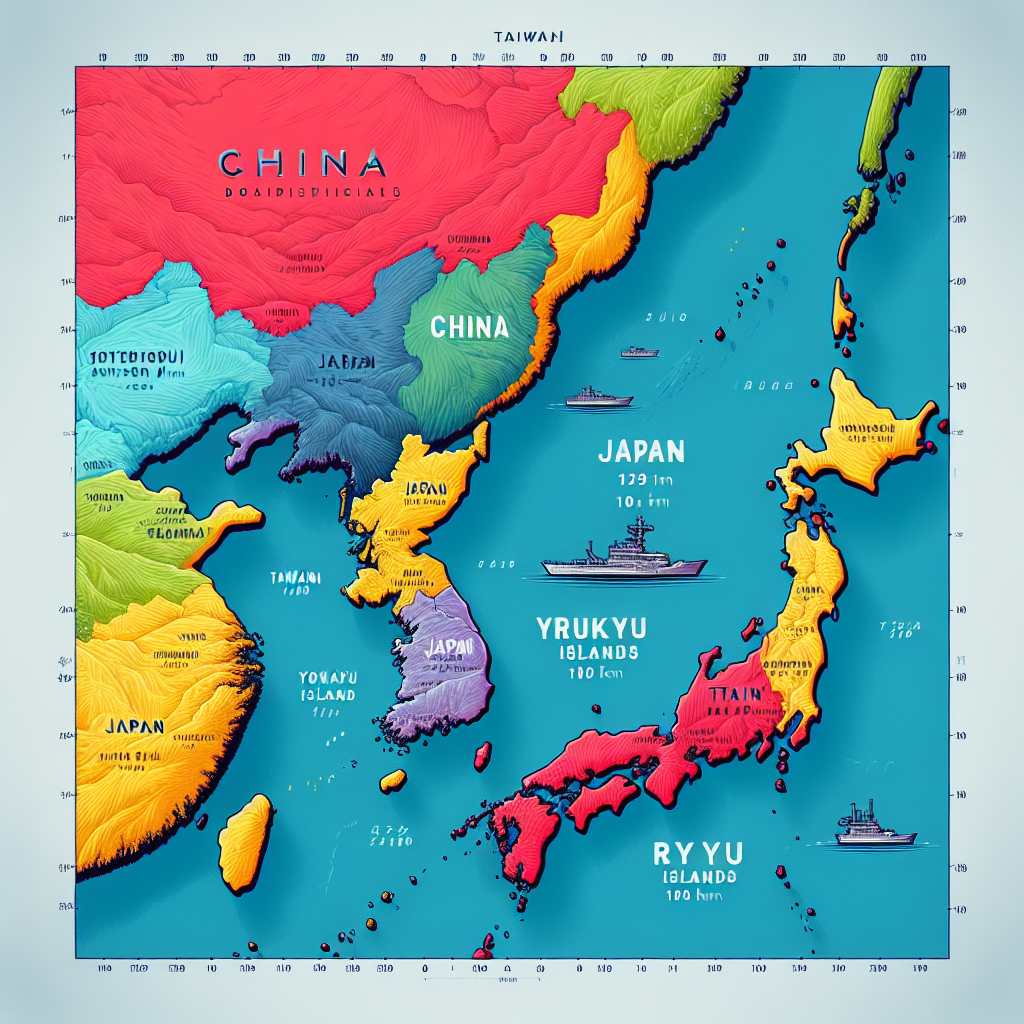
Relations between China and Japan continue to remain tense, with Japan accelerating its military deployment in the Southwest Island Chain (Ryukyu Islands) in response to the increasing military pressure from the Chinese authorities. Among them, Yonaguni Island, only 110 kilometers from Taiwan, has become the front line.
According to Bloomberg, the Japanese government is constructing missile systems, radar stations, ammunition storage, and electronic warfare facilities along the Ryukyu Islands. This defense line stretching from Kyushu to near Taiwan is described as the “Missile Archipelago,” marking Japan’s largest military construction effort in over forty years.
In Kyushu, Japan also has significant military deployments, including F-35 fighter jets and long-range missiles.
In 2022, during a visit to Taipei by then-Speaker of the US House of Representatives Nancy Pelosi, China launched missiles that landed near Yonaguni Island. This incident led Japan to accelerate its military deployment plans in the Southwest Island Chain.
Currently, Beijing is increasing pressure on Japan, demanding that Prime Minister Sanae Takaichi retract her statement regarding Taiwan. On the afternoon of December 6, in the open seas southeast of Okinawa Island, a Chinese J-15 fighter jet locked radar onto Japan’s Self-Defense Force’s F-15 fighter jet, heightening tensions between the two countries.
Former Lieutenant General of the Japan Ground Self-Defense Force Koichi Isobe stated that “The Chinese military is undoubtedly enhancing its ability to compel Taiwan to yield by force. Japan, the US, and other Western countries must show a firm resolve against changing the status quo.”
Bloomberg reported that there are currently about 230 Self-Defense Force members stationed on Yonaguni Island, with plans to increase by about 30 electronic warfare troops in the coming year, followed by the deployment of anti-aircraft missiles.
Franz-Stefan Gady, a researcher at the Center for a New American Security in Washington, indicated that in the event of a conflict in the Taiwan Strait, Japan joining the US-led collective defense action, with Yonaguni Island’s electronic warfare units shifting from passive observation posts to actively providing precise target information to US-Japan missile systems. However, this also risks making Yonaguni Island a target for military attacks.
Local residents have varying opinions on the heightened military deployments, with some expressing concerns while others welcoming them. In early December, the Japanese Ministry of Defense held a briefing session for local residents, attended by about 80 people, emphasizing that the deployments are for defensive purposes.
Mayor of Yonaguni-cho, Jiro Uechi, elected earlier in August of this year, expressed understanding for the Self-Defense Force’s enhanced deployment, citing its contribution to the island’s defense. However, he voiced concerns that further military expansion could increase psychological pressure on residents, adopting a cautious stance. Uechi also mentioned that most residents of Yonaguni Island are elderly and that he welcomes young military personnel to the island.
Former Mayor Kenichi Kisu, on the other hand, believed that Prime Minister Sanae Takaichi’s support for Taiwan was not clear enough. He emphasized that “self-defense alone is not enough for Japan” and called for the deployment of more missile systems on Yonaguni Island, along with joint military exercises with Japan, the US, and Taiwan.
Uechi garnered 557 votes in the summer elections this year, while Kisu received 506 votes.
Local Liberal Democratic Party councilor Ayako Aragaki noted that the common belief that Okinawans would oppose military deployments was inaccurate.
She stated, “China has long put forward views inconsistent with the international community, completely ignoring Japan’s thoughts.” “What we see is a country that accepts nothing unless its own demands are met.”
Okinawa experienced intense ground battles with the US military towards the end of World War II, managed by the US for a period post-war until its return to Japan in 1972. Memories of the war led many older Japanese citizens to identify with the Peace Constitution enacted in 1947, advocating against recognizing the nation’s right to engage in war, maintaining no army, navy, or air force, renouncing the use of force as a means to settle international disputes.
However, most young Japanese people support increasing defense spending and expanding military capabilities. A survey conducted by Sankei News and Fuji News Network in late November found that 83.2% of respondents aged 18 to 29 supported Sanae Takaichi’s plan to increase defense spending, nearly twice the percentage of those 70 years and older.
On October 24, 2025, Takaichi pledged to raise defense spending to 2% of the GDP two years ahead of schedule, garnering praise from the Trump administration.