
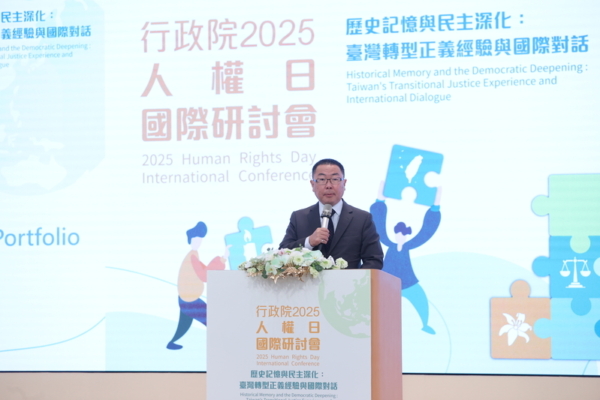
On December 9, 2025, the “2025 International Human Rights Day Symposium” took place in Taiwan. Executive Yuan Minister without Portfolio Lin Ming-hsin stated that at this moment when global democracy faces new challenges, Taiwan is deepening its historical memory and strengthening democratic resilience through cross-national dialogues. He emphasized, “International experience tells us: silence is not an option when faced with the past. Only through continuous reflection, learning, and institutional reforms can tragedies be prevented from recurring.”
The Republic of China’s Executive Yuan hosted the “2025 International Human Rights Day Symposium” on both today and tomorrow, focusing on the theme of “Deepening Historical Memory and Democracy: Taiwan’s Transitional Justice Experience and International Dialogue,” bringing together experts and scholars from countries such as Spain, Germany, South Korea, Lithuania, Poland, and Czech Republic for exchanges.
The two-day symposium included topics such as “Development Trends and Challenges in Transitional Justice in Spain,” “Reflection and Promotion Challenges in Post-War Germany’s Historical Memory,” “Global Perspectives on Transitional Justice,” “South Korea’s Practice and Reflection on Transitional Justice,” “Preservation and Transformation of Authoritarian Memories: Lithuania’s Social Practices,” and “How Poland and Czech Republic Commemorate Authoritarian History? – Paths of Memory Inheritance and Transnational Cooperation.”
Lin Ming-hsin stated in his opening speech that at this critical moment when global democracy faces new challenges, Taiwan’s deepening of historical memory and strengthening of democratic resilience through cross-national dialogue holds significant importance.
He pointed out that since 1950, the United Nations has designated December 10 as “International Human Rights Day.” However, during the same 1950s, Taiwan entered a long period of martial law and white terror, where human rights were violated and suppressed, and society was shrouded in silence and fear. Now, half a century later, according to the latest 2025 Global Freedom Report by Freedom House, Taiwan ranks second in Asia out of 195 countries in terms of freedom, demonstrating Taiwan’s position as one of the most robust democratic countries in Asia, deep-rooted in democratic resilience.
Regarding transitional justice efforts, Lin Ming-hsin mentioned that according to the United Nations transitional justice framework, a comprehensive approach needs to cover “truth, justice, reconciliation, ensuring non-recurrence, and commemorating memory.” Since the enactment of the “Promotion of Transitional Justice Act” in 2017, Taiwan has been continuously promoting transitional justice projects in a systematic manner.
Lin Ming-hsin highlighted that the Executive Yuan has completed several important policies this year, including the “Key Progress Measures for Transitional Justice Stage Policies,” “Strategic Plan for Promoting Transitional Justice Fund,” “Unjust Site Preservation Action Strategy,” and “Post-War Indigenous Peoples’ Transitional Justice Reinforcement Plan.” These multi-faceted strategic plans and tasks align with the holistic spirit of transitional justice emphasized by the United Nations.
He emphasized, “International experience tells us that silence is not an option when faced with the past. Only through continuous reflection, learning, and institutional reforms can tragedies be prevented from recurring.” Many countries post-war have experienced authoritarian rule traumas and have different contexts and approaches to common issues, providing valuable reform experiences for Taiwan to reference.
Lin Ming-hsin gave examples, such as Spain repositioning the country’s responsibility for its dictatorial history from the “Law of Historical Memory” to the “Law of Democratic Memory,” Germany establishing a culture of reflection through widespread historical education, South Korea setting up a Truth and Reconciliation Commission, Lithuania responding to trauma through social security mechanisms, and Poland and Czech Republic utilizing transnational memory networks and oral history projects to integrate personal stories into collective social memories.
Lastly, he expressed gratitude to the attending dignitaries, stating that Taiwan is a solid partner in the values of human rights and democracy worldwide, and with its own experiences in transitional justice, will contribute to piecing back a lost puzzle in the world’s map of freedom and human rights.
The Human Rights and Transitional Justice Office of the Executive Yuan of the Republic of China pointed out that in response to International Human Rights Day on December 10, through organizing this international symposium, a platform has been established to restore historical truth and share experiences in transitional justice policies and systems with various countries worldwide. The conference registration saw a significant turnout, bringing together scholars, government agencies, political victims and their families, civil society groups, and young generations from both domestic and international backgrounds, demonstrating the shared concern of civil society for transitional justice.
The Human Rights and Transitional Justice Office looks forward to nurturing the energy of civil society through continued dialogue and exchanges, allowing more experiences to be seen and understood, empowering Taiwan’s civil society to support democracy taking deeper and more stable roots in this land.