
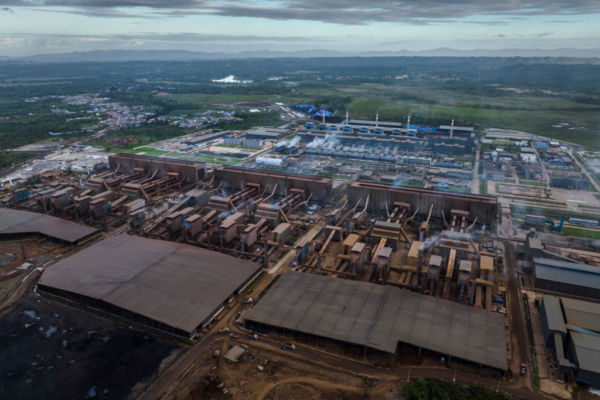
Indonesian Defense Minister Sjafrie Sjamsoeddin recently issued a warning about a privately-owned Chinese airport located in Indonesia’s nickel processing zone, operating without government supervision. He expressed concerns that this unregulated operation could threaten national sovereignty and economic security, potentially turning into a “state within a state.” The airport is situated next to the Indonesia Morowali Industrial Park (IMIP), which is a major hub for nickel mining industry.
During a joint military exercise by the Indonesian Armed Forces (TNI) on November 20, Sjamsoeddin raised this issue, noting that the Chinese-owned airport was operating without the presence of any government officials.
Sjamsoeddin emphasized the critical nature of infrastructure like this airport requiring government oversight to avoid the risk to Indonesia’s “economic sovereignty.” He highlighted that such unregulated operations represent an “abnormal phenomenon.”
On November 26, Sjamsoeddin published a written statement on the Defense Ministry’s website, asserting that Indonesia must not tolerate the existence of a “state within a state.” He stressed the importance of ensuring compliance with regulations impartially, regardless of the entity’s background.
Indonesian member of parliament T.B. Hasanuddin responded to Sjamsoeddin’s concerns, describing the airport as a “stealth airport” that might violate legal norms and pose risks to Indonesia’s sovereignty and national security.
In response, the Indonesian Ministry of Transportation claimed that the airport holds valid permits and refuted allegations of lacking national supervision at the facility.
According to the Ministry of Transportation, the IMIP airport is categorized as a domestic “special airport” operated by PT IMIP, a company owned by the Indonesia Morowali Industrial Park Corporation.
Chairman of the Indonesian House of Representatives Commission of Transportation, Lasarus, stated that the committee would review whether such concerns indicate legal violations or misconceptions about the operation model of private airports.
Lasarus argued that even in the absence of government officials present at the airport, flight activities could still be tracked as all planned departure flights must apply for permits recorded by the national air traffic control system. He mentioned similar operations of airstrips in Papua Province functioning without full-time government presence.
“As long as there are no international flights, this does not pose an issue,” he stated.
The ownership structure of the IMIP airport’s parent company, Shanghai Decent Investment (Group) Co. Ltd., comprises various entities including Tsingshan Group, Bintang Delapan Group, and Sulawesi Mining Investment, reflecting a complex ownership arrangement.
Despite being a private enterprise, Tsingshan Group has received support for its projects in Indonesia under China’s Belt and Road Initiative, including loans from state-owned banks like the China Development Bank and the Bank of China. Reports suggest Tsingshan Group is in talks with China’s state-owned enterprise Baowu Steel Group to sell some assets in Indonesia.
The Indonesia Morowali Industrial Park, located in Central Sulawesi Province, was established in response to Indonesia’s ban on the export of unprocessed minerals since 2014. The park is the world’s largest vertically integrated stainless steel production center and a significant nickel production hub.
In recent years, the industrial park has expanded to cover an area of 5,500 hectares.
Typically, Indonesian aviation regulations restrict “special airports” like the IMIP airport to serve the operational needs of their owners only and prohibit handling direct international flights without temporary ministerial approval. However, earlier this year, the Indonesian government passed a regulation designating three “special airports,” including the IMIP airport, as “international airports,” thereby breaking this restriction.
The public outcry following the Defense Minister’s warning led to the government revoking the IMIP airport’s “special” permit on November 28.
Nevertheless, the Democratic Party of Struggle called for President Prabowo Subianto to conduct a thorough investigation.
On November 30, parliament member Guntur Romli expressed confusion over former President Joko Widodo’s denial of inaugurating the airport, as Widodo had presided over the PT IMIP inauguration ceremony in 2015, raising questions about the government’s lack of action during his ten-year tenure.
An investigation seems likely, given the support for such action from those close to the current president.
H. Kurniawan, chairman of the nationwide volunteer organization supporting President Prabowo, expressed concerns about restrictions on airport access and the government’s perceived absence.
Mori Hanafi, a member of the NasDem Party and the House of Representatives Commission of Transportation, stated that the committee would seek clarification on whether the Chinese-owned airport complied with national aviation laws, executed cross-border flights, and why its operations were never formally discussed at the parliamentary level.
“We were indeed surprised. The airport’s permit falls under the jurisdiction of the Ministry of Transportation, yet it was never mentioned in previous hearings,” he told reporters.
He warned that if indications of international flight operations at the IMIP airport were found, it would constitute serious violations involving immigration control, customs supervision, and national security.
The Business and Human Rights Resource Centre highlighted several concerns regarding the IMIP project (including the airport), such as extensive environmental impacts and poor occupational health and safety standards, reportedly leading to worker fatalities.