
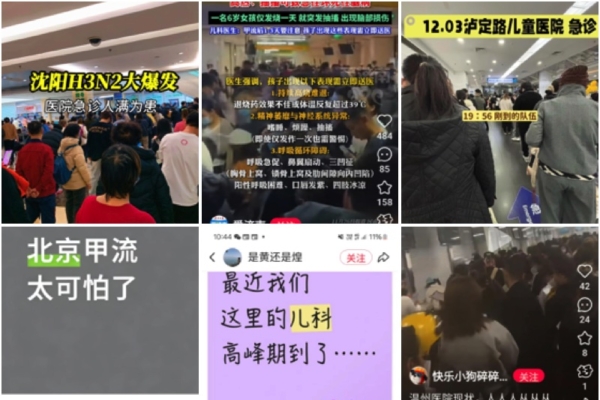
Recent days, the flu epidemic in mainland China has been getting increasingly severe, with children’s hospitals across the country overflowing with patients in the emergency room. Schools are being closed all over China, and in the streets of Beijing, almost everyone is seen wearing masks. Healthcare workers in the inspection department are overwhelmed with their workload.
The flu continues to ravage mainland China, as indicated by the recent report “National Surveillance of Acute Respiratory Infectious Diseases (Week 47 of 2025)” released by the Chinese Center for Disease Control and Prevention. It shows that the influenza positivity rate among flu-like cases in outpatient departments across the country is close to 45%, reaching an overall epidemic level, with some provinces already at a high epidemic level.
Dr. Wang Dayan, Director of the National Influenza Center in mainland China, stated that 17 provinces have reached a high epidemic level, with other provinces at a moderate level. The predominant pathogen causing the flu this season is the A/H3N2 subtype influenza virus, accounting for over 95% of cases, with a small amount of A/H1N1 subtype and B type influenza viruses also circulating. The number of clustered flu outbreaks is higher than in the previous season, with most originating from schools and childcare institutions.
According to the “Health Protection Guidelines” in mainland China, the current susceptibility index for the flu in Beijing indicates that over 12.6 million people (12,684,170) have been infected, marking a 121% increase from the previous week. This has led some netizens to lament that the flu outbreak in Beijing is unprecedented and the most severe witnessed.
Faced with this wave of flu viruses and other illnesses, hospital emergency departments are overwhelmed. A mother from Shanghai recounted that when she took her child to the pediatric emergency department at Fudan University Hospital at 9 p.m. a few nights ago, she found the waiting area packed with a long queue, prompting her to seek care elsewhere.
She further mentioned, “Not only is the flu severe in Shanghai, but also in Beijing. Half of the children in my child’s class are infected. However, not many people in Shanghai wear masks as immunity varies among individuals.”
A healthcare worker at a children’s hospital in Beijing revealed, “The pediatric outpatient department on the second floor is seeing a high influx of children with fever and cough, numerous cases every morning. Everyone must take necessary precautions.”
Some Beijing residents shared that the community hospital near their homes had stopped accepting flu patients and directed them to larger hospitals for treatment. Public hospitals’ overflowing emergency rooms have redirected many parents to private hospitals, where they expected shorter queues and lower costs, only to find long waiting times.
In various social media groups for doctors, there have been complaints about the overwhelming workload. A laboratory physician in Jiangsu shared on December 2, “Are you coping with the tests tonight? I feel like I’m losing my mind.”
Another laboratory physician from Shanghai added, “The workload in the lab has been insane lately, I haven’t experienced such intensity in a while.”
A medical intern in Jiangsu lamented, “I conducted over 100 flu tests overnight with zero extra pay.”
The strain on medical professionals was further highlighted by a lab doctor in Shanghai, who disclosed, “I performed around 700 blood tests for various illnesses, including 300 for flu, in a single day. It’s relentless, drawing blood standing up, and by the time you sit down, it’s time to go home.”
An elementary school nurse in Hunan expressed, “I’ve been busy for three weeks now, couldn’t even find time for proper meals.”
A doctor from Zaozhuang, Shandong Province, shared his experience, “Many fever patients turned out to be positive for the flu, infecting healthcare workers. Most doctors fell ill, and only a few are left to work, feeling utterly drained.”
He stressed, “This time it’s particularly severe; even colleagues who were usually healthy have fallen ill.”
In a social media post, a parent in Beijing mentioned that their first-grade child’s school suddenly announced the suspension of classes the next day due to the outbreak. Parents from Xicheng District in Beijing echoed the same sentiment.
Parents in Beijing revealed that their children had been attending online classes for four days last week.
A parent from Chaoyang District shared that the school had instructed parents to ensure their children wear masks upon returning to campus.
Another Beijing resident confirmed, “With the nationwide flu peak, many in Beijing are wearing masks, especially in crowded places like subway stations, where almost everyone is masked.”
The same source explained that aside from fears of infection, the severe recent smog in Beijing, coupled with strong winds stirring up dust, has prompted widespread mask-wearing.
A retired actress from mainland China created a video detailing the chaotic scenes in pediatric emergency departments during this flu wave. She mentioned that out of 22 students in her child’s class, only 7 attended school on Monday.
A mother from Tianjin mentioned that her son, who has the flu, has experienced repeated high fevers and severe shivering, with the entire class appearing to have contracted the flu.
Moreover, reports from local newspapers uncovered the acute and rapidly progressing nature of the current flu cases, emphasizing the importance of timely detection. Examples included cases of high fever and seizures leading to acute necrotizing encephalopathy and brain damage in children.
Tragic incidents were also reported, such as a three-year-old boy in Henan who initially presented with a high fever and was misdiagnosed with a common cold but sadly passed away the following day due to the flu.
In response to these unfortunate events, a health blogger stressed the importance of basic Traditional Chinese Medicine knowledge for parents in caring for sick children. She quoted an ancient saying, “Parents should feel no shame in seeking medical help for their children, nor should children feel disrespectful for seeking medical care.” She advised mothers to avoid giving children cold-fruited during high fever, as it may exacerbate the illness, leading to regrets.
These firsthand accounts and reports shed light on the immense challenges being faced by individuals, families, healthcare workers, and communities amidst the ongoing flu epidemic in mainland China. The toll on public health and the healthcare system serves as a stark reminder of the importance of preventive measures, timely medical intervention, and community support in combating such outbreaks.