
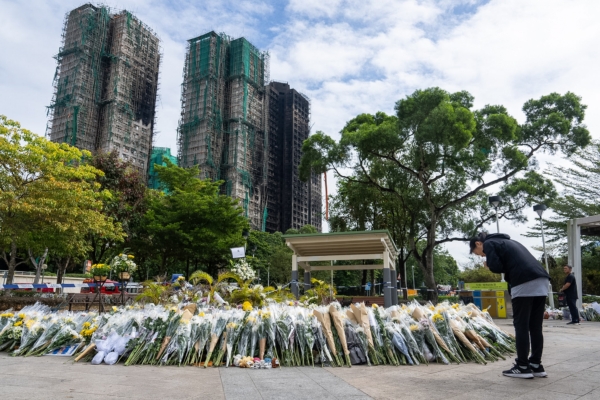
Hong Kong authorities have officially announced that the fire at Grandview Gardens in Tai Po has resulted in the deaths of 159 people, with approximately 30 individuals still unaccounted for. Some family members of the deceased have informed reporters that they have yet to confirm the identity of their parents. The police estimate that one of the bodies found at the scene belongs to the father, but only a small portion the size of a fist has been identified, making it difficult for the family to determine his identity. Meanwhile, the mother’s body remains missing.
There are concerns raised by a woman, identified as Ms. E, about the official figures of the death toll and missing persons being lower than the actual numbers. The police only count the bodies that have been identified, and there may be individuals who have not been reported missing by family or friends.
Ms. E has stated that she has submitted dental records, surgical records, and denture reports to the authorities but has yet to receive a definitive response. She believes that the actual number of families missing is more than the official count of around 30 individuals, as many residents may not have family or friends to report them missing. Additionally, due to limited knowledge of the residents’ structure by the security personnel, it is challenging to accurately present the number of residents. If an entire family perishes without anyone reporting them missing, the authorities might only list that household as “one person” or “no one,” leading to an underestimation of the actual figures.
She questions the discrepancy between the official death toll of 159 and the information known to the residents. Resident groups estimate that over 330 people are missing or deceased. The Amoy Building is considered a severely affected area, with reportedly over 100 people still unaccounted for. Therefore, she believes that the actual death toll exceeds the figure announced by the authorities.
Based on witness accounts and the extent of the damage at the scene, some residents speculate that the temperature on-site was higher than a standard incinerator. The main walls of some units exploded, potentially resulting in entire families turning to ash and being unidentifiable. Unidentified bodies have not been included in the list of deceased individuals, and some remains in the list are still unclaimed by relatives.
She mentioned that the household’s closed-circuit television went offline entirely after 3:05 pm during the fire, making it impossible to know if her family managed to escape. Near the lower-level units, some bodies are severely damaged, and identification can only be confirmed using personal identification documents. The high temperature caused some skeletal remains inside the units to stick together, making it extremely difficult for the forensic department to discern the identities of multiple bodies. Fire exits and escape routes were obstructed, dense smoke sealed off units, preventing many families from escaping.
She believes that both the upper and lower levels were severely affected by the fire, with many individuals potentially perishing in corridors or stairwells while attempting to flee.
She pointed out that many seniors had to pay over tens of thousands of dollars during major renovations, and now that their units have been burned down, compensation has yet to be distributed. She holds the district councilor of the Democratic Alliance for the Betterment and Progress of Hong Kong, Wong Pik Kiu, responsible for the major renovation and criticizes her for not assisting the victims afterward.
Regarding the government’s emphasis on the Legislative Council elections not affecting the rescue efforts, Ms. E disagrees, as some government officials’ family members affected by the fire were still required to report to work afterward and were not allowed time off to handle their family affairs. Some supervisors reportedly said, “Even if there are deaths in the family, you must return to work.” She questions whether the government prioritizes elections over post-disaster arrangements.
Ms. E also expressed confusion about the government’s proposal to provide “one social worker per household” to support the victims, stating that social workers did not appear in the initial stages and only followed up on individual cases notified by the police.
She criticized the government’s request for residents to vote as “excessive,” pointing out that disaster victims have lost their homes and loved ones and are neither emotionally nor financially capable of voting.
Regarding assistance distribution, she described the on-site arrangements as chaotic, leaving her feeling helpless. Some financial aid quotas were suddenly halved, requiring long wait times and applications for documents at different locations, causing the victims to tire themselves out. She revealed that some individuals received only one thousand Hong Kong dollars in aid and noted the complicated procedures of submitting stock and time deposit information, feeling as if they were begging the government and opting not to apply.
She suggested that the government should provide a centralized location for assistance to avoid victims lining up at multiple locations and criticized the scattered information, especially difficult for the elderly to manage.
She described herself as mentally and physically exhausted at present, having to search for family members, handle documents, and deal with the stress of accommodation, material needs, and emotions, hoping that the authorities address the genuine post-disaster needs seriously.